Tag Archives: depression

Surviving Child Abuse, Part 1 -Impact

File:Child abuse awareness ribbon.jpg

Blue Ribbon for Child Abuse Awareness, Source flickr.com, Author Trauma And Dissociation Project (CC BY-SA 2.0 Generic)

Childhood abuse — whatever form it may take, including exposure to family violence — can have long-term effects ranging from anxiety, depression, and Post Traumatic Stress Disorder (PTSD), to eating disorders and more [1A][2A][3A].

Shame and Suicide Risk

Our self-esteem is in tatters.  The shame, itself, can be crippling — no matter how misplaced [4].  The risk of suicide is greatly increased [5A].

Physiological Effects

But not all effects are so obvious.  Child abuse is, for instance, thought to contribute to such chronic health issues as heart disease, as well as such autoimmune disorders as type 1 diabetes, psoriasis, fibromyalgia, inflammatory bowel disease, and rheumatoid arthritis [1B][2B][5B]. Continue reading

15 Comments

Filed under Child Abuse, Child Molestation, domestic abuse, domestic violence, Emotional Abuse, Neglect, Physical Abuse, Sexual Abuse, Violence Against Women

Domestic Violence and Suicide

File:Day 353 - West Midlands Police - Tackling Domestic Violence (8284795632).jpg

West Midlands Police – Tackling Domestic Violence Campaign, Author West Midlands Police, United Kingdom (CC BY-SA 2.0 Generic)

Historically, the focus in suicide prevention has been on men because of their longstanding higher suicide rate [1A].  This has overshadowed the growing rate of attempted suicide and self-harm among women, and the close link with domestic abuse.

“…when a woman presents to [mental health] services in suicidal distress it is likely that she’s a victim of domestic abuse.

–Sally McManus, Sr. Lecturer in Health at the Violence and Society Centre

A groundbreaking study in the United Kingdom last year found that women subjected to domestic abuse (physical, psychological, or economic) are three times more likely to attempt suicide [2A].

Women who have experienced sexual abuse within their relationship are seven times more likely to self-harm [2B].   And women are ten times more likely to experience sexual abuse by a partner than straight or gay men are [1B].

Intimidation, Threats, and Force

Domestic abusers attempt to control their victims through intimidation, threats, and/or actual force [3A].  Typically, they humiliate their partners; isolate partners from friends and family; rigidly regulate what partners may do; and deny partners access to money or other basic necessities [3B].

Emotional Toll

Fear, shame, learned helplessness, a perceived lack of support by family members and friends, hopelessness, and despair are likely to result [3C][4A].  Intimate partner victimization is associated with an increased risk of depression, anxiety, and Post Traumatic Stress Disorder (PTSD), in both men and women [4B]. Continue reading

5 Comments

Filed under domestic abuse, domestic violence, Rape, Sexual Assault, Violence Against Women

Abuse and Defensiveness, Part 2

https://upload.wikimedia.org/wikipedia/commons/d/dd/Cath%C3%A9drale_d%27Amiens%2C_fa%C3%A7ade_-_d%C3%A9tail.JPG

Depiction of Final Judgment on the facade of Amiens Cathedral, France, Author Savant-fou (CC BY- SA 3.0 Unported)

We continue our discussion of defensiveness with an examination of the impact of this psychological defense mechanism on relationships, and the tactics abuse victims can use to stop relying on it.

Impact of Defensiveness

When defensiveness is frequently employed by partners (romantic and otherwise), it is likely to become a vicious cycle with both parties critical and entrenched in their positions before any real discussion of an issue can take place [1A][2A].

Situations easily become tense and hostile.  Everything seems to escalate into a fight [2B].  Issues are never resolved.

In a business context, this is likely to cause isolation from colleagues, and may put a job in jeopardy [2C][3A].  In a romantic context, it will interfere with empathy and intimacy, ultimately becoming destructive to the relationship [1B][3B].

Tactics to Overcome Defensiveness

Professional counseling is one technique for overcoming defensiveness (along with underlying mental health issues like anxiety, depression, and PTSD), particularly as such counseling will increase our awareness of the problem [1C][4A].  Journaling can, also, assist, in this regard [4B].

Acknowledging (rather than attempting to deflect) our feelings can help validate them, and defuse a situation before it gets out of hand [4C].  This allows us to remain calm, listen, express empathy, and focus on the issue at hand without rushing to judgment [2D][4D].

Taking responsibility for something we may truly have done wrong is an opportunity for growth, not a sign of weakness [4E].

Other tactics include building self-esteem, and learning more beneficial communication skills [1D].  Assertiveness training is, for instance, available [5].

Once we recognize the triggers for our defensiveness and understand what may be prompting it, we can more readily ask ourselves what behaviors might be more effective in achieving the specific outcomes we desire while preserving the relationships we value [1E].

Recognition and Eternal Rewards

And whatever you do, do it heartily, as to the Lord and not to men, knowing that from the Lord you will receive the reward of the inheritance; for you serve the Lord Christ” (Col.  3: 23-24).

This is a flawed and broken world.  We will not always receive from it the justice we believe we deserve or the recognition we desire.  As followers of Christ, we will, in fact, be rejected, reviled, and persecuted (1 Peter 4: 12).

God, however, knows our hearts, as well as our failings.  He knows the experiences, positive and negative, which have shaped our lives.  He knows our pain, and our good intentions, whether we can fully express them or not.

Since He sees and knows all things — but loves us immeasurably, despite that — excuses before God are worthless (Luke 8: 17).  Imperfect as we are, He purchased us at the price of His blood.  This makes defensiveness with Him unnecessary, reducing the pressure on us to employ it with others.

God alone is the final Judge, in any case, the only One whose opinion of us really matters in the end.

[1A through 1E]  Healthy Love & Money, “What Is Defensiveness and How It Becomes a Vicious Cycle” by ED Coambs MBA, MA, MS, LMFT, 10/20/22, https://www.healthyloveandmoney.com/blog/what-is-defensiveness-and-how-it-becomes-a-vicious-cycle.

[2A through 2E]  Verywell Mind, “How to Stop Being Defensive” by Sanjana Gupta, https://www.verywellmind.com/how-to-stop-being-defensive-7187366.

[3A and 3B]  Wikipedia, “Defensive communication”, https://en.wikipedia.org/wiki/Defensive_communication.

[4A through 4E]  Verywell Mind, “What Is Defensiveness?” by Arlin Cuncic MA, https://www.verywellmind.com/what-is-defensiveness-5115075.

[5]  Wikipedia, “Assertiveness”, https://en.wikipedia.org/wiki/Assertiveness.

Part 1 in this series was posted last week.

FOR MORE OF MY ARTICLES ON POVERTY, POLITICS, AND MATTERS OF CONSCIENCE CHECK OUT MY BLOG A LAWYER’S PRAYERS AT: https://alawyersprayers.com

6 Comments

Filed under Child Abuse, Child Molestation, Christianity, domestic abuse, domestic violence, Emotional Abuse, Neglect, Physical Abuse, Religion, Sexual Abuse

Jellyfish

File:Jelly cc11.jpg

Pacific Sea Nettle, Monterey Bay Aquarium, CA, Source  https://www.flickr.com/photos/dan90266/37269957/, Author Dan Parsons Dan90266 (CC Attribution-Share Alike 2.0 Generic)

Jellyfish are equipped with stinging tentacles used to paralyze, capture, and kill their prey.  The largest known specimen, the lion’s mane or giant jelly, has tentacles which can reach 120 feet in length.  That is longer than a blue whale.

The sting of a jellyfish can be agony.  In humans, that sting can cause burning and blistering of the skin, difficulty breathing, changes in heart rate, chest pain, abdominal cramps, vomiting, muscle spasms, numbness, weakness, and collapse.

The tentacles can sting, even after a jellyfish has died.

The Tentacles of Abuse

Like jellyfish, abuse has long tentacles.  Rather than extending into deep water, those tentacles extend across the years.  But their sting can still be agony.  Like the tentacles of jellyfish, the tentacles of abuse can paralyze, capture, and in some cases kill.

Real Wounds

Whether we suffer with physical ailments and visible scars or with depression, anxiety, and PTSD, the wounds stemming from our abuse are severe and real.  We are not weak.  We are not malingering.

It is, in some ways, easier when our wounds can be seen by the naked eye.  Burns are recognizable as such.  By contrast, the wounds of many abuse victims cannot be bandaged or sutured.  Invisible, those wounds can yet be deadly.

Long-Term Damage

Because it was inflicted early in our lives, while we were most vulnerable, the damage done by abuse is long-lasting and multi-faceted.  Victims must endure it for decades, across the full range of life activities.  This can be exhausting.

Eventually, we may feel overwhelmed by anxiety or depression, as if we were drowning; may feel trapped by our past, despite our best efforts; may feel wrongly that ending our lives is the only way out. Continue reading

13 Comments

Filed under Child Abuse, Christianity, Emotional Abuse, Neglect, Physical Abuse, Religion, Sexual Abuse

PTSD and Grief – Healing Through Nature

File:Early Fall in Sierra Nevada Range, CA 9-16 (29957191822).jpg

Early Autumn in the Sierra Nevada, Author Don Graham of Redlands, CA (CC BY-SA 2.0 Generic)

“Everybody needs beauty as well as bread, places to play in and pray in, where nature may heal and give strength to body and soul alike.”

– John Muir

The respected naturalist and environmental philosopher, John Muir, believed that nature offers the body and mind opportunities to heal themselves [1].

Muir tirelessly hiked the Sierra Nevada, writing extensively about his experiences and ultimately co-founding America’s premier conservation organization, the Sierra Club.  His activism helped to preserve both Yosemite and Sequoia National Parks.

Mission Outdoors https://missionoutdoors.org/ and Hometown Hero Outdoors https://hometownherooutdoors.org/ are two small non-profits which share Muir’s view.

They afford military service members and veterans a temporary escape from the stress of combat or the difficulties of transitioning to civilian life through hunting, fishing, and other outdoor activities.  Hometown Hero Outdoors is open to law enforcement personnel, as well.

PTSD

Many of these individuals suffer from post-traumatic stress disorder – an illness to which victims of childhood abuse and domestic abuse are, also, prone. Continue reading

18 Comments

Filed under Child Abuse, Child Molestation, Christianity, domestic abuse, domestic violence, Emotional Abuse, Neglect, Physical Abuse, Rape, Sexual Abuse, Sexual Assault, Violence Against Women

Psychedelics for Anxiety, Depression, and PTSD, Part 2

File:FerndalePoliceStop102415.jpg

Drug paraphernalia including marijuana/cannabis and a methamphetamine pipe, following a police stop in Ferndale, CA, Author Ferndale Police Dept., Source https://kymkemp.com
(PD per California Public Records Act)

We continue our discussion of the risks and benefits of a drug-based psychiatric approach utilizing psychedelics to treat anxiety, depression, and post-traumatic stress disorder (PTSD).

Despite growing enthusiasm for the use of psychedelics, the evidence is far from in.

LSD

Lysergic acid diethylamide (LSD) – one of the most potent hallucinogens – was studied from the 1950s to 1970s in order to assess behavioral and personality changes, as well as relief from psychiatric symptoms [1][2A].

LSD was originally used in the treatment of anxiety, depression, addiction, and psychosomatic illness.  Readers may recall that the US Army and CIA, also, experimented with LSD as a truth serum.  But most early studies were not performed to today’s standards.

Across 11 randomized-controlled studies (involving a combined total of 567 patients) positive outcomes were observed, particularly with regard to alcoholism [2B].

In rare instances, however, psychedelics such as psilocybin and LSD can evoke a lasting psychotic reaction (more frequently in patients with a family history of psychosis) [3A].  Adequate screening of a patient’s vulnerability and prior psychotic episodes before the use of LSD is, therefore, emphasized. Continue reading

6 Comments

Filed under bullying, Child Abuse, Child Molestation, domestic abuse, domestic violence, Emotional Abuse, Law, Neglect, Physical Abuse, Poverty, Rape, Sexual Abuse, Sexual Assault, Violence Against Women

Psychedelics for Anxiety, Depression, and PTSD, Part 1

File:Ecstasy monogram.jpg

Ecstacy a/k/a Molly, Author DEA, Source https://www.dea.gov, (PD as work product of federal govt.)

“I am more convinced than ever that psychiatric medications, over the long term, cause net harm.  I wish that weren’t the case, but the evidence just keeps mounting that these drugs, on the whole, worsen long-term outcomes…The inventor of frontal lobotomy…was awarded a Nobel Prize for inventing that surgery, which today we understand as a mutilation.”

-Award-winning science author and journalist, Robert Whitaker [1][2]

Recently, a number of drug trials have been conducted re-assessing the effectiveness of psychedelics for anxiety, depression, and post-traumatic stress disorder (PTSD).

While the results of these trials have been heralded as providing new treatment options for tenacious illnesses, there are serious dangers associated with psychedelics.

Serotonin

Psychedelics act on receptors in the brain for serotonin, a neurotransmitter that effects mood.

There is some thinking that psychedelics enhance the brain’s capacity to form and reorganize synaptic connections, especially following injury [3A].  But this hypothesis needs further research.

In the therapeutic setting, psychedelics cause a receptive, dream-like state during which memories are readily accessible [3B].  The theory is that this state opens the door to fresh ideas the therapist can introduce.

Unsupervised use is not recommended. Continue reading

5 Comments

Filed under Child Abuse, Child Molestation, domestic abuse, domestic violence, Emotional Abuse, Neglect, Physical Abuse, Sexual Abuse, Violence Against Women

Chaos

Poor child, Author Pankajauyangoda (CC BY-SA 4.0 International)

They are like straw before the wind, and like chaff that a storm carries away” (Job 21: 18).

Often, those of us not raised in dire poverty fail to understand the chaos of that environment.

The electricity is turned off, and homework is not done.  The ceiling falls in, literally.  The grocery bag rips, the eggs smash, and there is no dinner.  Children sleep in the bathtub as their only defense against drive-by shootings.  An intoxicated neighbor sets the house on fire.  An argument over sneakers escalates into a shooting.  Police arrest a parent, and the children go into foster care.

No Safety Nets

There are no safety nets.  There are no margins for error.  What to the rest of us might be an inconvenience, at worst a minor hardship, can be devastating to the poor.  Progress is impossible.  A youthful indiscretion may cost a life.

Is there any wonder that long range consequences are imperfectly understood?  These children have not been in a position to predict from one hour to the next what may befall them.

Disappointed and Discouraged

Children in poverty face constant disappointment, and daily discouragement from the adults around them.  Promises must be broken again and again.  Some of the criticism may actually be an attempt by adults to protect their children against the bias they are expected to face.  Underachievement is perceived as “safer” than success. Continue reading

2 Comments

Filed under Child Abuse, Christianity, Emotional Abuse, Neglect, Physical Abuse, Poverty, Religion

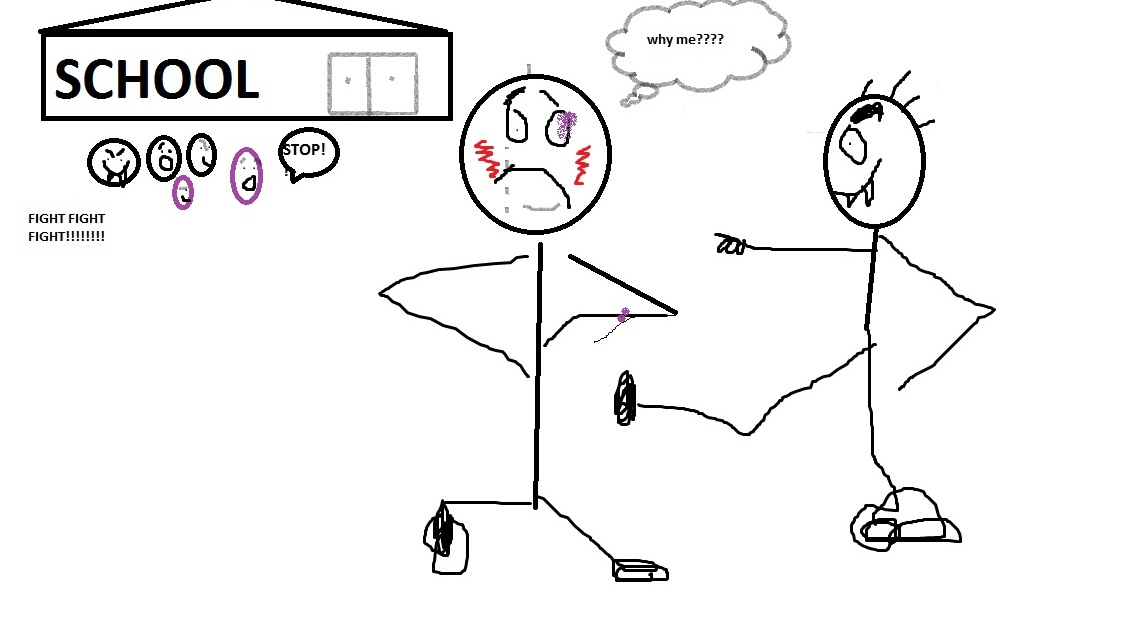
“How Being Bullied Affects Your Adulthood” by Kate Baggeley

Bullying, Author Dalia098 (CC BY-SA 3.0 Unported)

While the coronavirus has disrupted the normal school year, for some of our children this may actually have come as a relief.

“In American schools, bullying is like the dark cousin to prom, student elections, or football practice:  Maybe you weren’t involved, but you knew that someone, somewhere was.  Five years ago, President Obama spoke against this inevitability at the White House Conference on Bullying Prevention.  ‘With big ears and the name that I have, I wasn’t immune.  I didn’t emerge unscathed,’ he said.  ‘But because it’s something that happens a lot, and it’s something that’s always been around, sometimes we’ve turned a blind eye to the problem.”’

We know that we shouldn’t turn a blind eye:  Research shows that bullying is corrosive to children’s mental health and well-being, with consequences ranging from trouble sleeping and skipping school to psychiatric problems, such as depression or psychosis, self-harm, and suicide.

But the damage doesn’t stop there.  You can’t just close the door on these experiences, says Ellen Walser deLara, a family therapist and professor of social work at Syracuse University, who has interviewed more than 800 people age 18 to 65 about the lasting effects of bullying…”

[Continued at:  https://slate.com/technology/2016/06/the-lasting-effects-of-childhood-bullying-are-surprisingly-not-all-detrimental-in-adulthood.html ]

FOR MORE OF MY ARTICLES ON POVERTY, POLITICS, AND MATTERS OF CONSCIENCE CHECK OUT MY BLOG A LAWYER’S PRAYERS AT: http://www.alawyersprayers.com

41 Comments

Filed under bullying, Child Abuse, Emotional Abuse, Neglect, Physical Abuse, Sexual Abuse

Vigilance, Part 3 – Physical Abuse

Rib fractures in an infant, secondary to child abuse, Author/Source National Institute of Health (PD as work product of US Dept. of Health and Human Service, a federal agency)

Physical abuse is the form of child abuse most frequently reported by the media and most familiar to the public.  It is, also, the form most frequently fatal.

Children can and do sustain bumps and bruises, in the course of ordinary play.  Physical abuse, however, is deliberate harm by a parent or caregiver.

An abuser may characterize physical abuse as punishment for a perceived infraction.  But such punishment is out of all proportion to the infraction, and severe beyond a child’s capacity to understand or endure it. Continue reading

16 Comments

Filed under Child Abuse, Child Molestation, Emotional Abuse, Neglect, Physical Abuse, Sexual Abuse