Monthly Archives: April 2026

Good Men

Domestic violence has again been in the news lately.  But I received the following response from an old friend, on the topic:

I don’t claim to understand the violence in society. I do know there are many men out there who are as outraged as I am. I am lucky enough to go to a church with many good men.

We have a monthly men’s lunch to talk and share stories. Guess who organizes this group?
Don’t give up on us!
                                        Steve

With that in mind, I though it worthwhile to republish the following post.

Despite what some women may have experienced, there are good men out there. The trick can be finding them. For that, we have to apply appropriate criteria [1] [2].

While this is not a dating guide, I offer you some of the Bible’s advice on the topic. The language may sound old fashioned, but the sentiments apply to our day.

A good man exemplifies integrity, both in his public and private life. This should be the standard women, also, demand of themselves.

If I have walked with falsehood, Or if my foot has hastened to deceit, Let me be weighed on honest scales, That God may know my integrity” (Job 31: 5-6).

A good man deals justly with others, whatever their status. 

If I have despised the cause of my male or female servant When they complained against me, What then shall I do when God rises up?…Did not He who made me in the womb make them? Did not the same One fashion us in the womb?…” (Job 31: 13-15, 21-22).

A good man sets godly priorities in his life, actively living out his faith. This means more than his just attending church on Sundays. It involves forgiving others; extending help to the needy; and trying to do right in all things. It does not involve a pompous or superior attitude. Continue reading

13 Comments

Filed under Violence Against Women, Religion, Christianity, domestic abuse, domestic violence

Rationalization

Diagram “The Thinking Human” by Rene Descartes Source Scanned by Dagfinn Døhl Dybvig & Magne Dybvig from “Descartes:  The World and Other Writings”, (PD)

WARNING:  Graphic Images

It is difficult for most of us to understand the reasoning of abusers (pedophiles among them).

What lies do they tell themselves?  How can they reconcile their actions and the harm they inflict with a positive self-image, and avoid being overcome by guilt and shame?

Psychologists tell us this is accomplished through rationalization and a series of related defense mechanisms which include minimization, reframing, projection, entitlement, externalization, and moral disengagement [1][2].

Rationalization

Rationalization is the umbrella mechanism which allows abusers to justify their actions, rather than acknowledging the uncomfortable truth [3].  “He was asking for it.”  “She made me do it.”

Many abusers will focus on their own intent, rather than the harm actually done to victims. “I never meant to hurt her.”

Associated with this, some abusers will use self-loathing as a means of manipulation. But statements like “I’m toxic”, “I hate myself for what I do to you”, and “I don’t deserve you” are no guarantees of changed behavior.

Minimization

Minimization allows the abuser to downplay the severity of the harm he is inflicting.  “It wasn’t that bad.”  “He’s too young to remember, anyway.”

Abusers will refer to trauma they may have experienced in the past as justification for the trauma they, themselves, are inflicting in the present.  “After all, I only used my hand on the boy.  My father used to beat me with a belt.”

Reframing

This approach shifts the focus from the abuser to the emotion which supposedly overwhelmed him, making it sound as if the abusive behavior was unintentional.  It ignores the ongoing pattern of abuse.  “I just snapped.” “It was in the heat of the moment.”

Alternatively, the abuse is mischaracterized as a form of instruction or correction.  “I was only teaching her about sex.”  This is, also, applied to emotional abuse.  “It was tough love.”  “I was only being real.”

Projection

Projection allows the abuser to attribute his own undesirable traits, feelings, or inclinations to others [4].  “I don’t care if she was only 9 y.o.  She wanted sex.  I could tell by the way she looked at me.” Continue reading

13 Comments

Filed under Child Abuse, Child Molestation, Christianity, Emotional Abuse, Neglect, Physical Abuse, Religion, Sexual Abuse, Violence Against Women

Witnessing Evil – Secondary Trauma

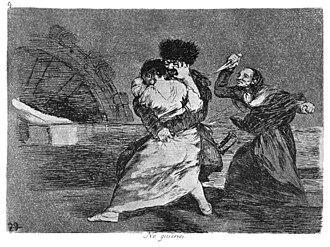
Plate No. 9 (“They Do Not Want To”) from the series “The Disasters of War” by Francisco Goya (1810s), Source Arno Schmidt Reference Library (PD)

The impact of witnessing trauma of any kind is profound. This is known as secondary or vicarious trauma. It leaves a scar on the psyche. Symptoms can range from sadness, fear, and guilt, to anxiety and emotional numbness [1A].

Secondary Trauma

Of course, trauma takes many forms and is not limited to abuse. We may, for instance, witness an auto accident, seeing victims removed from the scene. Those in law enforcement, emergency care, and frontline journalism frequently experience this [1B][2].

But many of us will encounter secondary trauma simply through life experience.

A. Domestic Violence

Children who witness domestic violence in the home are exposed to evil firsthand, and are most vulnerable to the effects of vicarious trauma. It shapes their character and their view of the world even if they, themselves, are not the victims.

Boys are far more likely to become abusers; girls, to seek out abusers as partners. The statistics are appalling [3].

B. Bullying

We may as children have seen others bullied, feeling powerless, ourselves, to intervene.

C. Vicarious Abuse

Whether as children or adults, we may see a beloved friend or relative gradually worn away by domestic violence, her self-esteem eroded.

Though we may never actually see the blows struck, this is for us, in effect, vicarious abuse. If we try unsuccessfully to persuade that friend or relative to leave her situation, we are bound to feel frustrated, angry, and helpless.

What We Can Do

If we do lose a loved one to abuse, we are not as helpless as we may feel.

A few of us may become advocates, as a result, in or out of the courtroom. Far more will go on to interact with countless other women we can educate about domestic violence. While we may never give formal lectures, we can share our experience with friends, coworkers, and a host of others.

As important, we can treat them the way they should be treated. And we can raise our own children to know they deserve better from a relationship.

That has the power to save lives.

[1A and 1B] Office for Victims of  Crime (OVC), “The Vicarious Trauma Tool Kit — What Is Vicarious Trauam?”, https://ovc.ojp.gov/program/vtt/what-is-vicarious-trauma.

[2] ACLS, “Understanding Secondary Trauma: The Impact of Witnessing Traumatic Events” by Melanie Kolmetz, DFAAPA, EMT-P, https://acls.com/articles/the-impact-of-witnessing-traumatic events/.

[3] Domestic Shelters, “Children and Domestic Violence”, 1/17/15, https://domesticshelters.org/resources/statistics/children-and-domestic-violence.

The US Supreme Court has ruled against a Colorado law which prohibited so called “conversion therapy” in cases of gender dysphoria.  The Supreme Court considers such counseling “free speech,” therefore, protected. 

See, https://www.nbcwashington.com/news/national-international/supreme-court-rules-conversion-therapy/4081114/.

Some 23 states have prohibited licensed Christian counselors from exploring underlying issues with patients suffering from this condition, or advising how they might align their perceived gender and biological sex.  

FOR MORE OF MY ARTICLES ON POVERTY, POLITICS, AND MATTERS OF CONSCIENCE CHECK OUT MY BLOG A LAWYER’S PRAYERS AT:  https://alawyersprayers.com

14 Comments

Filed under bullying, Child Abuse, Child Molestation, domestic abuse, domestic violence, Emotional Abuse, Neglect, Physical Abuse, Sexual Abuse, Violence Against Women

Easter Sunday

Children dressed for Easter, Tallahassee, FL (1957), Source/Author Florida Memory, State Library and Archives, https://floridamemory.com/items/show/261196 (PD per Section 257.35(6) Florida Statutes)

Easter Sunday was an important day on the calendar when we were children. 

We would be dressed in our best Spring finery for church – Easter bonnets, white cotton gloves, starched dresses, lace anklets, patent leather shoes.  With trees coming into bud and daffodils in bloom, the whole world seemed fresh and new.

Of course, appearances can be deceiving.  Child abuse can be disguised for the world.  But no amount of chocolate eggs or jelly beans can make up for it.

These days the focus seems more on the Easter bunny than the Resurrection.  Which is a tragedy, since it is Christ who offers abuse victims genuine comfort and healing. 

He offers us, in fact, a new life (whatever may have caused our scars).

Therefore, if anyone is in Christ, he is a new creation; old things have passed away; behold, all things have become new” (2 Cor. 5: 17).

Wishing you all a Happy Easter!

FOR MORE OF MY ARTICLES ON POVERTY, POLITICS, AND MATTERS OF CONSCIENCE CHECK OUT MY BLOG A LAWYER’S PRAYERS AT: https://alawyersprayers.com


12 Comments

Filed under Child Abuse, Child Molestation, Christianity, domestic abuse, domestic violence, Emotional Abuse, Neglect, Physical Abuse, Religion, Sexual Abuse, Sexual Assault, Violence Against Women