
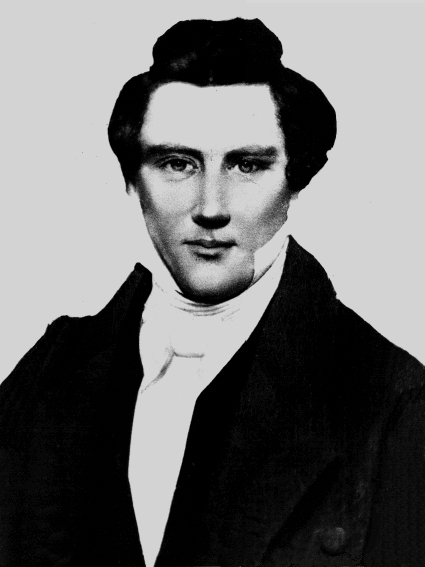
Joseph Smith, founder of Mormonism, photo by Lucian Foster (1843), Source http://comevisit.com/lds/faq-dld.htm, (Public Domain)
The Roman Catholic Church child sex scandal has received a good deal of press – justifiably so. But it is by no means the only sex scandal in America’s churches and elsewhere.
Mormon Church
We begin with sexual abuse in the Mormon Church, the Church of Jesus Christ of Latter-day Saints (LDS).
The 17 million members of the Mormon Church value marriage and family above all [1A]. The church has a strict moral code which includes abstaining from alcohol (even caffeine) and premarital sex, while fostering a deep sense of community [1B]. Unfortunately, this outward appearance of virtue hides a dark underbelly.
A culture of secrecy has enabled decades of unchecked sexual abuse [1C]. Institutional protection prioritizes the church’s reputation over the safety of its most vulnerable members [1D]. According to Mormon sexual abuse database Floodlit, at least 4195 reports of abuse have been made [2A].
One of the earliest publicized cases involved Joseph Bishop, a former president of the LDS Church’s Missionary Training Center in Provo, Utah. Although Bishop was accused of having sexually assaulted a missionary sister in the 1980s, he was allowed to continue in ministry.
Bishop was never criminally charged because the Statute of Limitations had run. After the legal deadline for filing rape charges was extended, a civil lawsuit was dismissed by agreement between the plaintiff and the LDS church. Just days after the release of a trove of documents by a whistleblower website, Bishop finally admitted sexual impropriety in 2018 [1E].
Mormon church members who have been convicted of child sexual abuse and/or rape include Jacob Bowers, Scott Bowers (his son), Arvid Oakely, and Gerald Salcido [2B]. Salcido, a former police officer, was excommunicated. However, the church never informed law enforcement.
Unfortunately, those who point to the fact that the Mormon Church is not a genuinely Christian denomination (with the Book of Mormon contradicting the Bible in many key respects) [3][4], and comfort themselves with the thought that evil like this is only prevalent among non-believers are merely deluding themselves.
Amish Church
Sexual abuse is widely regarded as an open secret in many Amish communities [5A].
Some communities have begun supporting victims [5B]. However, guided by the principle of “forgive and forget”, many continue to silence survivors, pressuring them to forgive their abusers publicly, while at the same time discouraging police involvement [5C].
One survivor, Lizzie Hershberger, has broken her silence, in the hope of encouraging others to come forward [5D]. Her story is told in a recently released documentary film titled “Keep Quiet and Forgive” [5E][6]. Her book “Behind Blue Curtains” is available on Amazon.
—
[1] Survivors Rights, “The LDS Church Sexual Abuse Scandal: A History of Cover-Ups, Betrayal, and the Fight for Justice”, 2/7,25, https://survivorsrights.com/lds-church-sexual-abuse-scandal-coverup/.
[2] FloodLit, “Sexual Abuse in the Mormon Church”, https://floodlit.org/.
[3] Bible Ask, “Does the Book of Mormon Contradict the Bible?”, 1/20/17 (updated 11/28/25), https://bibleask.org/does-the-book-of-mormon-contradict-the-bible/.
[4] Institute for Religious Research, “Contradictions Between the Book of Mormon and the Bible” by Luke Wilson and Robert Bowman Jr., 7/6/11 (updated 12/1/25), https://mit.irr.org/contradictions-between-book-of-mormon-and-bible.
[5A through 5E] KPBS Public Media, “Independent Lens: Keep Quiet and Forgive” by Jennifer Robinson, 3/10/26, https://www.kpbs.org/news/2026/03/10/independent-lens-keep-quiet-and-forgive.
[6] Fillmore County Journal, “Amish Sexual Abuse Survivor Shares Story in PBS Documentary” by Charlene Corson Selbee, 3/23/26, https://fillmorecountyjournal.com/amish-sexual-abuse-survivor-shares-story-in-pbs-documentary/.
Part 2 in this series re: the Anglican, Baptist, and Methodist Churches will be posted next week.
Taxpayer funded sexual harassment settlements involving federal lawmakers totaled $550,000 in recent decades, with the largest settlement for $220,000 made on behalf of Democratic Rep. Alcee Hastings (now deceased).
For more information, see https://www.msn.com/en-us/news/politics/previously-unaccounted-for-case-shows-taxpayers-bankrolled-more-than-550000-in-congressional-sexual-harassment-settlements/ar-AA238iVv?ocid=BingNewsSerp,
FOR MORE OF MY ARTICLES ON POVERTY, POLITICS, AND MATTERS OF CONSCIENCE CHECK OUT MY BLOG A LAWYER’S PRAYERS AT: https://alawyersprayers.com


It’s always disgusting to me when abuse is treated like like a secret & something the victim needs to be ashamed of…but it happening that way in these settings is even more disgusting. No doubt that has turned many victims against God. Who could blame them?! They must feel He’s not real, doesn’t care or is a hypocrite to condon such things. Yet, He’s who they need most! Just heartbreaking.
I could not agree more, Cynthia.
It’s heartbreaking. I know a lady who was raised by her extremely abusive Catholic grandparents. She’s against anything labeled “Christian” because of that. She’s gotten into false religions. But, she says my writing has helped her tremendously (hope this doesn’t sound like I’m bragging!!) & I think that means she’s not a lost cause.. there’s a chance in time she may realize God isn’t why she was abused & He loves her.
You do important work, Cynthia, distinguishing those who falsely claim to be Christian from Christianity, itself. I hope that woman does find her faith again.
Thank you, Anna. You do important work too. ❤
A difficult but important read Anna. Accountability and transparency should never depend on the institution involved.
These types of crimes occurring within institutions is one thing. Where there are people, bad things are sure to happen eventually. But the institutional reaction, the cover-ups, the shaming, the secrecy and cultural pressure are every bit as bad, to me, as the perpetrators actions. It’s infuriating.
I fully agree. These institutions were complicit w/ the predators.
I frequently come across articles detailing sexual abuse in churches, and if there is one thing they all have in common it is that no group or denomination is excluded from these acts. It is as if Satan has infiltrated “religion” with the purpose of destroying the faith of people by any means necessary, and he has found sexual abuse to be a powerful weapon in his arsenal.
So true, Ron.
It’s very sad because such things often serve to separate sexual abuse victims from Jesus. I try to remind people that Jesus Himself was abused by religious people, so He understands the issue well. He had a few choice words to say about millstones and throwing people into the sea! He was also perfect and sin free, and that did not protect Him, so anyone who feels false blame or shame about being victimized can hang onto that truth.
One of my favorite sayings is that, “when Satan fell from heaven he landed in the choir loft.” It’s kind of funny, and keeps your bones from drying out, but it also helps me to cope with some of the horrors that sometimes go on in religious settings. It’s maddening, but not unprecedented, not illogical.
Well said.
As I have analyzed this topic some time before, I do not believe that churches or religious organizations create predators. In my view, the mechanism often works the other way around: predators seek environments where they can obtain trusted, relatively uncontested authority over children and minors.
In many societies, churches enjoy immense trust. A person holding an ecclesiastical function may be believed more readily than a child, which creates precisely the kind of imbalance a predator can exploit.
There is also another factor. Like all predatory actors, they are subject to a kind of selection process: those who cannot conceal their warning signs are more likely to be detected and removed. Over time, this favors the most convincing “actors” — individuals who appear almost indistinguishable from non-predatory people.
Yet one weakness seems to persist: impatience. Their ability to wait for years before acting appears limited. This may remain one of the few detectable vulnerabilities within an otherwise carefully hidden pattern.
And it is precisely this weakness that may lead them to seek shortcuts. Entering a church hierarchy, or any trusted religious or youth-oriented structure, can provide such a shortcut: access, authority, and credibility are granted more quickly than they would be in ordinary circumstances. Combined with the deep trust many communities place in religious figures, this creates a dangerous opening that predators are capable of recognizing and exploiting.
As always, Hubert, this is an extremely insightful observation on your part.
Unfortunately, it does not explain or excuse the repeated failure by multiple religious institutions to report complaints of abuse to the authorities, as required by law in some 46 states. See, https://legalclarity.org/are-clergy-required-to-report-crimes/.
Such reporting is generally required w/i 24-48 hours of suspicion — not decades later. See, https://www.churchlawandtax.com/keep-safe/abuse-prevention/mandatory-child-abuse-reporting-laws-what-church-leaders-must-know/.
Nor does it explain or excuse the pressure by religious institutions on victims to remain silent. See, https://aleteia.org/2025/10/17/victims-voices-at-heart-of-report-on-combating-church-abuse/.
Indeed, even now — some 40 years after the Roman Catholic Church sex scandal first came to light — that denomination is still slow to enforce transparency on abuse, despite the fact that an estimated 420,000 to 1 million victims in 60 countries have been impacted. See, https://religionnews.com/2025/10/16/vatican-report-admits-church-is-still-slow-to-enforce-transparency-on-abuse/ and https://www.bishop-accountability.org/2024/12/a-look-at-the-sexual-abuse-crisis-in-the-catholic-church-in-2024/.
That access, authority, and credibility are granted more quickly than they would be in ordinary circumstances should make these institutions more vigilant on behalf of victims, not less so.
Anna, I agree with you. My analysis does not explain or excuse the repeated failure of religious institutions to report abuse complaints to the authorities — at least not directly. That failure remains a moral and legal failure in its own right.
What my analysis may help explain, however, is the deeper structural rot that can develop within such institutions, including but not limited to the Roman Catholic Church. A perpetrator who wishes to survive scrutiny does not merely hide their actions; they often build protective structures around themselves. This may include cultivating powerful contacts within the hierarchy, making themselves useful to influential people, or attaching themselves to projects that are genuinely valuable to the community.
That last point is particularly dangerous. When a perpetrator becomes associated with work that others depend on — charitable projects, schools, youth programs, parish initiatives — their removal may appear, to some within the institution, as a threat to the “greater good.” This does not justify concealment. It makes it worse. It shows how moral cowardice can disguise itself as institutional prudence.
In such cases, the institution is no longer merely failing to detect predators. It is allowing itself to become part of their defense system.
—
There is also another factor worth considering: every church, like every institution built upon moral authority, depends heavily on public trust. Many within church hierarchies appear to have operated under the mistaken assumption that disclosing scandals openly would irreparably damage this trust and perhaps even threaten the survival of the institution itself.
Ironically, the long-term effect proved almost the exact opposite.
During a visit to Ireland (once a staunchly Catholic country), I once witnessed a relatively young priest riding a bicycle being casually harassed by a group of youngsters. Some even invited me to join them in attacking him physically. I refused and asked them why they considered such behavior acceptable. Their answer was striking: according to them, no police officer would believe a priest younger than forty anyway.
Whether exaggerated or not, this reaction revealed something deeply troubling — namely the degree to which decades of scandals and institutional cover-ups had eroded public trust in the Catholic Church in Ireland. Once trust collapses so profoundly, even innocent clergy may begin to carry the burden of collective suspicion.
One must also consider the long-term consequences of such institutional decay. Young men may increasingly hesitate to pursue the priesthood, not only because of declining religiosity, but because they fear social hostility, suspicion, or association with past scandals. If such trends continue for generations, countries once deeply Catholic may gradually become predominantly secular societies.
In this sense, the concealment of scandals did not preserve the institution. It may instead have accelerated the erosion of the very trust upon which the institution depended.
That is a brilliant analysis, Hubert. I believe you are exactly right.
It is sad to see the very trust people have in their faiths can been disrespected so. It demonstrates the darkness of humanity and institutions 😔
Well said, Ravishank.
Thank you Anna
Always so hard to read – but you do such important work lifting the shadows and veils. L xx
You are very kind. If I can help even one individual in some small way, then the effort has been worthwhile. ❤
I once heard the saying; “if you save one life you save humanity entire” – that’s what you do xx
You are very kind. ❤
😘
How disquieting, Anna. Covering up sexual abuse in the “interest” of preserving the institution of a church is ironically cult-like and very much against the interests of the church.
Such a heinous sin..