
Wishing All of You a Happy New Year!
FOR MORE OF MY ARTICLES ON POVERTY, POLITICS, AND MATTERS OF CONSCIENCE CHECK OUT MY BLOG A LAWYER’S PRAYERS AT: https://alawyersprayers.com
Wishing All of You a Happy New Year!
FOR MORE OF MY ARTICLES ON POVERTY, POLITICS, AND MATTERS OF CONSCIENCE CHECK OUT MY BLOG A LAWYER’S PRAYERS AT: https://alawyersprayers.com
Lost Voices https://www.lostvoices.org/ is a non-profit which uses music as a vehicle to change the lives of children impacted by violence, abuse, neglect, and human trafficking.
The non-profit was founded by Executive Director Mike Ball, after a visit to a Juvenile Detention Center.
Young people are encouraged to get in touch with their feelings by writing and performing their own songs. Workshops are facilitated by trained musicians.
A key element of the Lost Voices program is trauma informed care which focuses on the need to understand life experiences, establishing a non-judgmental setting in which young people can work through their emotions.
The goal is to confirm for these children that — whatever they may have done or been subjected to — their lives remain valuable.
“A bruised reed He will not break, And smoking flax He will not quench; He will bring forth justice for truth” (Isa. 42: 3).
FOR MORE OF MY ARTICLES ON POVERTY, POLITICS, AND MATTERS OF CONSCIENCE CHECK OUT MY BLOG A LAWYER’S PRAYERS AT: https://alawyersprayers.com

“Good Shepherd” by Bernhard Plockhorst (c. 1889), Source allposters.com, (PD-Art, PD-old-100)
As abuse survivors dealing with the scars of our experience, we tend to repeat certain mistakes and despise ourselves for that fact…as if will power alone could overcome trauma.
Often, we imagine that God despises us, as well. God does not, however, view our efforts with contempt. Far from it.
Author Jennifer Arimborgo who blogs at Feeding on Jesus https://feedingonjesus.com explores this topic in a post titled “God Is Not Sick of Your Struggle” (excerpted below).
Jennifer’s books are available at Amazon.com.
“…We sometimes live under the false impression that God is repelled by our imperfections and brokenness…Scripture teaches us that the opposite is true…His heart does not despise it when we lay bare our worst failures before Him. He is not disgusted with us. On the contrary, He gets stirred up with deep compassion and a desire to restore us to a place of wholeness.
After all, that’s what He gave His life for. Our gentle Shepherd submitted Himself to torture to redeem us. If He was willing to pour out his life unto death, what wouldn’t He do for us?…”

Early Autumn in the Sierra Nevada, Author Don Graham of Redlands, CA (CC BY-SA 2.0 Generic)
“Everybody needs beauty as well as bread, places to play in and pray in, where nature may heal and give strength to body and soul alike.”
– John Muir
The respected naturalist and environmental philosopher, John Muir, believed that nature offers the body and mind opportunities to heal themselves [1].
Muir tirelessly hiked the Sierra Nevada, writing extensively about his experiences and ultimately co-founding America’s premier conservation organization, the Sierra Club. His activism helped to preserve both Yosemite and Sequoia National Parks.
Mission Outdoors https://missionoutdoors.org/ and Hometown Hero Outdoors https://hometownherooutdoors.org/ are two small non-profits which share Muir’s view.
They afford military service members and veterans a temporary escape from the stress of combat or the difficulties of transitioning to civilian life through hunting, fishing, and other outdoor activities. Hometown Hero Outdoors is open to law enforcement personnel, as well.
PTSD
Many of these individuals suffer from post-traumatic stress disorder – an illness to which victims of childhood abuse and domestic abuse are, also, prone. Continue reading

“Young Slave” by Michelangelo (1520-1523), Galleria dell’ Accademia, Florence, Italy, Author Jörg Bittner Unna (CC BY-SA 3.0 Unported)
Those of you familiar with the perfection of Michelangelo’s “David” or “Pieta” may not know that he created a series of sculptures loosely referred to as the slaves, prisoners or captives.
Art critics argue over the merit of these – the central issue being whether Michelangelo intended them as finished works of art or not. Details on these statues are vague, chisel marks still clearly visible.
The figures though are striking. Incomplete, they struggle not only to free themselves from their chains, but from the very stone in which they are encased.
The Scars of Abuse
Like Michelangelo’s captives, the victims of childhood abuse wrestle with the scars of their abuse – low self-esteem, perfectionism, boundary issues, depression, anxiety, PTSD, relationship difficulties, sexual promiscuity and/or dysfunction, addiction, and the rest. We struggle against the chains binding us, desperate to get free.
The Figure Within
Michelangelo’s entire approach to sculpture was to envision the figure within. He saw his role as first identifying that figure, then removing unnecessary elements to reveal the image present all along.
Despite our scars, God, too, sees the figure within. Like a sculptor, He shapes us to an image only He can see. Bit by bit, He removes unnecessary elements, always aware of the ultimate outcome. Continue reading
As we mature into adulthood, we gain not only physical and emotional strength, but power over our lives. This opens up new opportunities, and options never available to us before.
Distinguishing between the feeling of vulnerability and actual vulnerability becomes crucial.
“…Do I need to better protect myself from a danger in the environment? Or do I need to muster the courage to face something that isn’t going to kill me and that can help me grow stronger and more confident? Often we can conflate the two…Once we determine what our vulnerable feelings are about, we can thus make a decision to protect ourselves from real danger, or face an opportunity for personal growth by facing real feelings, emotions and needs…”
-“Stephen” of Therapy Glasgow, https://therapyglasgow.com/2020/04/26/the-vulnerable-self/
Barricades
In an effort to protect ourselves, we may be tempted to erect emotional barriers, barricades against further abuse. This is only natural. To the extent that we re-establish safe boundaries, it is all to the good.
But we must remember that barricades can become traps for those inside. Inadvertently, we may cut ourselves off from the opportunities now accessible to us, and the very relationships which might help us to heal. Continue reading
:focal(541x183:542x184)/https://public-media.si-cdn.com/filer/c4/a7/c4a78bd1-80b6-40ff-b530-078b46b8a265/batb2017textlesspostercropweb.jpg)
Enchanted Rose from Disney’s “Beauty and the Beast” (Disney Wiki/Creative Commons), courtesy of Smithsonian Magazine
In the Disney version of the fairytale “Beauty and the Beast”, an enchanted rose is shielded against the elements by a glass dome. Though sheltered and hidden away, the rose remains fragile and continues to lose its petals. In so doing, it presents a perfect picture of vulnerability.
The victims of child abuse are all too familiar with vulnerability. We were preyed upon at our most vulnerable – at a time when we should have been protected and nurtured.
It is only reasonable that we retain a sense of fragility, along with the recollection of our very real abuse. This is an echo of the intense fear we experienced as children.
Feeling Vulnerable v. Being Vulnerable
But there is a difference between feeling vulnerable, and being vulnerable. To save our own lives, we must learn to distinguish between the two.
“…I might feel vulnerable whilst speaking of things I have kept hidden for a long time, whilst there is no actual threat to my existence. By revealing myself I reveal truths that I may not yet have fully accepted in myself. I may in fact be safe, but the experience of exposure feels like I am in danger….
By contrast, I might actually be vulnerable standing out on the ledge of a forty-storey building, where the merest breeze might shift my balance sufficiently to result in a terrifying death a few seconds later.”
-“Stephen” of Therapy Glasgow, https://therapyglasgow.com/2020/04/26/the-vulnerable-self/
Life was not meant to be lived under glass.
This series will conclude next week.
FOR MORE OF MY ARTICLES ON POVERTY, POLITICS, AND MATTERS OF CONSCIENCE CHECK OUT MY BLOG A LAWYER’S PRAYERS AT: http://www.alawyersprayers.com

“Figure of Christ” by Heinrich Hofmann (1884), Source https://i.pinimg.com/originals (PD-Art, PD-old)
Abuse frequently destroys the faith of victims, undermining our capacity to trust. While we may reject God or despise Him, He loves and values us. It can be difficult for us to reconcile God’s love with our experience. But that love is real.
Let me try and explain what I mean.
Self-Worth and the Cross
“For God so loved the world, that He gave His only Son, that whoever believes in Him should not perish but have eternal life.” (John 3: 16).
As abuse victims, we were taught at an early age that we were worthless. Our needs were insignificant. Our feelings did not matter. Our bodies were not our own.
These were the inferences we drew from our experience with those who rightly should have loved and cared for us. God, however, sees things differently. To Him, we are of infinite value. He proved it by giving His Son, Jesus Christ over to a death on the cross for our sakes.
Our value is not governed by a predator’s opinion of us. It was established for all time at the cross. No one need add to it. No one can detract from it.
God’s Unconditional Love
“Your love, O Lord, reaches to the heavens, your faithfulness to the skies” (Ps. 36: 5).
God’s love for abuse victims is limitless and unconditional. The concept of unconditional love may be foreign to us. We were taught that love was unreliable. It had to be earned, over and over again. Most of us paid a high price for a counterfeit version of love.
Sin and Our Relationship to God
“There is therefore now no condemnation for those who are in Christ Jesus…For the law of the Spirit of life has set you free in Christ Jesus from the law of sin and death” (Rom. 8: 1-2).
God’s love is not withdrawn when we make mistakes or fall short. We grieve His heart at such times, but He does not turn away from or reject us. We are His beloved children. Even when our relationship with Him is rocky, He continues to love us immeasurably. Continue reading

Shrapnel fragments visible on x-ray, Author Hellerhoff (CC BY-SA 3.0 Unported)
WARNING: Graphic Images
The sharp, jagged, metal fragments from an exploding bomb, grenade, or landmine are known as shrapnel.
Shrapnel wounds require special care. Initially, these are open puncture wounds, with impaled objects so hot that medical personnel are strictly advised to leave them in place. Pressure on shrapnel wounds must be avoided, as this will only cause more damage to surrounding tissues and organs.
After it cools, some shrapnel can be removed surgically [1]. Often, however, surgery would do more harm than good. There may be hundreds or thousands of small objects.
Over the years, fragments left behind can migrate within the body, making them still harder to find and access. It is not unusual for shrapnel to remain imbedded for decades [2].
Trauma Beliefs
The same is true for trauma beliefs. When children undergo trauma, they experience strong emotions. Like scorching metal fragments, these searing emotions highlight the traumatic event.
But children, also, draw conclusions from trauma. This is their attempt to make sense of the world. Unfortunately, the conclusions children draw may not be accurate [3].
Since the traumatic event is not fully understood, the child cannot fully process it. Instead, the emotions and faulty conclusions surrounding the trauma remain sharp, jagged, and are re-experienced, again and again.
This happens even after conscious memory of the event has faded. Like shrapnel, trauma beliefs remain in the body, and continue to do harm.
False Core Beliefs
Having been abandoned as children, we may fear that others will leave us as adults. Having been abused as children, we may believe ourselves unworthy of love as adults. These core beliefs about ourselves and the world around us may never be vocalized, never questioned. But they are deeply held.
Trauma beliefs “feel” accurate not because they are, but because we have held them for so long [4]. They “feel” protective, but are actually self-sabotaging [5]. Continue reading
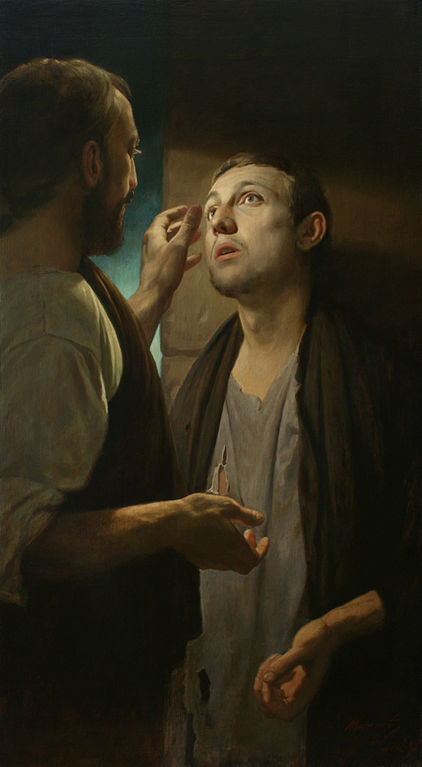
“Healing of the Blind Man” by AN Mironov (2009), Author Andrey Mironov (CC BY-SA 4.0 International)
“…He [Christ] spat on the ground and made clay with the saliva; and He anointed the eyes of the blind man with the clay. And He said to him, ‘Go, wash in the pool of Siloam’…So he went and washed, and came back seeing” (John 9: 6-7).
The miracle of the blind man is recorded in the Bible to teach us that infirmity is not necessarily the consequence of sin.
Certainly, as the victims of child abuse, we did not, ourselves, sin. Trauma, however, lefts its mark on us. Among its scars is the tendency we have to seek out and return to dysfunctional relationships.
What Christ’s love does for abuse victims is heal (or reduce) those scars, and cause the scales to fall from our eyes. We can see the world more clearly, undistorted by the lies we were told by predators about the nature of love and our own supposed lack of value.
Christ’ love for victims is tender. “A bruised reed He will not break…” (Isaiah 42: 3). Rather than inflict pain on us, He grieves over the pain we have endured. That tenderness restores our self-worth, eliminating the need we feel to return to toxic relationships, and making us again whole.
FOR MORE OF MY ARTICLES ON POVERTY, POLITICS, AND MATTERS OF CONSCIENCE CHECK OUT MY BLOG A LAWYER’S PRAYERS AT: https://alawyersprayers.com


