Tag Archives: negative self-talk

Unrequited

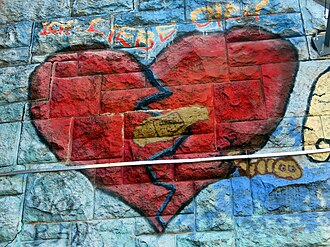
“Ich Liebe Dich (I Love You) – Broken Heart”, Source https://www.flickr.com/photos/donaldjudge/52226706001/, Author Donald Judge, (Creative Commons Attribution 2.0 Generic)

You love someone desperately.  Being around the beloved is a joy, whether the interaction is romantic or not.  You live on hope that a relationship will develop.  Only the object of your affection does not return your love, and may not even be aware of it.

Unrequited love is the experience of strong romantic feelings that go unreciprocated [1A].  

This one-sided affection leads to intense sadness, feelings of rejection, and emotional exhaustion – not surprising, since the brain processes romantic rejection similarly to physical pain [2A].

Roots of Unrequited Love

The victims of childhood abuse or neglect may be particularly vulnerable to unrequited love [3A][4A].

Abuse (whether emotional, physical, or sexual) and neglect leave us with the haunting feeling that we are damaged and unworthy of love.  We idealize love, and are happy with the smallest crumbs of affection.

Attachment Styles

As a result, some of us develop an “avoidant” attachment style.  Unconsciously, we pursue emotionally distant partners. 

This allows us the illusion of a relationship with all its emotional highs and lows while, at the same time, preserving our control, letting us avoid vulnerability, and reinforcing our belief that we are unlovable [1B][3B]. 

In a genuine relationship, our flaws would be visible.  The prospect of that is too frightening.

Others develop an “anxious” or needy attachment style.  We may fixate on unavailable partners, but interpret unresponsiveness as a challenge to win affection [1C][3C][7].  We simply try harder. 

This keeps us attached to narcissists who dole out affection with an eye dropper [3D]. In fact, we seek out partners that make us feel needed (ignoring the red flags that should send us running for safety).

The approach can, also, undermine healthy relationships.  Any slight by a partner is immediately interpreted as a lack of concern or outright abandonment.  No reassurance is sufficient, and the relationship eventually fails.

Impact of Unrequited Love

Unreciprocated affection can lower our self-esteem, causing us to question our desirability and value [1D][4B].  We replay conversations and events endlessly, in the fruitless search for clues to securing the love we so desire [2B].

Over time, unrequited love can lead to negative self-talk, self-doubt, and even depression [5A].  It may, also, impede forming meaningful connections with available partners [6A].  We may not even recognize that they are there.

Link to Obsession

As mentioned, childhood abuse or neglect can manifest as the maladaptive attempt to regulate our fear of abandonment and sense of unworthiness by clinging to a disinterested romantic partner [7].  The degree to which we cling to the illusion of a relationship actually reflects the emptiness inside us.

Anger and resentment can, also, emerge when our admiration for the beloved is frustrated [2C].

This is the emotional turmoil that is obsession.

Healing from Unrequited Love

Recovering from unrequited love is definitely possible.  Distance from the beloved can be a major step in the direction of healing [3E][5B][6B].  This should be coupled with self-care, and supportive relationships.  Professional counseling can help us gain perspective.

Our challenge is to exchange idealization for a realistic understanding of love.  Neither we nor our partner will ever be perfect.  We do not have to be to deserve love.

[1A through 1D]  Science News Today, “Unrequited Love:  The Science, Psychology, and Human Experience of Loving Without Return”, 11/4/25, https://www.sciencenewstoday.org/unrequited-love-the-science-psychology-and-human-experience-of-loving-without-return.

[2A, 2B, and 2C]  PsyCix, “The Psychological Effects of Unrequited Love”, 11/24/25, https://www.psycix.com/article/the-psychological-effects-of-unrequited-love.

[3A through 3E]  PsychCentral, “How Childhood Emotional Neglect Impacts Adult Relationships and How to Heal” by Hope Gillette, 7/13/22, https://psychcentral.com/relationships/childhood-emotional-neglect-romantic-relationships.

[4A and 4B]  Brainz Magazine, “Why Childhood Sexual Abuse Could Be Affecting Your Love Life Now” by Sandra Cohen PhD, 2/19/25, https://www.brainzmagazine.com/post/why-childhood-sexual-abuse-could-be-affecting-your-love-life-now.

[5A and 5B]  Marriage, “7 Possible Effects of Unrequited Love & What You Can Do” by Dylan Banks, 3/25/26, https://www.marriage.com/advice/self-love/effects-of-unrequited-love/.

[6A and 6B]  Psychreg, “Unrequited Love Can Harm Your Mental Health But There Are Ways to Heal” by Dino Relojo, 11/7/25, https://www.psychreg.org/unrequited-love-can-harm-your-mental-health-but-there-are-ways-heal/.

[7]  Psychology Today, “How Childhood Neglect Can Turn Love into Obsession” by Annie Tanasugarn, 12/24/25, https://www.psychologytoday.com/us/blog/understanding-ptsd/202512/how-childhood-neglect-can-turn-love-into-obsession.

FOR MORE OF MY ARTICLES ON POVERTY, POLITICS, AND MATTERS OF CONSCIENCE CHECK OUT MY BLOG A LAWYER’S PRAYERS AT: https://alawyersprayers.com

8 Comments

Filed under Child Abuse, Child Molestation, domestic abuse, domestic violence, Emotional Abuse, Neglect, Physical Abuse, Sexual Abuse

The Rose Garden, Chapter 17 – Illness

File:MarkhamStouffvilleHospital23.jpg

Emergency Room, Markham Stouffville Hospital, Ontario, Author Raysonho @ Open Grid Scheduler/Grid Engine, (CC0 1.0 Universal Public Domain Dedication)

“…rejoicing in hope, patient in tribulation, continuing steadfastly in prayer…” (Rom. 12: 12).

There may be an abuse-related dimension common to all the major illnesses from which I have suffered over the years, disparate though at first they appear.

The mechanism of this is not fully understood, but is thought to involve somatization, i.e. the expression of psychological or emotional factors as physical symptoms [1].  The pain associated with somatization is a physiologic response to the stress and trauma of abuse, but all too real [2]. This is NOT hypochondria.

Abuse and Autoimmune Disease

Around the age of twelve, I suffered a major attack of hives.  Though I did not know it then, this presaged the chronic urticaria (CU) from which I suffer today.  In effect, the body does not recognize, and so attacks itself.

A growing body of research suggests a link between childhood abuse and the development of autoimmune disease [3].

At the time of the initial hives, I was repeatedly bathed in ice water as I writhed.  Since they had been on the phone to a physician, it was twenty-four hours before my mother or grandmother considered taking me to an emergency room.

Of course, my mother had gone to work with a second degree sunburn.  Her enormous blisters burst while she was on the subway.  My grandmother washed the kitchen floor on her hands and knees the day after she returned home from the hospital, following a hysterectomy.

After years of childhood earaches and tonsillitis, I finally had my tonsils removed at age nineteen.  Following surgery, I awoke from anesthesia to find my father at the foot of the hospital bed.  I cannot convey the joy I felt.  It was entirely unexpected and moved me immensely that he had taken time off from work to see me.

It strikes me as funny to this day that I shared a room with a Jehovah’s Witness and a Black Muslim.  Unable to speak, I lay there between them as my fellow patients held theological arguments at high volume across my bed.

Abuse and Endometriosis

From the time I first began to menstruate, my periods were irregular and accompanied by severe cramps.  Endometriosis was ultimately diagnosed.  Child abuse has, also, been linked to endometriosis [4].

It would not be until my thirties that I obtained any relief.  Before that, each month I would swallow as many aspirin as I could tolerate, then lie prostrate on the bathroom floor, comforted by the cool tile until the pain passed.

Again, no one took me to an emergency room.  I remember the pain ending early one Christmas morning, after I had endured it for some ten days.  Julia Child was on TV at the time, demonstrating how to stuff a turkey.  I have retained a sentimental fondness for her ever since.

The day I took the scholarship exam for college, my period came on suddenly during lunch.  We had completed the morning session and were sitting in the cafeteria.

With the onset of cramps and bleeding, I rushed to the ladies room, but could find no sanitary napkins.  Desperate, I attempted unsuccessfully to insert my first tampon, all the while doubled over in pain.

Wave after wave of cramps rolled over me.  I broke out in a sweat.  For some reason, after forty minutes, the cramps stopped on their own.  I used toilet tissue to craft a make-shift pad, and rejoined the others in time to sit for the afternoon session.

I won a full scholarship, as a consequence.  With no thought to a career, I chose biology as my major out of wonder at the beauty of the world.  Medicine — since I tend to faint at the sight of blood — was never an option.

Years later, I, too, had a hysterectomy.  I had to be taken from my office by stretcher — moaning, but issuing last minute instructions to the staff as I went.

My then Office Manager, a close friend, stayed by my side.  This was no surprise.  We had done the office budget together one weekend, as her infant daughter lay asleep in a carrier on the floor at our feet.

Abuse and Chronic Back Pain

I have had many years of back pain.  A fall may have aggravated the scoliosis from which I suffer.  It, also, produced disc herniation.  But childhood trauma is frequently associated with chronic neck or back pain [5].

At times the pain has been so severe I have wondered if it would kill me.  Ultimately, I had to undergo a spinal fusion at the cervical level, then spend three months strapped into a brace.

The procedure necessitated a bone graft from my right hip.  The night before surgery, the nurse and I laughed together as we wrote on my left side in black marker, “Wrong Hip.”

Groggy from pre-anesthesia medication and fearful that a tube could damage my vocal chords, my last words to the anesthesiologist before surgery were, “Please, be careful.  I’m a lawyer.”  He undoubtedly thought I was issuing a threat.

I did not let my mother (who was seriously ill, herself, at the time) know about my surgery until it was over.

While I recuperated, a long-time friend, arranged to have meals sent to my home.  Another close friend drove me upstate to her summer place.
Continue reading

25 Comments

Filed under Child Abuse, Child Molestation, Christianity, Emotional Abuse, Neglect, Physical Abuse, Religion, Sexual Abuse