
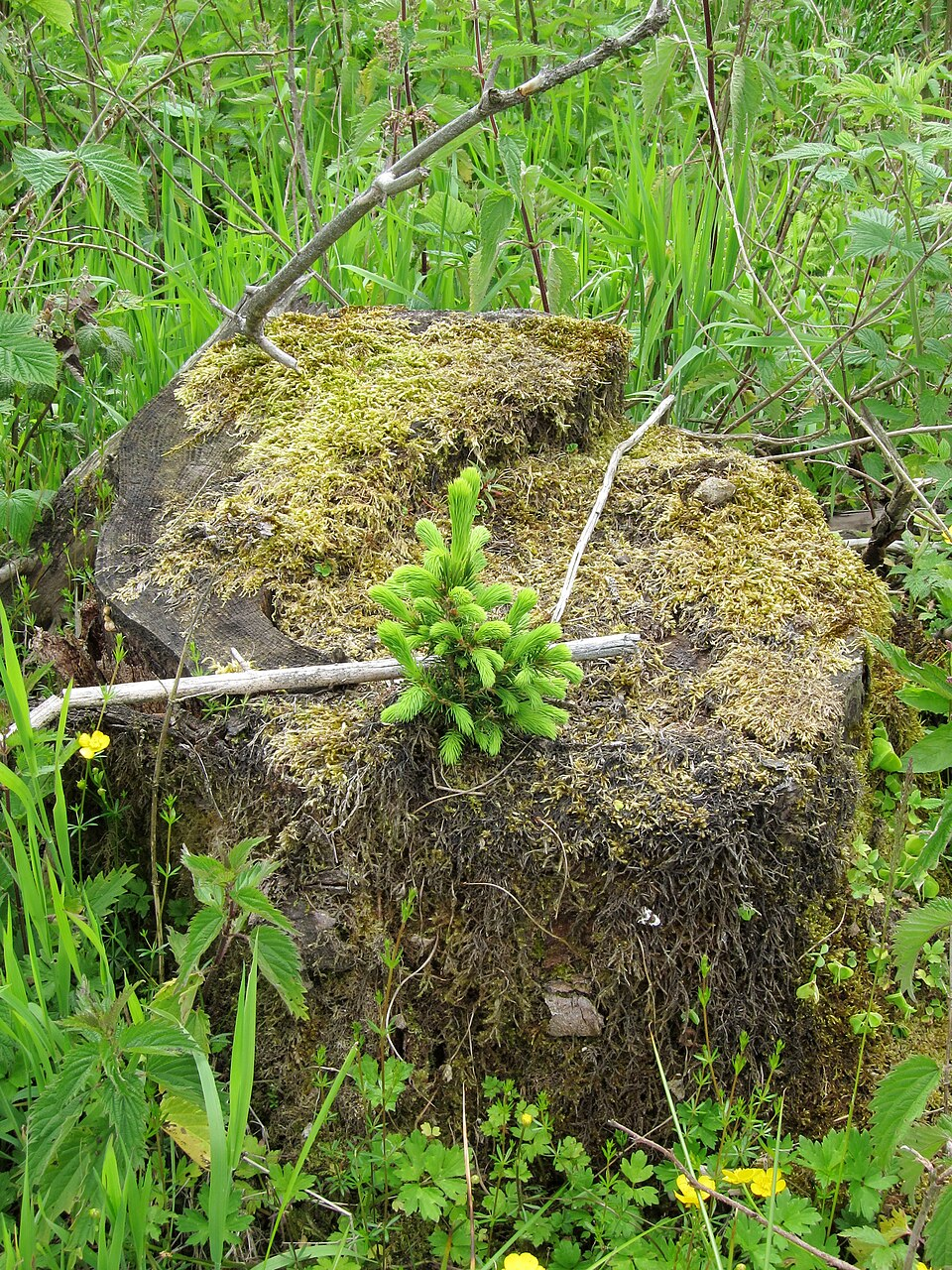
Young Norway Spruce on Stump, Image Author Neptuul, (Creative Commons Attribution 3.0 Unported, GNU Free Documentation License)
Post Traumatic Stress Disorder is today well known [1]. There is, however, a lesser known psychological condition which is equally real and equally impactful called Post Traumatic Growth [2][3][4]. This is the positive change in thinking some individuals experience following a traumatic event or life crisis like abuse.
Post Traumatic Growth does not in any way minimize or negate the agony of childhood abuse or domestic violence. Post Traumatic Stress Disorder and Post Traumatic Growth can actually co-exist.
Post Traumatic Growth, however, demonstrates that profound suffering or adversity can deepen our understanding of the world and ourselves in life altering ways.
Research by psychologists Richard Tedeschi and Lawrence Calhoun in the 1990s described 5 categories of Post Traumatic Growth:
- Recognition of new opportunities.
- Heightened empathy and the establishment of stronger relationships (not only with loved ones, but with fellow victims).
- Increased inner strength from the knowledge of having overcome tremendous hardship.
- A greater appreciation for life.
- Increased spirituality.
These shifts in perspective allow the victims of trauma or abuse to give new meaning and purpose to their lives.
Psychologists continue to debate Post Traumatic Growth. Some view it as an adaptive tool or a coping mechanism, a way for trauma survivors to put the pieces of their broken lives together again.
Christians might call it grace in action, or the work of God in the aftermath of trauma. God can heal the most grievous of wounds…or enable us to live with them (Ps. 23: 3; 2 Cor. 12: 9).
Whatever the label, Post Traumatic Growth involves not only the crisis response skills, perseverance, and resilience often associated with Post Traumatic Stress Disorder — valuable as they are — but reflection and fresh insight.
Not every abuse survivor will experience Post Traumatic Growth. But researchers estimate as many as 2/3 do. For them the positive change can last a lifetime.
“…we also glory in tribulations, knowing that tribulation produces perseverance; and perseverance, character; and character, hope” (Rom. 5: 3-4).
—
[1] Psychology Today, “The Struggles and Strengths of Trauma Disorders” by Katie Pryal, JD, PhD, 3/10/24, https://www.psychologytoday.com/us/blog/living-neurodivergence/202403/the-struggles-and-strengths-of-trauma-disorders.
[2] Wikipedia, “Post-traumatic growth”, https://en.wikipedia.org/wiki/Post-traumatic_growth.
[3] Psychology Today, “Post-Traumatic Growth” (reviewed by Lybi Ma), 5/29/26, https://www.psychologytoday.com/us/basics/post-traumatic-growth?msockid=36f5a235063367c5102cb59b07576654.
[4] PostivePsychology, “What Is Post-Traumatic Growth? (+ PTG Inventory & Scale)” by Jeremy Sutton PhD, 8/31/19, https://positivepsychology.com/post-traumatic-growth/.
Part 1 in this series was posted 10/18/26.
FOR MORE OF MY ARTICLES ON POVERTY, POLITICS, AND MATTERS OF CONSCIENCE CHECK OUT MY BLOG A LAWYER’S PRAYERS AT: https://alawyersprayers.com


