Tag Archives: alcoholism

The Rose Garden, Chapter 7 – The Snow Fort

File:Snow Fort 2009.jpg

Snow fort, Author Andrew Wiseman (CC BY-SA 3.0 Unported)

For He says to the snow, ‘Fall on the earth’; Likewise to the gentle rain and the heavy rain of His strength” (Job 37: 6).

Winter followed summer, and one year another.  With time I acquired logic and organizational skills from my grandmother.  From my grandfather, I learned to dance.

My grandfather reveled in music.  Where my grandmother’s taste ran to hymns, he enjoyed livelier music — polkas, waltzes, mazurkas, csárdáses.  I first learned to dance to these standing on the sofa, supported in Grandpa’s arms.

As I grew older, he chided me sternly to dance in a ladylike manner — “Small steps, small steps!” — something I never quite mastered.  Absorbing my grandfather’s passion for life more readily than his instructions on decorum, I was routinely swept away by the music.

Grandpa taught me the difference between pints and quarts, patiently pouring paint from one can to another for me.

Grandpa was, also, the one to part my hair on the left.  I would stand between his knees, as he carefully plied the comb.  “No, not on the right, Annalein.  Never on the right.  Hitler parted his hair on the right.”

It was my father who cut my hair.  Since it was usually kept short, I worried that strangers might mistake me for a boy.

Evenings the family would sit contentedly listening to my grandfather’s large collection of records or watching televised wrestling with him.

Sunday afternoons, we would all listen to Strauss on the radio with its rotating display of vinyl fish.  My sister and I would lie on the living room rug on these afternoons, drawing or coloring as the sun spilled through the windows.

My recollection of Grandpa is of a smiling, mustachioed man in a white cotton undershirt — a glass of beer and a box of crackers at his side. Continue reading

15 Comments

Filed under Child Abuse, Child Molestation, Christianity, Emotional Abuse, Neglect, Physical Abuse, Religion, Sexual Abuse

Psychedelics for Anxiety, Depression, and PTSD, Part 2

File:FerndalePoliceStop102415.jpg

Drug paraphernalia including marijuana/cannabis and a methamphetamine pipe, following a police stop in Ferndale, CA, Author Ferndale Police Dept., Source https://kymkemp.com
(PD per California Public Records Act)

We continue our discussion of the risks and benefits of a drug-based psychiatric approach utilizing psychedelics to treat anxiety, depression, and post-traumatic stress disorder (PTSD).

Despite growing enthusiasm for the use of psychedelics, the evidence is far from in.

LSD

Lysergic acid diethylamide (LSD) – one of the most potent hallucinogens – was studied from the 1950s to 1970s in order to assess behavioral and personality changes, as well as relief from psychiatric symptoms [1][2A].

LSD was originally used in the treatment of anxiety, depression, addiction, and psychosomatic illness.  Readers may recall that the US Army and CIA, also, experimented with LSD as a truth serum.  But most early studies were not performed to today’s standards.

Across 11 randomized-controlled studies (involving a combined total of 567 patients) positive outcomes were observed, particularly with regard to alcoholism [2B].

In rare instances, however, psychedelics such as psilocybin and LSD can evoke a lasting psychotic reaction (more frequently in patients with a family history of psychosis) [3A].  Adequate screening of a patient’s vulnerability and prior psychotic episodes before the use of LSD is, therefore, emphasized. Continue reading

6 Comments

Filed under bullying, Child Abuse, Child Molestation, domestic abuse, domestic violence, Emotional Abuse, Law, Neglect, Physical Abuse, Poverty, Rape, Sexual Abuse, Sexual Assault, Violence Against Women

Psychedelics for Anxiety, Depression, and PTSD, Part 1

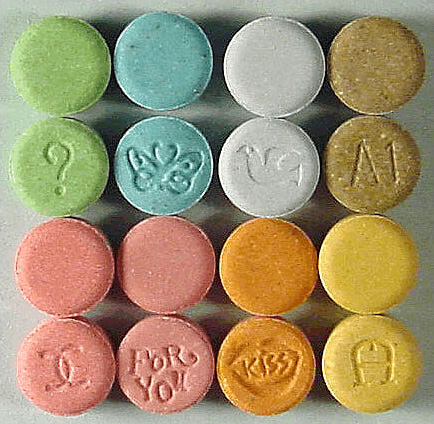
File:Ecstasy monogram.jpg

Ecstacy a/k/a Molly, Author DEA, Source https://www.dea.gov, (PD as work product of federal govt.)

“I am more convinced than ever that psychiatric medications, over the long term, cause net harm.  I wish that weren’t the case, but the evidence just keeps mounting that these drugs, on the whole, worsen long-term outcomes…The inventor of frontal lobotomy…was awarded a Nobel Prize for inventing that surgery, which today we understand as a mutilation.”

-Award-winning science author and journalist, Robert Whitaker [1][2]

Recently, a number of drug trials have been conducted re-assessing the effectiveness of psychedelics for anxiety, depression, and post-traumatic stress disorder (PTSD).

While the results of these trials have been heralded as providing new treatment options for tenacious illnesses, there are serious dangers associated with psychedelics.

Serotonin

Psychedelics act on receptors in the brain for serotonin, a neurotransmitter that effects mood.

There is some thinking that psychedelics enhance the brain’s capacity to form and reorganize synaptic connections, especially following injury [3A].  But this hypothesis needs further research.

In the therapeutic setting, psychedelics cause a receptive, dream-like state during which memories are readily accessible [3B].  The theory is that this state opens the door to fresh ideas the therapist can introduce.

Unsupervised use is not recommended. Continue reading

5 Comments

Filed under Child Abuse, Child Molestation, domestic abuse, domestic violence, Emotional Abuse, Neglect, Physical Abuse, Sexual Abuse, Violence Against Women

“13 Characteristics of Adult Children of Alcoholics” by Buddy T and Dr. Steven Gans

traits of children of alcoholics

Illustration by JR Bee, Verywell

The following is excerpted from “13 Characteristics of Adult Children of Alcoholics” on VeryWellMind.  The full article may be found at:  https://www.verywellmind.com/common-traits-of-adult-children-of-alcoholics-66557.

“If you grew up in an alcoholic home, you’re probably familiar with the feeling of never knowing what to expect from one day to the next.  When one or both parents struggle with addiction, the home environment is predictably unpredictable.  Argument, inconsistency, unreliability, and chaos tend to run rampant…

Continue reading

9 Comments

Filed under Child Abuse, Child Molestation, Emotional Abuse, Neglect, Physical Abuse, Sexual Abuse

In the Aftermath of Abuse, Part 2 – Guilt and Shame

Crying child, Author Asad Amjad ChangEzi (CC BY-SA 4.0 International)

‘If anyone causes one of these little ones—those who believe in Me—to stumble, it would be better for them to have a large millstone hung around their neck and to be drowned in the depths of the sea’ ” (Matt. 18: 6).

It is easier for children to believe they “deserve” the evil done to them, than to take in the fact an adult who should care for them actually has little or no regard for their well-being.

The Statute of Limitations and other obstacles can make it difficult to hold child abusers and molesters accountable legally.  Even with a conviction, however, the feeling of “sinfulness” may rebound from an abuser to his victims.

This in no way implies that they were at fault.  Victims, however, relive the trauma of having been treated as worthless. They are often left with a vague sense of unworthiness that can permeate their lives, and undermine subsequent relationships.

Though this feeling of their own “sinfulness” can be overwhelming to abuse victims, the conclusions they draw from it are not accurate.  Victims did not warrant or invite the abuse.  They remain deserving of love.

The feeling of “sinfulness” is just one of the scars left in the wake of abuse.  Other symptoms can include anxiety, depression, alcohol or drug addiction, eating disorders, and sexual dysfunction.  These behaviors either stem from the pain or are attempts to numb it.  All of them “punish” the victim, who was never at fault in the first place!

The symptoms of abuse may, themselves, become a cause of shame to victims.  Self-destructive behaviors shift the focus away from the abuse, while silently declaring it to the world.  Imperfect as coping mechanisms, these behaviors can have dire consequences but are, in effect, a cry for help.

Originally posted 7/7/13

Of NoteA Vatican tribunal has found Archbishop Anthony Apuron of Guam guilty of abusing minors and removed him from office.  Apuron was suspended in June 2016 following accusations that he sexually abused altar boys as a parish priest during the 1970s.

Thus far, the Archdiocese of Guam has been named in 159 sex abuse lawsuits involving Apuron and others.

FOR MORE OF MY ARTICLES ON POVERTY, POLITICS, AND MATTERS OF CONSCIENCE CHECK OUT MY BLOG A LAWYER’S PRAYERS AT:  https://alawyersprayers.com

12 Comments

Filed under Child Abuse, Child Molestation, Emotional Abuse, Neglect, Physical Abuse, Sexual Abuse

In the Aftermath of Abuse, Part 2 – Guilt and Shame

Sexually abused child (1910), Author Dr. P. Langenscheidt, Source “Der Sexualverbrecher” [“The Sexual Criminal”], (PD, published before 1/1/23)

‘If anyone causes one of these little ones—those who believe in Me—to stumble, it would be better for them to have a large millstone hung around their neck and to be drowned in the depths of the sea’ ” (Matt. 18: 6).

It is easier for children to believe they “deserve” the evil done to them, than to take in the fact an adult who should care for them actually has little or no regard for their well-being.

The Statute of Limitations and other obstacles can make it difficult to hold child abusers and molesters accountable legally.  Even with a conviction, however, the feeling of “sinfulness” may rebound from an abuser to his victims.

This in no way implies that they were at fault. Victims, however, relive the trauma of having been treated as worthless. They are often left with a vague sense of unworthiness that can permeate their lives, and undermine subsequent relationships.

Though this feeling of their own “sinfulness” can be overwhelming to abuse victims, the conclusions they draw from it are not accurate.  Victims did not warrant or invite the abuse.  They remain deserving of love.

The feeling of “sinfulness” is just one of the scars left in the wake of abuse.  Other symptoms can include anxiety, depression, alcohol or drug addiction, eating disorders, and sexual dysfunction.  These behaviors either stem from the pain or are attempts to numb it.  All of them “punish” the victim, who was never at fault in the first place!

The symptoms of abuse may, themselves, become a cause of shame to victims.  Self-destructive behaviors shift the focus away from the abuse, while silently declaring it to the world.  Imperfect as coping mechanisms, these behaviors can have dire consequences but are, in effect, a cry for help.

FOR MORE OF MY ARTICLES ON POVERTY, POLITICS, AND MATTERS OF CONSCIENCE CHECK OUT MY BLOG A LAWYER’S PRAYERS AT:  https://alawyersprayers.com

6 Comments

Filed under Child Abuse, Child Molestation, Emotional Abuse, Neglect, Physical Abuse, Sexual Abuse