
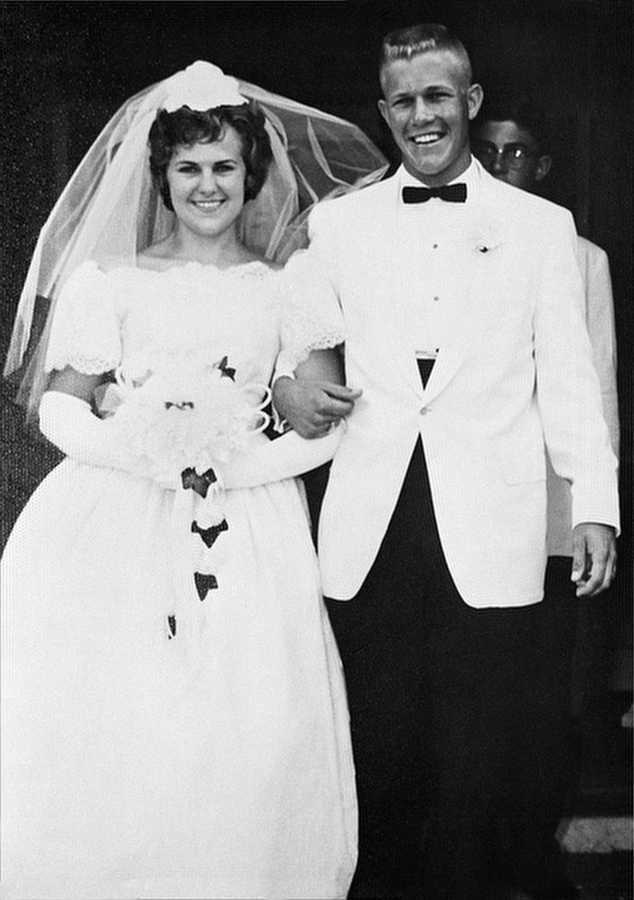
Wedding photo of Charles and Kathleen Whitman (1962), Source eBay, Author unknown (Public Domain).
The Bible describes marital fidelity as a sacred commitment involving love, respect, and faithfulness between spouses [1].
A Divine Covenant
The Bible views marriage as a divinely instituted covenant where a husband and wife become “one flesh” (Gen. 2: 24) [2]. Fidelity is central to this covenant, so sexual immorality or adultery is explicitly condemned (Heb. 13: 4). The Seventh Commandment, of course, forbids adultery (Ex. 20: 14).
A Loving Bond
However, marital fidelity extends beyond avoiding adultery. It encompasses honesty, loyalty, and a deep respect. The Bible instructs husbands to love their wives as Christ loves His church (Eph. 5:25), and wives to respect their husbands (Eph. 5: 33). Such love is not just a feeling, but an unwavering bond [3].
Sexual Fulfillment
Surprisingly, the Bible specifically addresses sexual fidelity within marriage, emphasizing that spouses should fulfill each other’s conjugal rights to prevent temptation and maintain intimacy (1 Cor. 7: 3-5). Lustful intent constitutes adultery in the heart (Matt. 5: 28).
Sexual Revolution
We may today think this old fashioned.
After all, the sexual revolution of the 1960s changed attitudes and behavior related to sexuality throughout the Western World [4]. Nearly 2 in 5 children in the United States – some 1 million children – are now born out of wedlock each year [5A][6]. More than 2 in 3 Black children are born outside marriage [7]. This is part of a global trend, with out of wedlock births exceeding 50% in many countries [5B].
Poverty and Out of Wedlock Births
Unfortunately, research consistently shows that children born out of wedlock face poverty risks approximately 5 times higher than those born to married parents [8]. This is because single parents often have lower household incomes, fewer resources, and less access to economic stability.
Studies find that never-married mothers work less outside the home, earn less when they do work outside the home, and experience slower income growth compared to married or divorced mothers [9]. This limits their ability to lift their children out of poverty.
Growing up in poverty can have a profound and lasting impact on children’s self-esteem [10]. Children living in poverty often face stressors like chronic food insecurity, unstable housing, and limited access to healthcare, all of which can ultimately lead to anxiety, depression, and behavioral issues [11].
Modeling
Moreover, children raised in single parent households do not see fidelity modeled. They do not see women treated with respect, hence the term “baby mamas” for unmarried mothers who no longer have even the status of girlfriends. It is not a great leap to domestic violence.
Abuse Risk
Studies show that children in single-parent households are at greater risk of abuse and neglect as compared to those living with married biological parents, and at greater risk of witnessing domestic violence [12][13].
History
There may be still another lesson to be drawn here.
The ethnologist and social anthropologist JD Unwin found a correlation between marital fidelity and cultural achievement across the 80 tribes and 6 major civilizations he studied, covering a period of 5000 years [14]. The people groups who became increasingly liberal toward sexual morality eventually vanished.
Having embraced so called “sexual freedom” in the name of progress, we may well have doomed ourselves to the ash heap of history, regardless of our technological achievements.
—
[1] OpenBible, “Marital Fidelity”, https://www.openbible.info/topics/marital_fidelity.
[2] BibleHub, “The Seriousness of Marital Fidelity”, https://biblehub.com/topical/t/the_seriousness_of_marital_fidelity.htm.
[3] BibleRepository, “35 Important Bible Verses about Fidelity to Relationships (Explained)” by “Pastor David”, 5/12/26, https://biblerepository.com/bible-verses-about-fidelity-to-relationships/.
[4] Wikpedia, “Sexual revolution”, https://en.wikipedia.org/wiki/Sexual_revolution#:~:text=The%20sexual%20revolution%2C%20also%20known%20as%20the%20sexual,late%201950s%20to%20the%20early%201970s.%20%5B1%5D%20.
[5A and 5B] World Population Review, “Out of Wedlock Births by Country 2026”, https://worldpopulationreview.com/country-rankings/out-of-wedlock-births-by-country.
[6] Institute for Family Studies, “America’s Unmarried Birth Rate Puts 1 Million Kids at Risk A Year” by Nicholas Zill, 6/3/26, https://ifstudies.org/blog/americas-unmarried-birth-rate-puts-1-million-kids-at-risk-a-year.
[7] World Data, “Unmarried Birthrate by Race in US: Statistics and Facts”, 10/29/25, https://theworlddata.com/unmarried-birth-rate-by-race/.
[8] American Enterprise Institute (AEI), “Dynamics of Families after a Non-Marital Birth” by Angela Rachidi, 1/8/24, https://www.aei.org/research-products/report/dynamics-of-families-after-a-nonmarital-birth/.
[9] Institute for Family Studies, “The Poverty of Single Mothers Is Persistent” by Nicholas Wolfinger and Matthew McKeever, 5/6/25, https://ifstudies.org/blog/the-poverty-of-single-mothers-is-persistent.
[10] Academia, “Recognition, Poverty and Self-Respect” by Jonathan Seglow, 7/21/20, https://www.academia.edu/67998406/Recognition_Poverty_and_Self_Respect.
[11] PS 169 Baychester Academy, “How poverty influences social-emotional learning” by “Rick”, 8/26/24, https://baychesteracademy.org/how-poverty-influences-social-emotional-learning/.
[12] Hope 4 Hurting Kids, “Risks of Child Abuse and Neglect Based on Family Structure” (adapted from an article originally published on Divorce Ministry 4 Kids 9/28/11), https://hope4hurtingkids.com/trauma-tragedy/abuse/risks-of-child-abuse-and-neglect-based-on-family-structure/.
[13] Institute for Family Studies, “Kids of Single Parents More Likely to Witness Domestic Violence” by Nicholas Zill, 1/6/15, https://ifstudies.org/blog/children-in-single-parent-families-are-more-likely-to-witness-domestic-violence/.
[14] Wikipedia, “JD Unwin”, https://en.wikipedia.org/wiki/J._D._Unwin.
FOR MORE OF MY ARTICLES ON POVERTY, POLITICS, AND MATTERS OF CONSCIENCE CHECK OUT MY BLOG A LAWYER’S PRAYERS AT: https://alawyersprayers.com


Now this is an issue that doesn’t get talked about near enough in our era. I fear that this is one of those subjects where the further you get from the idea of marriage as a lifelong covenant, the harder it is to explain why fidelity matters in the first place. I pray we are not beyond the point of no return because, as you mention, there are very real Biblical and practical consequences when that commitment breaks down. Well said, Anna!
Thank you, Scott.
Thank you for this information Anna. One could almost make the case that God’s plan for the family was right all along. 😊
🙂
This is very well said from another old fashion.
Many thanks.
In Australia the cost of living and housing crisis are putting many married couples under increasing pressure. It is left to the charities to help those that have fallen into poverty.
That’s terrible. I had not heard.
Yes, and the number of homeless is increasing. Little hope for improvement at this stage 😔
Growing up in a mainline Protestant denomination, I remember the easy acceptance of abortion and sex before marriage. Though not flaunted. it was never spoken against from the pulpit and so silence became complicity.
We have fallen so far from biblical principles, that it seems anachronistic today to condemn premarital sex or speak of marital fidelity. Yet God placed restrictions around sexual behavior for our own good. They are actually safeguards.
Apart from being an expression of basic respect for one’s partner, marital fidelity has always served a practical protective purpose. Sexually transmitted infections cannot usually be recognised from outward appearance alone; many produce no obvious symptoms, even today. Through infidelity, a person may therefore endanger not only themselves but—far worse—their unsuspecting partner.
Infidelity exists and, I suppose, always will. For the reasons above, I believe that once disloyalty is discovered, swift separation may be justified—not merely because trust has been broken, but because the faithful partner’s health has been placed at risk without their knowledge or consent.
I have also noticed that many people fail to ask themselves one simple question before marrying: “What good can I bring into the life of the person I wish to marry?” Merely asking it honestly might prevent many future disasters.
You speak as an honorable and caring man, and make an excellent point about sexually transmitted disease. Sadly, not everyone has the same concern for their partner’s health or emotional well being.
I have learnt that life is a complicated thing. I have known couples in which both partners were decent and honest people, yet so painfully incompatible that their marriages eventually fell apart. I have also witnessed partnerships that endured for more than forty years—forty years of abusive hell. Longevity alone proves very little.
As for my own marriage, I feel no desire to seek another partner. My brother once observed, however, that my loyalty has never been truly tested, largely because of my timidity and incompetence when it comes to approaching women. Perhaps he has a point. My earlier relationships certainly exposed these limitations: women with whom I had no established bond tended to strike me as cold, intimidating or, at the opposite extreme, rather infantile. Whatever virtue my fidelity possesses, opportunity has rarely tried very hard to corrupt it.
You are certainly right that life is complicated. There are good marriages and bad ones, just as you say. Obviously your wife does not view you as cold, intimidating, or infantile. Be grateful that neither of you has been tested beyond your limits.
I’m happy Anna : Though my happiness is at time stained by my life-long fear of failing them. But I’m sure, should the day come, I’ll double down on my efforts.
You are a fine man, Hubert. It is a pleasure to know you. I doubt there is much chance that you will fail your loved ones in any way.
I should add that my post was not meant as a judgment on human frailty. It was an expression of regret that the very concept of fidelity is being lost.
It’s my pleasure to know you. I hold your photo with books right next that of my grand-uncle 🙂
Don’t worry, I don’t think of you as judgmental person. I believe, firmly so, that all your articles have resulted from your analytical ability, augmented by your life’s experience.
That means a great deal to me, Hubert. Your kindness exceeds even your exceptional intellect. Whatever we may have been through in life, we must strive to make this world a better place.