
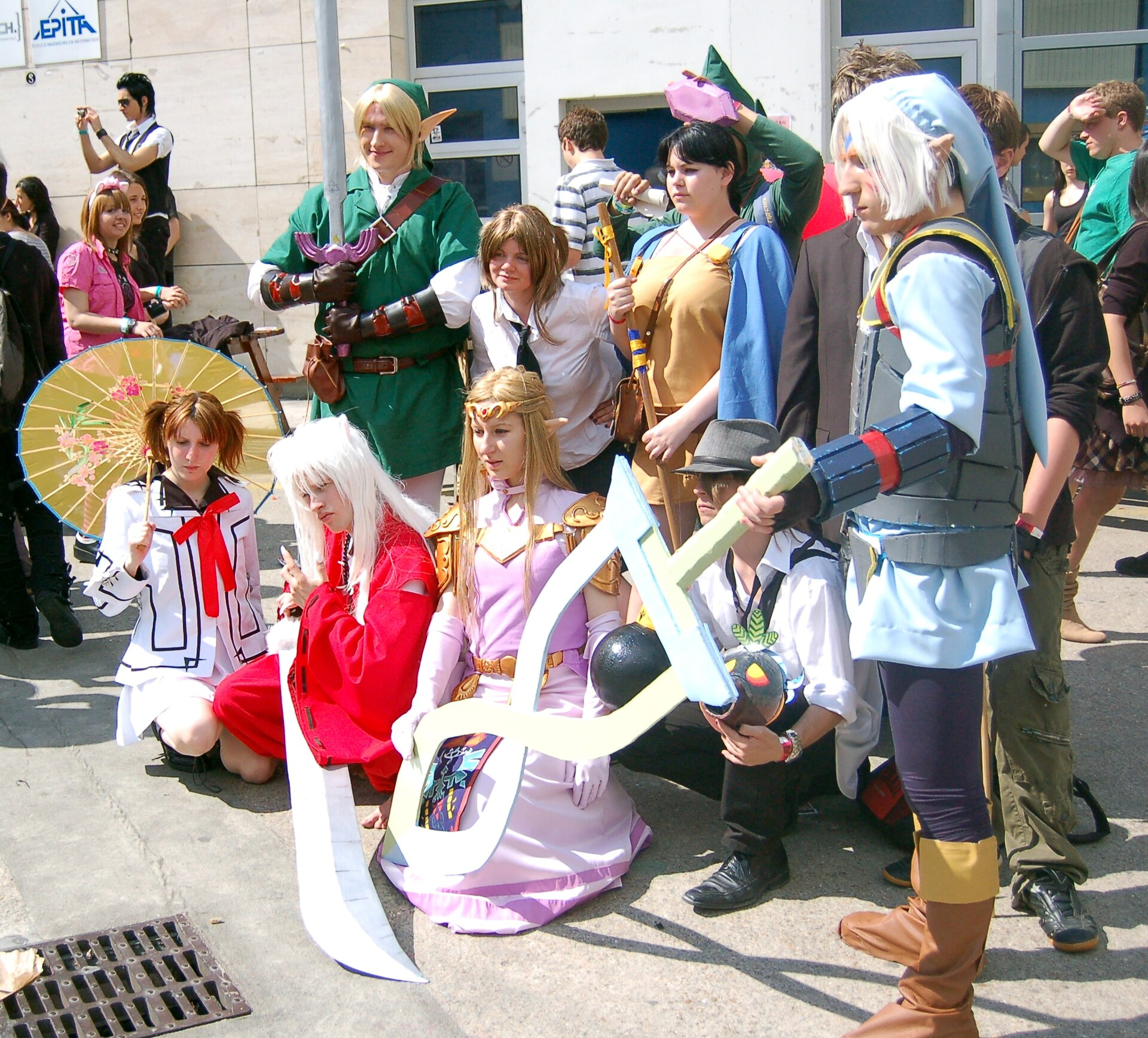
Cosplay Convention, Image Author KoS (CC Attribution-Share Alike 3.0 Unported, 2.5 Generic, 2.0 Generic, 1.0 Generic, GNU Free Documentation License)
There is a world of which most of us are unaware. On the surface, this world may seem innocent; may seem a children’s game of fantasy, of dress up and role play, in which adults engage. But there is a sinister aspect. This is the world of cosplay [1].
Escapism and Fame
Cosplay, in simplest terms, is the practice of dressing up as a favorite character from a movie, comic book, or video game. It is a world populated by many who are nerds, lonely, bullied, seeking to escape their lives…or seeking fame.
Costume Cost
Cosplayers invest a great deal of time, attention, and expense in the effort to portray their characters accurately. The cost of a costume can vary between $50 and $5000 or more, depending on the design, materials used, and craftsmanship [2A].
On average, cosplayers spend 40 hours building an individual costume, but may spend months learning to sew, style wigs, or craft foam into armor [2B].
Global Market
The results are shared at conventions and online [3][4].
Multi-genre conventions may range from Anime, Sci-Fi, Comics, and Gaming to Furry, Horror, Steampunk, and Post-Apocalyptic [5A]. Show specific conventions focus on particular shows such as My Little Pony, Power Rangers, or Doctor Who [5B]. Comic Con International in San Diego and Anime Expo in Los Angeles are two well known examples.
These are not amateur ventures. The global cosplay market is expected to reach $23 billion by 2030 [6].
Monetization
Individuals can monetize their efforts in a variety of ways: by making costumes, props, and accessories for others; by merchandising their own designs; by offering workshops; by hosting Live Action Role Play (LARP) events; or by creating online content featuring the characters they portray [7].
Not surprisingly, sexualized content draws the highest paying subscribers online [8A].
Dark Fantasies
“Characters once designed to be feared, hated, or opposed are now among the most photographed and celebrated figures in cosplay culture [9A].”
This is where dark fantasies come into play. Villains are portrayed at least as often as heroes or heroines [9B][10]. Characters like Sebastian Michaelis (Black Butler), Ryomen Sukuna (Jujutsu Kaisen), Sephiroth (Final Fantasy VII), and Muzan (Demon Slayer) are among the most photographed [9C].
Online content can be highly disturbing [8B]. And cosplayers who remain in character may become lost in their own fantasies.
Empowerment
For those who have been shattered by some form of abuse, cosplay may afford an escape from reality; welcome, if brief, relief from their pain.
Cosplay may – at least temporarily – assist with low self-esteem. Creative expression is good for the soul [1A]. The emotional and psychological shift can make a cosplayer feel invincible [11B][12A].
Conventions are filled with ready-made friends, or so it seems [11C][12B]. And the association with a villain can feel empowering, allowing the release of long repressed anger.
But the allure of that fantasy world may be more powerful than empowering.
Crossing A Line
In 2021, Helen Hastings, 18 y.o., was shot in the head by her friend and fellow cosplayer, Mary Anne Oliver-Snow a/k/a Yandere Freak [8C][13][14].
Although the shooting was an apparent accident, Snow’s portrayals of her cosplay character had become increasingly violent. She spent days in character, on screen and off, appearing as a harmless Anime child who gleefully murders her friends.
Was a line between fantasy and reality crossed here? The temptation was certainly there. And the danger remains for those who may be vulnerable to it.
—
[1] Wikipedia, “Cosplay”, https://en.wikipedia.org/wiki/Cosplay.
[2A and 2B] Gank, “How Much Are Cosplay Costumes: The Genuine Cosplaying Budget”, 10/17/22, https://ganknow.com/blog/how-much-are-cosplay-costumes/.
[3] Cosplay Convention Center, “Your Convention Season Starts Here”, https://www.cosplayconventioncenter.com/.
[4] FanCons, “Convention Schedule”, https://fancons.com/events/.
[5A and 5B] https://popculthq.com/cosplay-convention-list/.
[6] Business Calculators by Bigger Bottom Line, “How to Start a Cosplay LARP Business: Funding Guide”, 8/22/25, https://business-calculators.com/how-to-start-a-cosplay-larp-business-funding-guide/.
[7] Starter Story, “20 Business Ideas for Cosplayers [2026] by Pat Walls, 9/27/24, https://www.starterstory.com/business-ideas-for-i-cosplayer.
[8A, 8B, and 8C] Investigation Discovery, Lethally Blonde, “Snow the Salt Queen Had 1.6 Million Followers”, https://www.bing.com/videos/riverview/relatedvideo?q=lethally+blonde+oliver+snow&pc=GD06&ptag=29417&source=chrome.ob&ru=%2fsearch%3fq%3dlethally%2bblonde%2boliver%2bsnow%26pc%3dGD06%26form%3dGDNSBR%26ptag%3d29417%26source%3dchrome.ob&mmscn=vwrc&mid=A0BC3CA5D8490B6FE7F8A0BC3CA5D8490B6FE7F8&FORM=WRVORC&ntb=1&msockid=e2c3f3f76ca511f1af4b4875ee42ec0f
[9A, 9B, and 9C] Cosplay Real, “Why Villains Are Becoming More Popular Than Heroes in 2026”, 6/13/26, https://www.cosplayreal.com/blogs/anime-exhibition/why-villains-are-becoming-more-popular-than-heroes-in-cosplay-2026.
[10] Victims and Villains, “Cosplay: Heroes vs. Villains” by Dani Arii, 2/12/22, https://www.victimsandvillains.net/reviews/cosplay-heroes-and-villains.
[11A, 11B, and 11C] Inthastyle, “Is Cosplay Good for Mental Health?”, 4/24/25, https://www.inthaverse.com/articles/cosplay-mental-health-benefits-fantasy-costume/.
[12A and 12B] Cityscape Counseling, “How Cosplay Is Used to Improve Mental Health”, https://www.cityscapecounseling.com/post/how-cosplay-is-used-therapeutically-to-improve-mental-health-2/.
[13] Rolling Stone, “They Were Close Friends and Cosplay Stars Then Snow Killed Helen” by EJ Dickson, 10/21/21, https://www.rollingstone.com/culture/culture-features/cosplay-tiktok-manslaughter-yandere-snow-helen-hastings-1234452/.
[14] Y!Entertainment, “A TikTok influencer charged in the fatal shooting of their friend deleted their accounts a year after the incident” by Kieran Press-Reynolds, 11/2/21, https://www.yahoo.com/entertainment/tiktok-cosplay-influencer-charged-fatal-143935792.html?guccounter=1&guce_referrer=aHR0cHM6Ly93d3cuYmluZy5jb20v&guce_referrer_sig=AQAAAMKX_RBPPz08VUP8RVueu-vujUMljCsjhDgcMWmRhDb6gCRmhegFTmZrkLeCPZDtJ3ngyJ4GBEl3pfU8vZp1H64bgGMwTpla7toApxleTC1GNkSBpIW7-WStuo8Wz2eR7GgL-XoGGddao62kPHARW6tWWWr4Jdrt4P_KurUU2h_7.
FOR MORE OF MY ARTICLES ON POVERTY, POLITICS, AND MATTERS OF CONSCIENCE CHECK OUT MY BLOG A LAWYER’S PRAYERS AT: https://alawyersprayers.com


Interesting to say the least, Anna. Personally, I have never heard of the majority of the characters you mentioned, but one question comes to mind which is why do grown adults feel the need to spend so much time and money on what is essentially role play? Is this an escape mechanism from their awful reality or is something more sinister at work here? Either way, this one gets filed away in the “I don’t get it” basket.
Wondering to know Anna!
I knew almost nothing about the cosplay world beyond the basic idea of dressing up as fictional characters, so this was largely new to me. The question of when harmless escapism morphs into something unhealthy is an interesting one. I don’t know that there’s an easy answer, but that final story certainly demonstrates how dark things can become when the line between fantasy and reality gets blurred.
A most informative post. I walk past the fantasy genre shelves in the library without a thought and without realising the profound influence on individuals. Thanks Anna.
It was new to me, also, Ravishank.
It’s a popular activity but it seems to tend towards a decidedly unhealthy obsession for some.
I suppose my sons could be counted as cosplayers too, as they are deeply interested in medieval chivalry. This probably results from a combination of books, television, cinema and video games—perhaps reinforced by their mother being a kendo enthusiast.
I am less certain whether their low self-esteem plays any part in it. Their interest may simply be a healthy outlet for imagination, but perhaps I should mention it to their psychoanalyst. He may be better able to judge whether there is any underlying issue worth addressing early, if necessary.
Fantasy by itself is not inherently harmful. It sparks creativity. I did not mean to suggestion otherwise. The creations of Walt Disney are an example. The science fiction stories you write are another.
From everything you’ve said, your boys sound lively, intelligent, healthy, and whole.
Some adults though engage in dark fantasies about cruelty and violence. And those who have experienced trauma may succumb to such fantasies, finding them more alluring than reality.
My opinion, Anna, is that escapism in general can be both medicine and poison. It can give us shelter from the wounds of the real world and perhaps even help them heal, but taken too far, it can also erode our judgment and gradually distort our perception of reality.
After all, a dreamer is sovereign within his own imagination. Whatever darkness or unresolved conflicts the mind carries can therefore find their way into the worlds it creates, where there may be little external resistance to restrain them. Cosplay can take this one step further by giving those imagined worlds flesh and muscle—bringing fantasy into physical reality. Usually that is harmless play, but when the boundary between imagination and judgment begins to weaken, I think some caution is warranted.
—
As a father, I’m struggling with this myself at the moment. My eldest seems to use almost every game, including rather expensive ones, to seek out the roles of royalty, rulers, or people in command. I’m trying to teach him humility, but humility is one of those virtues that cannot simply be imposed by force.
The middle one, meanwhile, seems to follow very much in his elder brother’s wake. What troubles me most, however, is something more fundamental: I feel that I’m failing at one of the basic elements of family life—cohesion among siblings. Our youngest admires and adores his elder brothers, while they, sadly, can be rather dismissive of him.
At present, I have neither a conclusive analysis of what is happening nor a workable strategy for repairing this invisible crack in the fabric of our family. Perhaps, with time and careful observation, a way forward will present itself. For now, I can only keep watching, thinking, and trying not to make matters worse by forcing a solution before I understand the problem.
I agree completely w/ you about fantasy — its benefits and drawbacks.
As for parenting, you are clearly a good father, Hubert. You are not failing. The fact you are aware of and concerned about these issues reflects your love for your boys, and your involvement in their lives. You can encourage cohesion among the boys, but can’t force it. That would only produce resentment.
I have a few thoughts.
I am certain you already model humility for your children. I cannot imagine that you are haughty or imperious w/ them. Just the opposite, I’m sure.
Your oldest sounds as if he has leadership potential. But your son needs to learn that leadership is not a mere matter of dominance and scepter waving.
Christ taught that those who lead must serve. Christ was the perfect example. Perhaps you and your oldest could discuss why Christ washed the feet of the Apostles at the Last Supper. Get him a book about the qualities of Christian leadership.
Empathy and gratitude are, also, elements of humility.
Help your son realize that the status of human beings does not determine their value in God’s eyes.
Talk w/ him about the fact those who are wealthy or celebrities are not more “valuable” than working men and women, and those endowed w/ the kind of keen intelligence he has are not more significant than those less endowed.
Hearing you say that rulers are not more important those they rule will stay w/ him, though it may not immediately alter his behavior.
Point out that only those w/ a large but fragile ego are boastful. Those w/ a strong ego do not need to dominate others or boast about their attributes and achievements.
As for gratitude, help him recognize the extent to which others make his own success and happiness possible.
It was God who gave your son his gifts; he did nothing to earn them. You and his mother work hard to provide him food, shelter, and all the attributes of a loving home. There are many children who do not have as much. He is able to ride a bike, attend school, take vacations, etc. There are many children who do not have such privileges or opportunities.
Perhaps you and he could visit a children’s hospital or volunteer for the needy in some capacity.
As for exclusion of the youngest, first validate his feelings.
Then talk w/ all 3 boys about how it feels to be excluded, for example from a clique or club at school. Maybe you can share an example about exclusion from your own life.
Next, work out w/ them a family rule all 3 can agree on about including your youngest. Some activities may be too rough or dangerous for him. Other times all 3 boys may be able to take turns.
Be sure and monitor afterwards that the boys adhere to the rule. If you meet resistance from the older boys, explain calmly but firmly that exclusion is hurtful and unfair to your youngest.
Depending on the age differences among the boys, it may helpful if your youngest makes friends his own age. He can then develop skills at his own pace (and the confidence that brings) w/o needing to catch up to and compete w/ his older and more mature brothers.
Help your youngest to understand that his value is not dependent on inclusion in the activities of his older brothers. In all likelihood, he will eventually develop skills and interests entirely different from theirs, in any case.
These are just suggestions. Obviously your wife would be the best one to discuss all this w/. You two will manage to work it out. I have no doubt.
Thank you, Anna, for your valuable and carefully thought-out advice. To me, it is pure gold, and I intend to work through every point you have raised.
Your advice has also revealed what may be a fundamental flaw in my recent parenting strategy, particularly in my attempts to heal the exclusion of our youngest by his elder brothers. Your suggestion that I should instead help him find friends of his own age, develop his own skills and personality, and build self-respect through his own efforts seems far wiser than my attempts to force greater cohesion among the three boys.
As you pointed out—and I believe correctly—once our youngest develops his own interests, abilities, friendships, and confidence, there is a much better chance that his brothers will come to respect him naturally. More importantly, any closeness that develops between them would then arise from mutual affection rather than parental pressure.
Admittedly, much of this has now been placed in God’s hands. I can provide guidance, opportunities, and encouragement, but I cannot manufacture affection or brotherhood by decree. Some things must be allowed the time and space to grow on their own.