
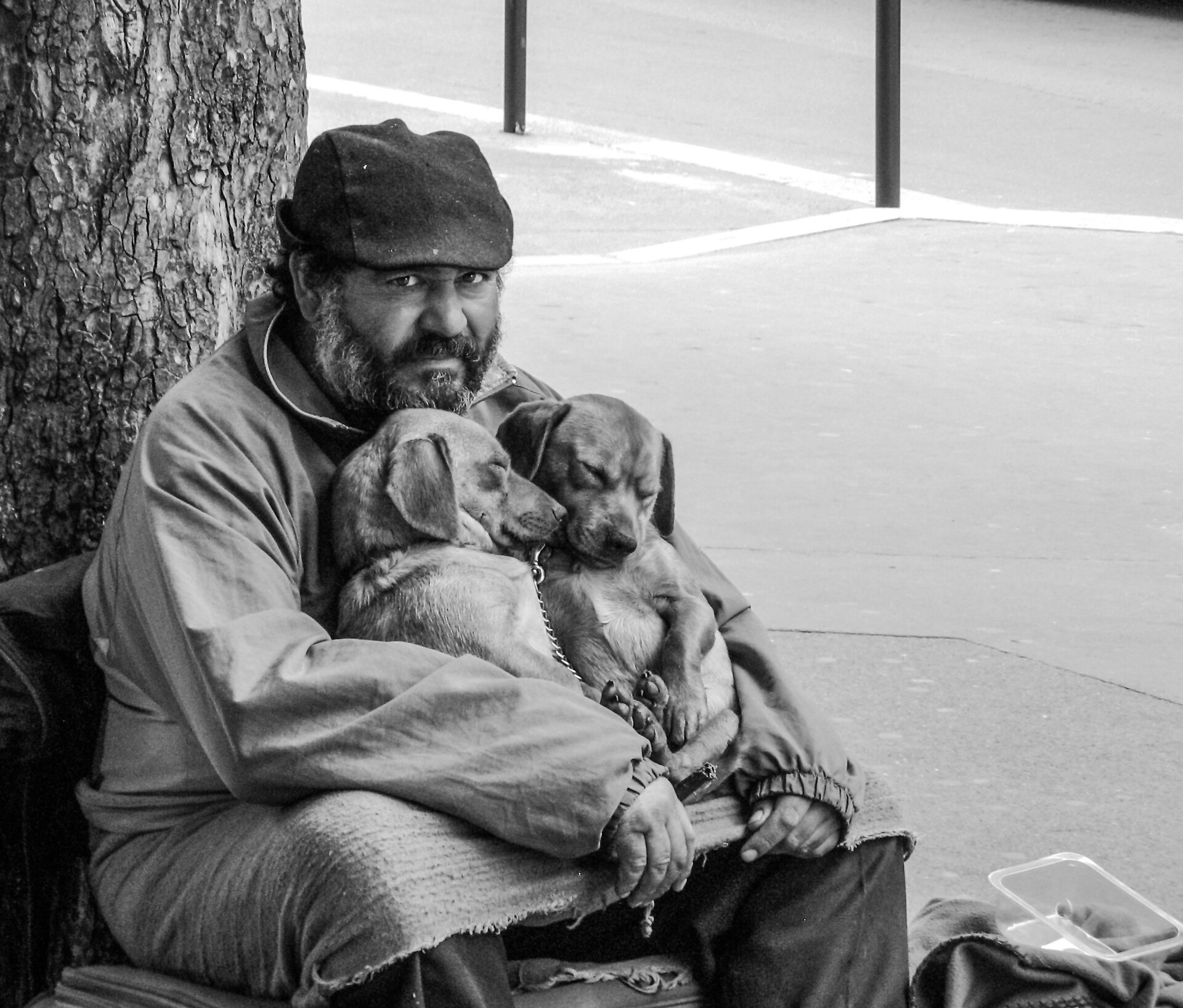
Unknown homeless man, Author Magdalena Roeseler, (Creative Commons Attribution 3.0 Unported)
We tend to shun the homeless. We may pity them, may even refer to them using the politically correct term “unhoused individuals” which supposedly preserves their dignity while doing nothing to improve their condition.
But we are likely to feel disgusted or threatened by them, at the same time.
Admittedly, a majority of the homeless do suffer from mental illness and/or addiction [1]. Yet research has consistently shown that there is strong correlation between childhood abuse and later homelessness [2].
And it should not be overlooked that approximately 1/3 of the homeless are families with children (85% of them single mothers) — some 259,473 men, women, and children among the estimated 770,00 homeless in the United States [7].
There is a link not just to child abuse, but to domestic violence here. Over 92% of homeless mothers with children have experienced severe physical and/or sexual violence during their lifetimes [8]. Moreover, 38% of all domestic violence victims become homeless at some point in their lives [9].
Adverse Childhood Experiences (ACEs)
The highly respected Adverse Childhood Experiences framework — widely used in public health, medicine, education, and social services — arose from a landmark study by the Centers for Disease Control and Kaiser Permanente in the 1990s [3A].
Over 17,000 participants were asked about adverse childhood experiences in three categories: abuse (emotional, physical or sexual); neglect (emotional or physical); and household dysfunction (parental mental illness, parental substance abuse, domestic violence, parental separation or divorce, and parental incarceration).
Among the homeless, 89.8% reported having had 1 or more adverse childhood experiences, and 53.9% reported having had 4 or more [4A]. In the general population, 38-39% reported having had 1 adverse childhood experience, while 3-5% reported having had 4 or more [4B].
Impact of Childhood Trauma
Childhood trauma creates vulnerabilities that may compound with time [3B]:
- Childhood trauma alters brain structure and function, making it more difficult to manage emotions, and reach sound decisions. This has the potential to undermine stable housing and employment, as an adult.
- Childhood trauma damages children’s trust and disrupts the support systems they need to thrive, interfering with their ability to form healthy relationships. Chaos is normalized. Self-sabotage becomes an unconscious life strategy. This can result in unstable adult relationships and attraction to abusive partners. Social isolation can be a maladaptive means of self-protection, leading to avoidance of services like schools, job programs, or shelters that could be of help.
- Childhood trauma increases the risk of mental illness which, also, has the potential to undermine stable housing and employment. Those with over 4 adverse childhood experiences are at 4.6 times the risk of depression, and 12 times the risk of suicide, compared with the general population.
- Childhood trauma greatly increases the risk of alcoholism and drug addiction. Those with over 4 adverse childhood experience are at over 7 times the risk of alcoholism, and over 10 times the risk of intravenous drug use. Self-medication becomes addiction.
Foster Care
Not only do the children placed in foster care all too often experience further trauma there, but aging out of foster care puts them at extraordinary risk of homelessness. They simply have no support system. Between 20-25% of those aging out of foster care are homeless within 4 years; over 50% are homeless by age 26 [3C].
Runaways
This does not take into account the young people who run away from unsafe homes where violence or sexual abuse is ongoing daily [5A]. These become the children of the streets, the easy prey of pimps and sex traffickers [6].
The Root of Homelessness
Early intervention; trauma informed services at school; regular monitoring and support, if children are placed in foster care; provision for adequate housing in Safety/Treatment Plans when children are about to age out of foster care; and trauma-informed healthcare are key to addressing the problem of homelessness at its root [5B].
This is the responsibility of a civilized society. Of course, we may not qualify as that.
“Is this not the fast I [your God] have chosen…To undo the heavy burdens, To let the oppressed go free…? Is it not to share your bread with the hungry, And that you bring to your house the poor who are cast out; When you see the naked, that you cover him, And not hide yourself from your own flesh?” (Isa. 58: 6-7).
—
[1] Psychiatric News, “Most People Experiencing Homelessness Have Mental Health Disorders, Study Says”, https://alert.psychnews.org/2024/04/most-people-experiencing-homelessness.html.
[2] Wikipedia, “Youth homelessness”, https://en.wikipedia.org/wiki/Youth_homelessness.
[3A, 3B, and 3C] The Steady Ground, “Childhood Trauma and Adult Homelessness: The ACEs Connection”, January 2025, https://thesteadyground.org/articles/childhood-trauma-homelessness.html.
[4A and 4B] The Lancet, “Adverse childhood experiences and homelessness: advance and aspirations” by Katherine Koh and Ann Montgomery, https://www.thelancet.com/journals/lanpub/article/PIIS2468-2667%2821%2900210-3/fulltext.
[5A and 5B] National Crimes Against Children Investigators Assoc. (NCACIA), “Nowhere to Go: Understanding the Link Between Child Abuse and Homelessness”, https://www.ncacia.org/post/nowhere-to-go-understanding-the-link-between-child-abuse-and-homelessness.
[6] 2026 Calendar-Canada, “What’s the difference between a pimp and a trafficker?”, https://www.calendar-canada.ca/frequently-asked-questions/whats-the-difference-between-a-pimp-and-a-trafficker.
[7] Institute for Children, Poverty, & Homelessness, “The Hidden Homelessness: Families with Children in the US”, August 2025, https://www.icph.org/wp-content/uploads/2025/08/Family-Homelessness-101-National-WEB_8.21.25.pdf.
[8] Green Doors, “Family Homelessness Facts”, https://www.greendoors.org/facts/family-homelessness.php.
[9] American Bar Association, “Five Facts about Domestic and Sexual Violence and Homelessness”, https://www.americanbar.org/groups/domestic_violence/Initiatives/five-for-five/five-facts-homelessness/.
FOR MORE OF MY ARTICLES ON POVERTY, POLITICS, AND MATTERS OF CONSCIENCE CHECK OUT MY BLOG A LAWYER’S PRAYERS AT: https://alawyersprayers.com


I must admit that this was enlightening. I was completely unaware of the link to abuse, or the significant percentage of the homeless population with children. This feels like an area that we could do much better at, and even have the knowledge at our disposal to do so. Thanks for the education, Anna.
Thank you for listening, Scott.
Good post, Anna. A history of child abuse definitely contributes to homelessness. Addiction of course is a huge factor that makes everything ten times worse, but we locally we do have homeless people who have adequate resources, maybe even places to live. Besides drug addiction, this is part of the reason why they have so much trouble maintaining stable housing. “Childhood trauma alters brain structure and function, making it more difficult to manage emotions, and reach sound decisions. This has the potential to undermine stable housing and employment, as an adult.” It’s maddening because even when people get sober and they are housed and they have a reliable income, they can still wind up back on the streets simply because they struggle to make sound decisions that support stability.
Thank you, Gabrielle. You are so right. The situation is maddening, and drugs greatly exacerbate the problem.
Pingback: Child Abuse, Domestic Violence, and Homelessness – NarrowPathMinistries
always so hard to hit the ‘like’ button on these posts…
😦
You are very kind. I realize these are difficult and painful subjects.
But so important and they need to be shared – you’re doing an amazing job xx
Our world can be sooo evil