Tag Archives: narcissism

Poor Pitiful Me – The Victim Mentality

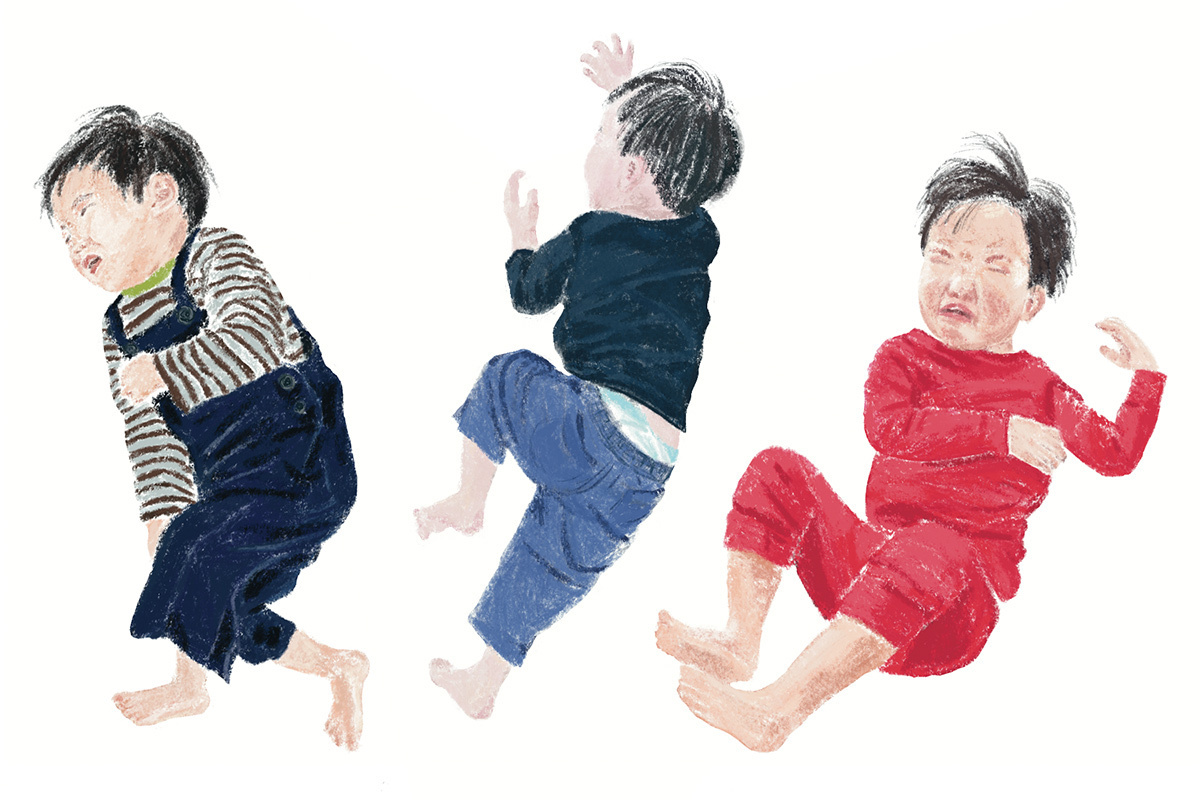
“Screaming and Watercolors” by Teresa Wong, Source The Walrus https://thewalrus.ca/good-mom-on-paper/

Whether we have been the victims of trauma or not, some of us adopt a victim mentality. 

We view the whole world as against us, and our “luck” as consistently bad [1][2].  We see ourselves as constantly wronged or treated unfairly.  We avoid taking personal responsibility, instead blaming our life choices (and their consequences) on others.  We have difficulty with change.  We can reject helpful suggestions outright.

Like toddlers, we may throw a tantrum, if our victimhood is challenged.

This is learned helplessness.  It results in frustration, resentment, and loneliness.

Maladaptive Coping

Self-pity as expressed in a negative view towards life is a maladaptive coping mechanism.  Meant to protect us against further disappointment, it is, in the long run, emotionally crippling. 

While adopting a “poor, pitiful me” attitude can generate sympathy, it does little or nothing to build character or promote personal growth.  The attitude is closely linked to self-sabotage, and not uncommonly associated with a narcissistic personality focused on entitlement. 

We may think we are avoiding risk.  But we are actually avoiding life, and all it has to offer.  Indeed, the chances are that we will attract only those with the same propensity for self-pity and complaint. Continue reading

28 Comments

Filed under Child Abuse, Child Molestation, Christianity, domestic abuse, domestic violence, Emotional Abuse, Neglect, Physical Abuse, Religion, Sexual Abuse

Invalidation

Distressed woman, Source https://pixaby.com, Author pixaby user “Free-photos” (Creative Commons CC0 1.0 Universal Public Domain Dedication)

“You’re overreacting.”

“You’re being overly sensitive.”

“You shouldn’t take things so personally.”

“You make a big deal out of everything.”

“I’m sure it wasn’t that bad.”

“You probably misunderstood.”

“It never happened that way.  You’re making things up.”

“You shouldn’t be angry [or hurt or sad].”

Invalidation of our feelings, when it becomes a pattern of behavior, is a form of emotional abuse [1A].  Depending on our upbringing, it can begin in childhood, occur during an adult friendship or romantic relationship, or both.

Feelings As Valid

We are born with the capacity to feel in response to our environment and those in it.  Emotions are an important source of information for us [1B].  They help us identify danger, and protect ourselves against it.

Feelings, in themselves, are not right or wrong.  They are the result of thoughts, prior life events, and perceptions unique to ourselves [1C].  Two people can legitimately have different emotional responses to the same situation.

Emotional validation is a critical communication tool, particularly in families [2A].  It helps sustain emotional connection, making us feel safe and secure.  Its absence has the opposite effect.

Mechanism of Invalidation

At various times our feelings may be [1D]:

  • Minimized as excessive for a given situation;
  • Dismissed as inappropriate or groundless, because our assessment of the situation is supposedly inaccurate; or
  • Ignored entirely, as if we were invisible and not experiencing them (or our experience was irrelevant to the abuser which – sad to say – it frequently is).

This can cause enormous shame, over and above the emotion we are actually experiencing and attempting to convey.

Impact on Children

Children who regularly experience emotional invalidation may learn to ignore, hide, or distrust their own emotions, while striving ever harder to please others [2B].  This leaves them dependent on and vulnerable to external validation. 

Invalidation can lead to emotional detachment or, in extreme cases, borderline personality or narcissism.  It is, also, a tool used by narcissists on children and adults alike.

Adult “Gaslighting”

Among adults, invalidation is a powerful if subtle means of manipulation known as “gaslighting” which allows the abuser to alter the victim’s reality.  Abusers routinely use it to blame the victim, and diminish their responsibility for the harm they have done [1E]. Continue reading

24 Comments

Filed under Child Abuse, Child Molestation, Christianity, domestic abuse, domestic violence, Emotional Abuse, Neglect, Physical Abuse, Religion, Sexual Abuse

Vigilance, Part 2 – Emotional Abuse

Image courtesy of Child Crime and Prevention Safety Center https://childsafety.losangelescriminallawyer.pro/kids-and-emotional-psychological-abuse.html

Emotional abuse is an underrated form of abuse, but no less damaging for that.

The warning signs of emotional abuse include the following [1]:

  • A child who exhibits a lack of attachment to the parent.
  • A child who is delayed in physical or emotional development, unrelated to an identifiable medical or psychological condition.
  • A child who is either inappropriately adult (parenting other children) or inappropriately infantile (constantly rocking or head-banging, for example).
  • A child who exhibits behavioral extremes (acute passivity or serious aggression; demanding behavior or abject compliance).
  • A child who attempts suicide.

The parent who rejects his/her child will constantly blame, belittle, or berate that child.  The parent unconcerned about his/her child’s well-being may refuse offers of help for that child’s school problems. 

On the other hand, a parent can be so self-involved that his/her child becomes little more than a pawn for manipulation.

[1]  Prevent Child Abuse America, “Recognizing Child Abuse:  What Parents Should Know”,   https://preventchildabuse.org/resource/recognizing-child-abuse-what-parents-should-know/.

Originally posted 1/12/20

This series will continue next week with Part 3 – Physical Abuse

FOR MORE OF MY ARTICLES ON POVERTY, POLITICS, AND MATTERS OF CONSCIENCE CHECK OUT MY BLOG A LAWYER’S PRAYERS AT: https://alawyersprayers.com

23 Comments

Filed under Child Abuse, Child Molestation, Emotional Abuse, Neglect, Physical Abuse, Sexual Abuse

The Rose Garden, Chapter 11 – Secrets

File:Little girl on swing.jpg

Girl on a swing, Source https://flickr.com, Author Luiz Carlos (Creative Commons Attribution 2.0 Generic)

WARNING:  Graphic Images

For nothing is secret that will not be revealed, nor anything hidden that will not be known and come to light” (Luke 8: 17).

Since my father often worked nights, he slept late during the day.  This required that we girls make no noise which might disturb him.  We were constantly cautioned about this.

If we were still awake when he came home at night, giggling in bed was strictly forbidden.  My father would pound on the ceiling with a broomstick, or stand at the foot of the stairs and shout unspecified threats up toward us.

This produced sheer panic on our part.  It did nothing to diminish our love for him.

Anger, Insecurity, and Tenderness

Though my father’s anger pervaded our young lives, anger was not the sole emotion to which we were exposed [1].

Gnawing insecurity about his own abilities manifested in a lack of confidence on my father’s part that either my sister or I would ever make our way in the world.  That projected insecurity is something we have had to fight against.

It was, I believe, coupled with a failure on my father’s part to recognize his children as distinct from himself.  Such a failure is characteristic of narcissism [2].

Yet, there were times when he treated us with genuine tenderness.  This is the source of trauma bonding.

My father enjoyed pushing me on the swings when I was little.  The higher I went the better he liked it, and the more he encouraged me.  That I had a morbid fear the swings would come loose from their moorings and topple over, I did not mention to him.  Love was defined by the willingness to sacrifice — even one’s life.

I remember the time my father ate the peel off an apple for me at the park, leaving behind the juicy fruit.  I still have the small piggy bank Pop bought for me at the zoo.

He affectionately referred to my sister (who owned a yellow raincoat) as his “yellow bubble.”  He scrambled eggs for us just the way we liked them.  He brought home an endless supply of cold cuts, cakes, and pies from the store.

It was my father who stayed with me on an unusual outing to the racetrack.  Since I was too young to be permitted entry to the track, we stood outside the gate in the rain, while my mother went inside to place her bets.

On another occasion, my father arranged for an acquaintance to take us flying in a private plane.  Only years after my father’s death did I learn from my mother how he agonized over our safety during that flight.

My father drove us around the neighborhood each year to see the Christmas lights.  He would take us through the car wash with him — something I found thrilling, and my sister upsetting.  My father was, also, the one who taught me to drive.

I came home from those sessions numb, Dad’s voice ringing in my head.  “No!  No!  Keep away from the divider!  You’re not going fast enough.  You have to predict what the other drivers will do.”  How to predict the actions of other drivers — or, more importantly, his own — my father never conveyed.

Early on, I had a major accident while my mother and sister were passengers in the car.  My sister was about fourteen at the time.  The first thing I saw, after coming to, was the blood running down her face.

Despite that, she never once refused to ride with me.  She simply gathered up her nerve, and got back in the car.  As a result, I regained my confidence behind the wheel.

Once I had my license, my sister and I could drive north on the Palisades Parkway and picnic alongside.  These are some of my sweetest memories. Continue reading

12 Comments

Filed under Child Abuse, Child Molestation, Christianity, Emotional Abuse, Neglect, Physical Abuse, Religion, Sexual Abuse

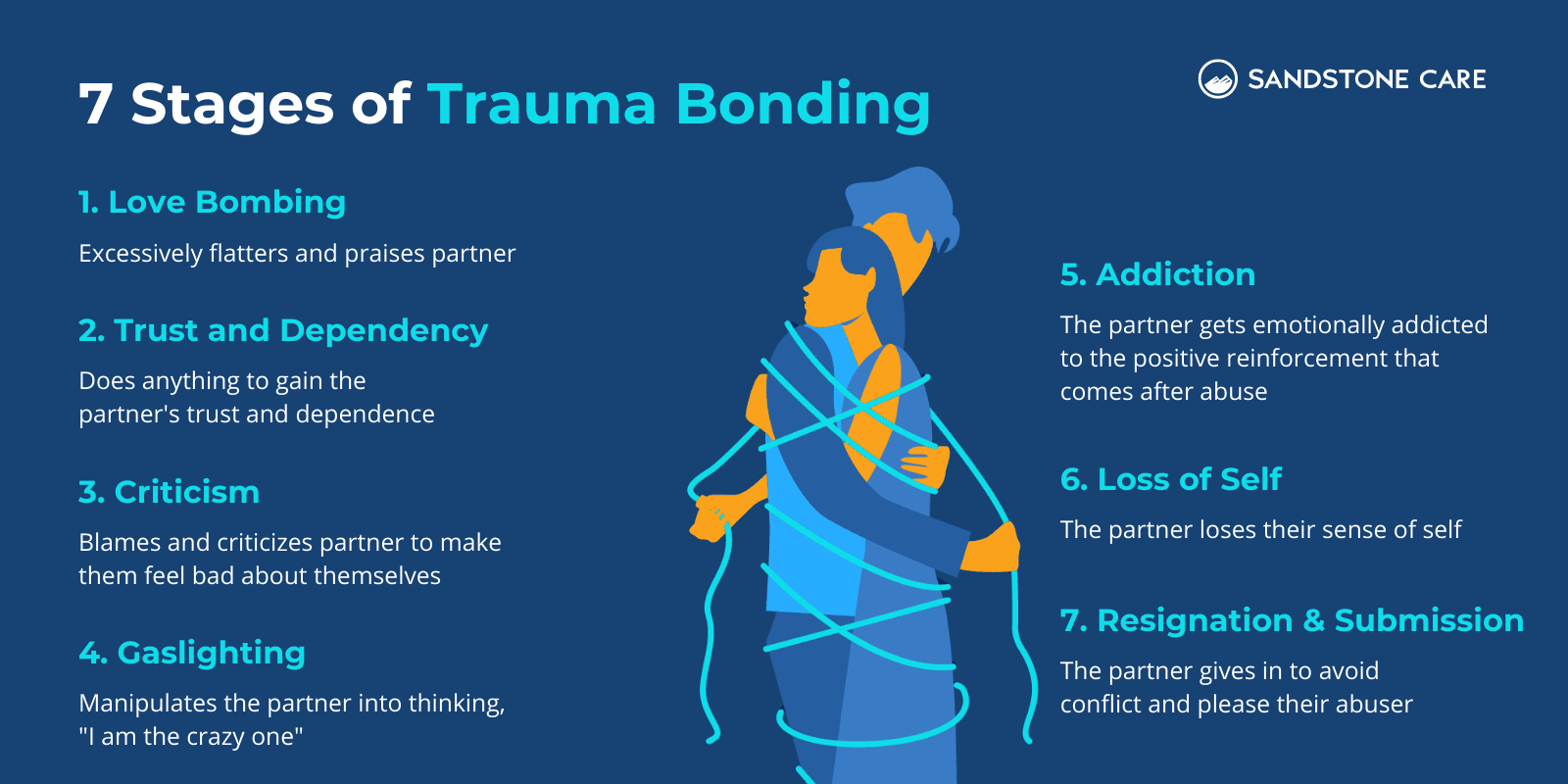
“Stages of Trauma Bonding” by Cynthia Bailey Rug

7 Stages Of Trauma Bonding explained on a dark navy background

Image courtesy of Sandstone Care

Below is a post by the Christian author, Cynthia Bailey Rug.  While this post is specifically directed toward the victims of narcissism, it is highly relevant to the victims of childhood abuse and/or domestic violence who are particularly vulnerable to trauma bonding.

Cynthia Bailey Rug blogs at https://cynthiabaileyrug.wordpress.com  .  The full text of this post dated 10/14/23 can be found there.

“Trauma bonding, also known as Stockholm Syndrome, is a common & strange phenomenon among victims of ongoing abuse [1][2].  It happens when abusers aren’t abusive all of the time, & show their victims random kindnesses.  Those kindnesses seem to prove to victims that their abuser isn’t all bad, & they really do care for their victim.  That thinking bonds the victim to their abuser & makes them more willing to tolerate abuse.

Narcissists are exceptionally good at trauma bonding their victims to them.  It happens very subtly & in gradually increasing stages of toxicity.  Trauma bonding is much like the story of putting a frog in a pot of water.  If the water is boiling when he goes in, he recognizes the danger & hops out immediately.  But, if it’s warm & gradually the temperature increases to boiling, he won’t notice he’s in danger until it’s too late…

The first stage of trauma is love bombing.  This is when the narcissist [or other abuser] showers you with love, praise & adoration.  You can do no wrong.  You are absolutely perfect!…Gifts can be a part of love bombing too…” Continue reading

20 Comments

Filed under Child Abuse, Child Molestation, domestic abuse, domestic violence, Emotional Abuse, Neglect, Physical Abuse, Sexual Abuse, Violence Against Women

“When Children Aren’t Allowed to Say No” by Cynthia Bailey-Rug

Narcissistic Personality Disorder - Causes, Symptoms, Complications, Diagnosis, Treatment

“Narcissistic parents are notorious for not allowing their children to have any boundaries. They have no problem going through their children’s personal belongings or even breaking or getting rid of things their child uses or loves. Children are allowed no privacy, & some narcissistic parents go as far as removing their bedroom doors. Possibly the worst thing narcissistic parents do is refusing to allow their children to say “no”.

Narcissistic parents are too self centered to realize or even care that by not allowing their children to say no, they are teaching their children some pretty terrible lessons. When children learn that saying no is bad & not allowed, this teaches them that others can treat them however they wish. This opens the door for other wicked people to abuse these children. It also sets these children up for a life of misery because they don’t believe they have the right to say no to anyone, no matter what. They also believe that they have to say yes to everyone & everything, & that obviously is a huge problem!…” [Continued at https://cynthiabaileyrug.wordpress.com/2022/05/26/when-children-arent-allowed-to-say-no/ ]

FOR MORE OF MY ARTICLES ON POVERTY, POLITICS, AND MATTERS OF CONSCIENCE CHECK OUT MY BLOG A LAWYER’S PRAYERS AT: https://alawyersprayers.com

7 Comments

Filed under Child Abuse, Child Molestation, Christianity, domestic abuse, domestic violence, Emotional Abuse, Neglect, Physical Abuse, Religion, Sexual Abuse

Abandonment

Abandoned teddy bear, Author Ryan Hodnett (CC BY-SA 4.0 International)

WARNING:  Graphic Images

Brittany Gosney, a 29 y.o. Ohio woman charged with murdering her 6 y.o. son James Hutchinson, has pleaded not guilty by reason of insanity [1]. 

In a confession now being contested, Gosney alleged that her boyfriend, James Hamilton, urged her to abandon all three of her children.  She proceeded to do this, leaving the children in a parking lot at Rush Run Wildlife Area.  The youngest grabbed the car door as Gosney gunned the engine, and was apparently dragged. 

Gosney turned the vehicle around to check on the boy, and found he was dead.  She then loaded the body and her two living children (7 y.o. and 9 y.o.) back into the car, and returned home.  Gosney and Hamilton later tossed the little boy’s remains into the Ohio River, and attempted to pass his absence off as a disappearance.

Abandonment

Child abandonment is the practice of relinquishing interest in and legal rights over one’s children in an illegal manner, the intention being never to resume guardianship [2A].  As in the Gosney case, this is often done in such a reckless way that the children’s welfare and their very lives are placed at risk.

The term “abandonment” is generally used to describe physical abandonment of a child.  It can, also, however, include severe neglect and emotional abandonment, as when parents fail to provide financial and/or emotional support to  minor children for a prolonged period of time.

Apart from the damage severe neglect can cause, this particular form of abandonment may expose a child to sexual abuse by other adults with whom the child then comes into contact.  It is not unheard of for addicted parents to trade their young children to sex traffickers in exchange for drugs. Continue reading

18 Comments

Filed under Child Abuse, Child Molestation, Christianity, Emotional Abuse, Neglect, Physical Abuse, Poverty, Religion, sex trafficking, Sexual Abuse

Vigilance, Part 2 – Emotional Abuse

Frightened child, Author Jean-Francois Gornet, Paris, Source Selfie Velib, Originally Posted to Flickr (CC BY-SA 2.0 Generic)

Emotional abuse is an underrated form of abuse, but no less damaging for that.

The warning signs of emotional abuse include the following [1]:

  • A child who exhibits a lack of attachment to the parent.
  • A child who is delayed in physical or emotional development, unrelated to an identifiable medical or psychological condition.
  • A child who is either inappropriately adult (parenting other children) or inappropriately infantile (constantly rocking or head-banging, for example).
  • A child who exhibits behavioral extremes (acute passivity or serious aggression; demanding behavior or abject compliance).
  • A child who attempts suicide.

The parent who rejects his/her child will constantly blame, belittle, or berate that child.  The parent unconcerned about his/her child’s well-being may refuse offers of help for that child’s school problems.

On the other hand, a parent can be so self-involved that his/her child becomes little more than a pawn for manipulation.

[1]  Prevent Child Abuse America, “Recognizing Child Abuse:  What Parents Should Know”,   https://preventchildabuse.org/resource/recognizing-child-abuse-what-parents-should-know/.

This series will continue next week with Part 3 – Physical Abuse

FOR MORE OF MY ARTICLES ON POVERTY, POLITICS, AND MATTERS OF CONSCIENCE CHECK OUT MY BLOG A LAWYER’S PRAYERS AT: https://alawyersprayers.com

18 Comments

Filed under Child Abuse, Child Molestation, Emotional Abuse, Neglect, Physical Abuse, Sexual Abuse

Narcissism – Those We Should Not Trust

“Narcissus” by Caravaggio (c. 1596), Galleria Nazionale d’Arte Antica, Rome (PD-Art, PD-Old-100).

Narcissists are known for extreme self-absorption and a glorified sense of self. 

The victims of their manipulation can suffer life-long, crippling consequences [1].  These may include  a mistrust of loved ones, severe self-doubt, depression, and an obsession with supposed faults.

For the victims of narcissistic abuse, I highly recommend the website of Cynthia Bailey-Rug https://cynthiabaileyrug.wordpress.com/ 

Her post titled “Warning Signs of Those You Shouldn’t Tell about the Abuse in Your Past”  clearly identifies those individuals whom abuse victims should not trust with information about their abuse history.  I have excerpted the warning signs below. 

The full post can be found at:  https://cynthiabaileyrug.wordpress.com/2019/06/09/warning-signs-of-those-who-you-shouldnt-tell-about-the-abuse-in-your-past/.

“…Below are some warning signs that someone is not safe to tell your story to.

If someone refers to your relationship as one where both you & your abuser are at fault for its demise, this person isn’t safe.  We all know that no one is perfect.  Everyone makes mistakes.  However, when a person is abusive, it’s not an innocent mistake.  It’s a deliberate choice to harm another person.  Any functional person should recognize that!

All victims need understanding & empathy.  Even if a person hasn’t been in an abusive relationship, anyone should be able to grasp that it’s not a pleasant experience & feel badly that anyone experienced that.  Someone who can’t clearly lacks empathy & is a toxic person.

Avoid anyone who trivializes the abuse.  One of my aunts once referred to the abuse I experienced as, ‘childhood hurts.’  That truly hurt me & it destroyed our relationship.  Luckily, it happened well into my healing journey.  If it happens to someone new to their healing, an invalidating comment like this can be devastating!

Those who make excuses for abusers should be avoided.  People who do this are as toxic as the abuser!  They invalidate the victim’s pain & suffering, & even make the victim feel ashamed for not being understanding, or being too sensitive & such.  The truth is there is NO good reason to abuse, period.

People who judge a person’s healing are toxic.  Everyone heals differently & at a different pace.  Many toxic people try to rush a victim along with comments like, ‘You need to let this go.’  ‘It’s been how many months since you left him?’  ‘You told me this already.’  This does no good!  To process & heal from abuse, it takes a lot of time, energy & sometimes even telling the same story over & over in an attempt to make some sense of it.  A person who doesn’t understand that is toxic.

Anyone who uses a person’s faith as a reason they should tolerate abuse is incredibly toxic & should be avoided at all costs.  While God didn’t promise this life would be easy, He never said anywhere in the Bible that tolerating abuse is good & holy.  Yet, there are many who think it is the ‘good Christian’ thing to do, tolerating abuse.  I’m no theologian, but I do recognize that tolerating & enabling abuse is not only wrong, it’s not God’s will.

If you come across these kinds of people, remember, not everyone needs to know your story.  Refuse to discuss it with them.  You don’t need to be abused even more than you already have been!”


[1]  PsychCentral, “Narcissistic Abuse and the Symptoms of Narcissistic Abuse Syndrome” by Dr. Athena Staik, 11/17, https://blogs.psychcentral.com/relationships/2017/03/narcissistic-abuse-and-the-symptoms-of-narcissist-victim-syndrome/.

FOR MORE OF MY ARTICLES ON POVERTY, POLITICS, AND MATTERS OF CONSCIENCE CHECK OUT MY BLOG A LAWYER’S PRAYERS AT:  https://alawyersprayers.com

21 Comments

Filed under bullying, Child Abuse, Child Molestation, Christianity, domestic abuse, domestic violence, Emotional Abuse, Neglect, Physical Abuse, Religion, Sexual Abuse

“Toxic People” by Pastor Dave Orrison

“Narcissus” by Gyula Benczur (1881), Hungarian National Gallery (PD-Art, Old-100)

Pastor Dave Orrison provides an excellent lesson (below) on the responsibility Christians have toward toxic people.  It draws a clear distinction between the charge to love others and the right we have to protect ourselves against them.

“What is a toxic person? A toxic person is someone who affects you in a negative way, poisoning your heart. In the presence of a toxic person, you become something you don’t want to be. You may be fearful, weak, angry, or even sad, but the emotions you experience will be inconsistent with how you want to feel and how you should feel in a normal relationship. In other words, a toxic person will damage you much like a poison destroys your health.

Narcissists are usually toxic people, toxic at least to certain others. Often through criticism, narcissists consistently bring certain people down. Sometimes by expectations or job requirements. Sometimes by gossip, or negative talk, or comparisons. Sometimes even by violent verbal and personal attacks. However they do it, narcissists bring people down…”

[Continued at https://graceformyheart.wordpress.com/2019/05/03/toxic-people/ ]

FOR MORE OF MY ARTICLES ON POVERTY, POLITICS, AND MATTERS OF CONSCIENCE CHECK OUT MY BLOG A LAWYER’S PRAYERS AT: https://alawyersprayers.com

6 Comments

Filed under Christianity, Religion