Tag Archives: dissociation

The Rose Garden, Chapter 22 – A Voice Reclaimed

File:Justice scale and flag.jpg

Scales of Justice, Author St. Louis Circuit Attorney’s Office, (CC BY-SA 4.0 International)

WARNING:  Graphic Images

we also glory in tribulations, knowing that tribulation produces perseverance; and perseverance, character; and character, hope” (Rom. 5: 3-4).

The American Psychiatric Association defines three major dissociative disorders [1]:

  • Depersonalization/derealization disorder — a sense of separation from self;
  • Dissociative amnesia — suppressed memories; and
  • Dissociative identity disorder — alternate identities.

These conditions arise from shocking, distressing, and/or painful events, including severe neglect or repetitive physical, emotional, and/or sexual abuse.  Symptoms can range from memory loss to disconnected identities.

Thankfully, I never, myself, suffered from suppressed memories or alternate identities.  There were, however, three aspects to my personality as a result of the incest:  an inner child; a capable woman; and a cynic.  By the grace of God, I have since managed to integrate these aspects with one another.

What purpose, I ask myself, did these aspects of my personality serve?

The Inner Child

The inner child preserved the feelings I experienced as a child.  She represented my lost innocence.

The child made a rare public appearance on the one occasion I was required to testify at trial, on my own behalf.  All legal knowledge on my part evaporated.  I leaned tensely forward on the witness stand, responding to each question precisely and with extreme care, my eyes fixed on opposing counsel.

Jurors commented afterwards that I seemed too sincere for an attorney, must have been holding some part of myself back.  Little did they realize how much I had actually revealed.

The Capable Woman

The woman was the attorney — competent, dignified.  She predominated.  Although heavily focused on work, she was able to function.

The Cynic

The cynic was a source of passion and strength.  She had no problem expressing anger.  And the cynic had a voice that the child did not.

Surprisingly, it was foul language which first allowed me access to that voice.  Not having heard such language as a child, I was not denied it.  That was the key.

The equipment necessary to the practice of law is located above the neck.  I acquired profanity as a way of conveying that fact to fools in the legal profession who actually believed gutter language a demonstration of strength.

Profanity is a weapon denied women, if they are to be considered ladies by our culture. Though I do not endorse it, I ask to be judged by the same standards applied to men for utilizing that weapon.

I never aspired to be a lady.  I aspired to be a hero. Continue reading

15 Comments

Filed under Child Abuse, Child Molestation, Christianity, Emotional Abuse, Justice, Law, Neglect, Physical Abuse, Rape, Religion, Sexual Abuse

The Rose Garden, Chapter 13 – Fighting the Scars

File:Fawn in grass 2, by Forest Wander.jpg

Fawn in grass, Source http://www.forestwander.com/fawn-in-grass-2/, Author ForestWander, (CC BY-SA 3.0 United States)

Come to Me, all you who labor and are heavy laden, and I will give you rest” (Matt. 11: 28).

Sometime in my late teens my pain and anger finally surfaced, and I lost my faith.

Throughout college, I declared to anyone within earshot that I was an atheist and existentialist.  Rather than bow before a God Who — as I saw it — would allow good people to suffer, I preferred to deny God’s existence.

Perfectionism and Procrastination

The evil in which my father had engaged produced a variety of scars on my psyche.  Perfectionism and its companion procrastination were among these.

Writing errors had to be liberally covered over by correction fluid, expunged.  Fasting was the ideal; a mouth full of food, and I was committed to bingeing.  If I so much as awoke later than planned, the day was marred.

It seemed far easier for me to be “perfect” than to be normal.  I had no idea what it was to be normal.   And if I could achieve perfection, perhaps my father would love me again.

Perfectionism is defined in Father-Daughter Incest by Judith Lewis Herman as behavior involving the setting of standards “high beyond reach or reason [1A].”  According to Lewis Herman, perfectionists strain “unremittingly toward impossible goals”; measure themselves “entirely in terms of productivity and accomplishment [1B].”

Perfectionism hinges on the belief that making mistakes is the same as failure.  Standards can be set so high they “actually interfere with performance [1C].”  The perfectionist dare not “risk being average,” yet filters out positive comments [1D].  The underlying belief of the perfectionist is that high standards will keep chaos at bay [1E].”

For incest survivors, a corollary of the belief is that lowering standards — even once, even briefly — is equivalent to the irretrievable loss of innocence.  My first panicked thought on being involved in an auto accident was that my record was now no longer spotless.

Related to perfectionism is paralysis:  better to do nothing than fail.  There is, however, another component to paralysis.

Fight or Flight Response

Most people today are familiar with the fight-or-flight response to danger.  The so-called “acute stress response” was first described by American psychologist, Walter Cannon, in 1929.  According to this theory, animals react to threats either by fleeing or facing them.

The response is automatic, with the sympathetic nervous system triggering the release of specific chemicals to prepare the body for either activity.  Stress results when we can pursue neither course of action in response to threat.

Freeze Response

More recently, psychology has begun to recognize the existence of a freeze response [2].  Think of a fawn frozen in tall grass at the approach of a predator.  The stimulus is overwhelming.  Yet neither fight, nor flight is an available option.  The fawn’s best chance of survival is, in effect, to disappear.

In humans, the freeze response is now believed the tie-in to dissociation.  The predator is so nearby his stench fills your nostrils.  The blood pounds in your ears.  Your heart threatens to explode.  Yet you cannot move, and cannot defend yourself.

Tragically, trauma in humans (especially the young) can have a permanent impact on the nervous system.  We do not possess the capacity to “unfreeze” readily when the danger has passed, so carry the trauma forward.

Situations that mimic key aspects of the traumatic event reproduce the response, and we are once again immobilized with dread.  In the context of molestation, sexual intercourse need not take place for permanent damage to be done. Continue reading

13 Comments

Filed under Child Abuse, Child Molestation, Christianity, Emotional Abuse, Justice, Law, Neglect, Physical Abuse, Religion, Sexual Abuse

The Rose Garden, Chapter 9 – Geography Lessons

File:The National Geographic Magaine - February 1910 Volume 21 Number 2.jpg

National Geographic Magazine, Source https://flickr, Author Jake Jakubowski (PD)

WARNING:  Graphic Images

But whoever causes one of these little ones who believe in Me to sin, it would be better for him if a millstone were hung around his neck, and he were drowned in the depth of the sea” (Matt. 18: 6).

As the superintendent of an apartment building downtown, my grandfather knew a number of well-to-do people.

To anyone who would listen, he spoke of his grandchildren.  “Annalein loves books.  Our little one loves music.”  All the building’s tenants knew that he was the one to seek out, if they were discarding anything his granddaughters might like.

By this means, Grandpa brought home milk glass decanters still smelling faintly of exotic perfumes.  He brought home a bright orange dress, just a decade out of date; silk scarves, frayed but still lovely.

Grandpa salvaged an entire set of arts and crafts style crockery from the dustbin.  Margaret and I played at “Heidi,” with secondhand furniture my grandfather had procured standing in for the mountains.

National Geographic

Greater than all these treasures were the National Geographic Magazines Grandpa regularly brought home.  I lived for these.  They disclosed a world of wonders, the photography breathtaking.

Most striking to me were the photos of African women, their lips artificially distended by huge plates.  The article described the disfigurement as an avidly sought after, if local, affectation.  It failed to mention that this beauty ritual had originated as a desperate effort by local peoples to dissuade slave-traders from carrying off their women.

Self-mutilation as self-defense was an approach I would adopt, as well.  While I never actually engaged in “cutting” (self-harm), I did develop weight issues which had the same effect.

I learned in school of other cultures, also.  There were, for example, the Vikings.  In the sixth grade my grandfather helped me fashion a Viking longship out of cardboard.

It did not occur to me I should delay turning in the project until it was due, so the ship sat forlornly on a school windowsill until the rest of the fleet arrived, a week later.

Behind the Iron Curtain

Many years after he emigrated to the States, my grandfather returned on a visit to Hungary.  This took him behind the Iron Curtain, still in place at the time.  Standing in an open field, he commented to a relation on the wheat crop.  “Shhh,” was the hasty reply.  “They may hear you.”

Bigotry

All this information I drank in — forming opinions about equality and freedom, power and the abuse of it, while my father railed against any race or ethnicity different from his own.  According to Pop, “they” were responsible for the ills of the world. Continue reading

7 Comments

Filed under Child Abuse, Child Molestation, Christianity, Emotional Abuse, Neglect, Physical Abuse, racism, Religion, Sexual Abuse

Surviving Child Abuse, Part 2 – Coping Strategies

File:Arizona Wildflowers (47287023152).jpg

Wildflowers, Peridot Mesa, AZ, Source Arizona Wildflowers, Author Alan Stark of Goodyear, AZ (CC BY-SA 2.0 Generic)

Denying or shutting down feelings — emotions, pains, etc. — usually blocks people’s energy or blinds them to important warnings [1].”

The instinctive coping mechanisms for child abuse are repression, denial, and dissociation [2].  These survival mechanisms protect us against the painful truth of the abuse, but tend to maintain the abuse secret.   They are, in the long run, maladaptive.

Therapy, Loving Friends, Self-Care, and Stress Reduction

While there is no single approach proven to be universally successful, there are helpful coping strategies for dealing with the long-term effects of childhood abuse [3A][4A].

These include cognitive behavioral therapy; the support of loving friends and family members; a healthy daily routine of self-care; and stress reduction activities like mindfulness, exercise, and prayer [3B][4B][5][6A].

Supportive and trusting relationships allow us to explore and express our feelings in a safe setting.

Medication can, at times, be useful, as well.

Creativity (Self-Expression)

Creativity is another outlet for expressing our feelings .  We may blog or keep a journal, snap photos, take up amateur dramatics, draw, paint, sculpt, learn to throw pottery or arrange flowers [7][8].  It makes no difference.

Nor does it make a difference whether our efforts meet some ideal standard or not.  The act of self-expression can help us expel the poison and reclaim our joy.

Music

Music touches the soul in ways that words alone cannot [9].  We can experience the positive effect music has whether we compose, play an instrument, dance, sing, or simply listen to music.

Continue reading

12 Comments

Filed under Child Abuse, Child Molestation, Christianity, domestic abuse, domestic violence, Emotional Abuse, Neglect, Physical Abuse, Religion, Sexual Abuse, Violence Against Women

Unbiblical, Part 2 – Sin Nature v. Abuse-Related Guilt

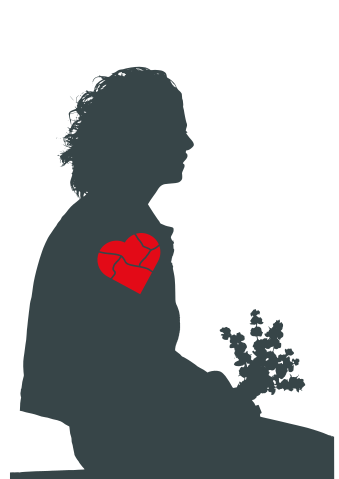
Woman with a broken heart, Author Nevit Dilmen, Source Sunset 02459.jpg and Broken Heart symbol.svg (CC BY-SA 3.0 Unported)

Christians speak regularly about the “sin nature” of mankind, the inclination by human beings to do wrong, as illustrated by wars and crime.

The following verses on the topic are typical:

“…[T]he imagination of man’s heart is evil from his youth…” (Gen. 8:21).

“ ‘The heart is deceitful above all things, and desperately wicked…’” (Jer. 17:9).

“ ‘Then I will…take the stony heart out of their flesh, and give them a heart of flesh that they may walk in My statutes…’ ” (Ezek. 11: 19-20).

“ ‘For out of the heart proceed evil thoughts, murders, adulteries, fornications, thefts, false witness, blasphemies’ ” (Matt. 15: 19).

If anyone has experienced that sin nature, abuse victims have.  Victims, however, have been more sinned against than sinning.

Unfortunately, the continuous emphasis on sin is likely to sound like condemnation to victims, when what they need is love, encouragement, and hope.

Christians should remember that abuse leaves behind deep scars.  Victims of abuse may struggle with gender identification, sexual addiction or dysfunction, self-neglect, anxiety, depression, dissociation and related amnesia, drug or alcohol addiction, cutting, anorexia, bulimia, bingeing, and other issues.  The majority of prostitutes are thought to be runaways, with a history of abuse.

Dealing with major problems like these is not for the faint of heart.  Nor is it for the self-righteous.  Merely living ordinary lives can take enormous effort and enormous courage by abuse victims.  That victims, for the most part, accomplish this is amazing.

Victims should not be made a topic of gossip.  Nor should they be subjected to snap judgments, whether about their morality or mental state.

Above all, victims should be reassured that they were not the guilty party in abuse; that, as children, they were wholly incapable of consent to whatever was done to them; and that God still loves them, despite all they have been through.

Originally posted 3/15/15

This series will continue next week with Humility v. Lack of Worth

FOR MORE OF MY ARTICLES ON POVERTY, POLITICS, AND MATTERS OF CONSCIENCE CHECK OUT MY BLOG A LAWYER’S PRAYERS AT: https://alawyersprayers.com


20 Comments

Filed under Abuse of Power, Child Abuse, Christianity, Emotional Abuse, Neglect, Physical Abuse, Prostitution, Religion, Sexual Abuse

Filth

Ancient Jewish bath for ritual immersion (“mikveh”), Author Arie Darzi to memorialize the Jewish communities in Spain, Source http://yavan.org.il/pws/gallery!82 (CC BY-SA 3.0 Unported)

WARNING:  Graphic Images

We have been made as the filth of the world, the offscouring of all things…” (1 Cor. 4: 13).

Filth pours out of the wall.  It may look like water, cool clear water, but it is filth.

In fact, the entire bathroom is contaminated.  God knows when it was last cleaned.  The room reeks of the sweat of prior occupants, is covered in a fine white powder from the predator’s own ablutions.

The door cannot be locked; the predator has seen to that.

You take your clothes off preparing to shower, but cannot find a place to lay down the cotton pajamas into which you plan to change.  Perhaps the toilet seat will suffice, if the clothes do not touch the floor, do not touch the wall, do not touch the tank.

You stand naked on the throw rug, an old shag which is, also, filthy, and prepare to step into the tub.  You grit your teeth, avoid looking at yourself in the small mirror that hangs over the sink.  The tub, too, is contaminated.  You know this must be done, so you step over the edge, cringing, toes curled under.

In the shower, you scrub your skin till it is raw.

You dread having to use the only towels available, stiff and worn, rough and faded towels.  You pull one down onto the floor, in order to be able to step out of the tub.  You carefully avoid touching the walls, touching the toilet tank.

You dry yourself awkwardly, as if drying off a stranger, avoid making eye contact with your image in the mirror.  Then you dress, step into slippers, gather your clothes and the used towels in a bundle for the hamper, and step over the threshold, out of the room.

You can never really get clean.  The bathroom may be contaminated by the predator.  But the dirt, the sin, is inside you.

No Escape

“…and though the…young woman cried for help there was no one to rescue her” (Deut. 22: 27).

This is how a victim of sexual abuse feels.  We despise ourselves, loathe our bodies, would shed them if we could [1].  This flesh is what he wants.  His hands have been all over it, taking possession of what is no longer ours.

Desperation alternates with hopelessness.  But there is no sign of rescue and no escape. Continue reading

15 Comments

Filed under Child Abuse, Child Molestation, Christianity, Emotional Abuse, Religion, Sexual Abuse

Humpty Dumpty

Illustration of Humpty Dumpty from “Denslow’s Mother Goose” by William Wallace Denslow, Source http://www.gutenberg.org/etext/18546 (Literary Work – Author’s Life plus 70 years, PD)

We tend to have little sympathy for Humpty Dumpty. What was he doing on that wall, anyway? Surely, he must have known how fragile and ungainly he was.

No one is certain of the origin of the nursery rhyme. Some have speculated that Humpty Dumpty may have been a parody of the evil (and humpbacked) King Richard III. Other possibilities have been put forward.

Whatever his origins, Humpty has found himself in a number of literary works, among them Alice Through the Looking Glass by Lewis Carroll and Finnegan’s Wake by James Joyce.

Abuse victims have a surprising amount in common with Humpty Dumpty. Our lives, like Humpty’s, were shattered by traumatic events. And we, too, may find ourselves in strange places.

The human mind is amazingly resilient.  When subjected to severe trauma it may involuntarily disconnect or dissociate from reality.  Many abuse victims describe this as “going away” – somewhere far from the pain, somewhere the abuser could not reach us.  Victims speak of leaving their bodies, watching events involving themselves from above or from a distance.

A defense mechanism, dissociation is protective, in the short term.  It can shield us from intolerably painful experiences.

Depending on the severity of our abuse, however, awareness, memory, and identity may be disrupted [1].  In extreme cases, alternate personalities (“alters”) can develop.  These may assume different physical and vocal mannerisms, even different ages, sexes, and races from one another.  They may or may not be aware of one another’s existence. Continue reading

29 Comments

Filed under Child Abuse, Emotional Abuse, Neglect, Physical Abuse, Sexual Abuse

Unbiblical, Part 2 – Sin Nature v. Abuse-Related Guilt

Christians speak regularly about the “sin nature” of mankind, the inclination by human beings to do wrong, as illustrated by wars and crime.

The following verses on the topic are typical:

“…[T]he imagination of man’s heart is evil from his youth…” (Gen. 8:21).

“ ‘The heart is deceitful above all things, and desperately wicked…’” (Jer. 17:9).

“ ‘Then I will…take the stony heart out of their flesh, and give them a heart of flesh that they may walk in My statutes…’ ” (Ezek. 11: 19-20).

“ ‘For out of the heart proceed evil thoughts, murders, adulteries, fornications, thefts, false witness, blasphemies’ ” (Matt. 15: 19).

If anyone has experienced that sin nature, abuse victims have. Victims, however, have been more sinned against than sinning.

Unfortunately, the continuous emphasis on sin is likely to sound like condemnation to victims, when what they need is love, encouragement, and hope.

Christians should remember that abuse leaves behind deep scars. Victims of abuse may struggle with gender identification, sexual addiction or dysfunction, self-neglect, anxiety, depression, dissociation and related amnesia, drug or alcohol addiction, cutting, anorexia, bulimia, binging, and other issues. The majority of prostitutes are thought to be runaways, with a history of abuse.

Dealing with major problems like these is not for the faint of heart. Nor is it for the self-righteous. Merely living ordinary lives can take enormous effort and enormous courage by abuse victims. That victims, for the most part, accomplish this is amazing.

Victims should not be made a topic of gossip. Nor should they be subjected to snap judgments, whether about their morality or mental state.

Above all, victims should be reassured that they were not the guilty party in abuse; that, as children, they were wholly incapable of consent to whatever was done to them; and that God still loves them, despite all they have been through.

This series will continue next week with Humility v. Lack of Worth

 FOR MORE OF MY ARTICLES ON POVERTY, POLITICS, AND MATTERS OF CONSCIENCE CHECK OUT MY BLOG A LAWYER’S PRAYERS AT: http://www.alawyersprayers.com


15 Comments

Filed under Abuse of Power, Child Abuse, Christianity, Emotional Abuse, Neglect, Physical Abuse, Prostitution, Religion, Sexual Abuse

Healing from Abuse

Child abuse – whether physical, emotional, or sexual abuse or neglect – is likely to have permanent consequences. The wounds of abuse are grievous, inflicted when we are most vulnerable.

The extent to which we heal varies from one victim to the next, as does the rate at which healing takes place. This makes perfect sense. Victims are violated at various ages, for varying lengths of time, in countless evil ways. They have unique internal resources, and varying degrees of external support (sometimes none).

All these are factors in recovery. We must not, therefore, gauge our progress by that of others.

The “Inner Child”

Experts often refer to the wounded “inner child”. This is not to suggest that victims develop multiple personalities, though some may. It is an abbreviated means of saying we remain sensitive to issues relating to abuse, and – at an emotional level, at least – retain a strong recollection of the trauma inflicted on us.

Misplaced “Coping” Strategies

Unable to defend themselves against abuse, some children adopt desperate strategies in the effort to cope with it. These childhood strategies may continue into adulthood, becoming a hindrance where they once served a legitimate purpose.

Dissociation is one such strategy. The child, in effect, imagines himself or herself elsewhere while the abuse is taking place. This is the “out of body” experience. Dissociation may later be triggered by events which recall (or mimic) the abuse. Though meant to be protective in nature, dissociation can produce serious gaps in a victim’s memory. Continue reading

16 Comments

Filed under Child Abuse, Christianity, Emotional Abuse, Neglect, Physical Abuse, Religion, Sexual Abuse