
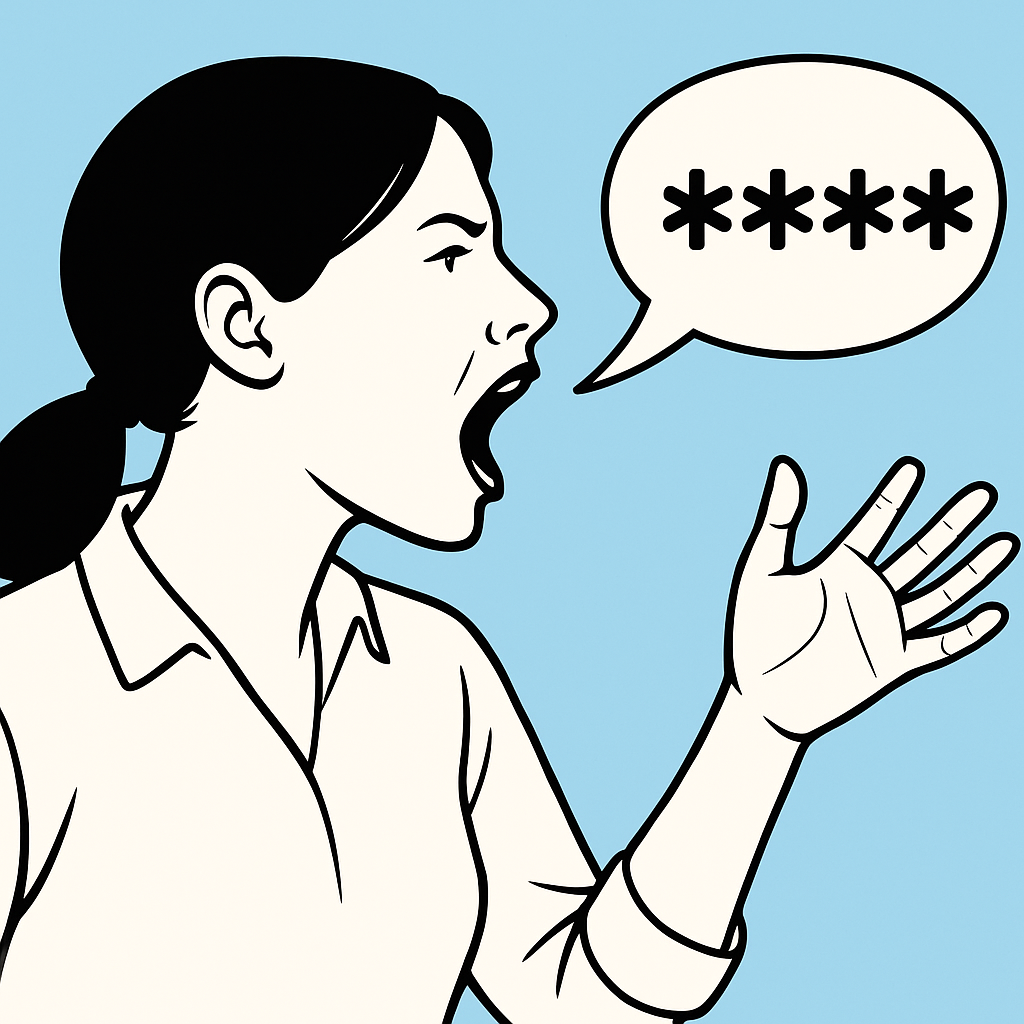
Cartoon image of woman using profanity, Author Unknown, (CC0 1.0 Universal Public Dedication)
Both child abuse and domestic abuse can leave lasting scars on our lives. One of these is the tendency to see abusers where they do not exist. Innocent gestures, innocent remarks by those who have never harmed us can be misperceived as predatory. In response, we may go on the attack.
This response on our part may seem a minor difficulty. After all, “better safe than sorry,” as the saying goes. In reality, however, it can damage careers and destroy relationships.
Our co-workers and partner or spouse are not likely to understand why we are being defensive. In the workplace, that can provoke conflict, leading to false accusations, formal investigations, and dismissal. In the home, it can lead to unnecessary arguments, emotional distance, and ultimately divorce.
Hypervigilance/Cognitive Distortion
The feeling that everyone is an abuser can be a sign of hypervigilance and trauma-related cognitive distortion [1][2][3]. We are so alert to danger that we see it everywhere, even when it is not present. This pattern is particularly common when the genuine abuse we experienced involved enforced isolation, surveillance, or constant provocation.
Anxiety
Unfortunately, seeing everyone as an abuser can reduce the trust we have in others, increasing our anxiety and fear of social contact. That makes it harder to form healthy relationships, reinforcing a cycle of isolation and self-blame.
Steps Toward Change
Recognizing our distorted thinking can be a step toward change. Hypervigilance is a learned response. Keeping a journal, and noting when our perceptions were accurate and when they were not, can be of great assistance.
Seeking the input of trusted friends and licensed mental health professionals is another helpful approach. Positive experiences of any kind can “recalibrate” the brain’s threat detection.
It is possible to recover a more balanced perspective, and reclaim our trust of others.
—
[1] Healthline, “What Is Hypervigilance?” by Timothy Legg PhD, 3/21/23, https://www.healthline.com/health/hypervigilance.
[2] Wikipedia, “Hypervigilance”, https://en.wikipedia.org/wiki/Hypervigilance.
[3] Cogntive Psychology, “Cognitive Distortions”, https://www.cognitivepsychology.com/Cognitive_Distortions.
FOR MORE OF MY ARTICLES ON POVERTY, POLITICS, AND MATTERS OF CONSCIENCE CHECK OUT MY BLOG A LAWYER’S PRAYERS AT: https://alawyersprayers.com


