
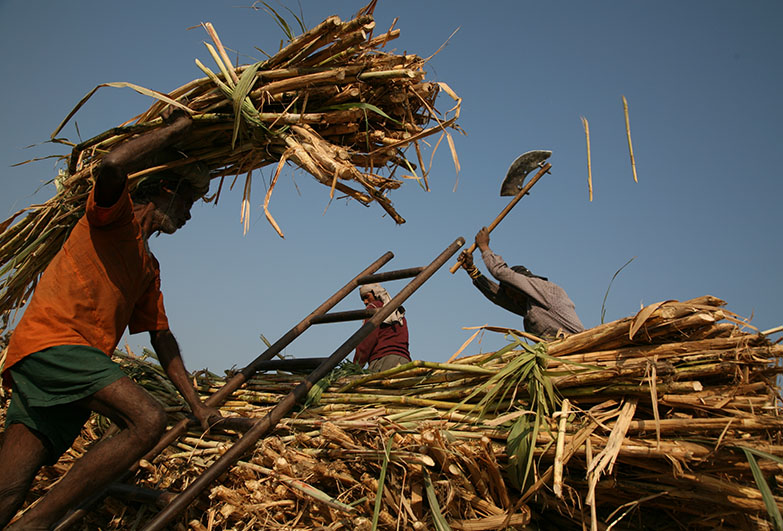
Image Credit: Pete Patisson, Courtesy of Anti-Slavery.org https://www.antislavery.org/slavery-today/bonded-labour/
Generational debt involves public or private financial obligations passed from one generation to the next in a cycle of economic hardship [1].
Public Debt
In the case of public debt, benefits are enjoyed by the present generation, while costs are shifted to those who come later.
In the United States, this is most clearly demonstrated by the impact the national debt will have on future generations in the way of higher taxes, increased borrowing costs, greater pressure on programs like Social Security and Medicare, and reduced public investment [2].
Argentina, Greece, Turkey, and many African nations, also, have high public debt-to-GDP ratios [3A]. In fact, almost half the world’s population lives in countries that spend more on interest than on education or health care [3B].
Private Debt
Private debt can involve unpaid loans, credit card debt, mortgages, medical bills, and other financial commitments.
Under most modern legal systems, heirs are not liable for a deceased’s debts beyond the value of the estate. Indirectly, of course, offspring are impacted by a lack of generational wealth when savings are absent.
In some countries, however, children are burdened with the debt taken on by their elders.
A. Debt Bondage
In South Asian countries like India and Pakistan, debt bondage (a specific form of forced labor tied to unpaid debt) is widespread in sectors from farming, brick kilns, and mills, to mining, and factories [4].
Though India’s Bonded Labor System Act of 1976 outlawed debt bondage, customary usage, corruption, and enforcement failures mean that parents’ debts are still passed on to their children and grandchildren [5][6][7]. An estimated 3 million or more children are engaged in such forced labor in India and elsewhere [8].
Human traffickers may trick individuals into assuming an initial debt willingly as a condition of future employment, then claim they “inherited” the debt of family members.
In many cases, workers are required to pay off extortionate fees for their recruitment, housing, or food. They may be beaten, and locked up to prevent their escape from an employer, denied access to health care and education, fed a starvation diet, forced to live in filthy conditions and work in dangerous ones, even killed [9].
Meanwhile, the interest on their debt continues to mount.
B. Sex Trafficking
Tragically, debt bondage and sex trafficking are related [10][11]. Debt bondage is a common method traffickers use to control and exploit victims trafficked for purposes of prostitution.
“The rich rule over the poor, and the borrower is slave to the lender” (Prov. 22: 7).
—
[1] PHNXpertise, “Generational Debt: Financial”, https://www.phnxpertise.com/resources/financial-generational-debt.
[2] Concord Coalition, “Passing the Buck: “How the National Debt Burdens Future Generations”, 6/27/22, https://www.concordcoalition.org/deep-dives/issue-brief/passing-the-buck-how-the-national-debt-burdens-future-generations/.
[3A and 3B] International Press Service (IPS), “We Owe Future Generations A Path Out of the Global Debt Crisis” by Ana Munoz and George Laryea-Adjei, 11/7/26, https://www.ipsnews.net/2026/07/we-owe-future-generations-a-path-out-of-the-global-debt-crisis/.
[4] Anti-Slavery.org, “What is bonded labour?”, https://www.antislavery.org/slavery-today/bonded-labour/.
[5] Social Work Institute, “Abolishing Bonded Labour in India: Legal and Social Perspectives”, 10/27/25, https://socialwork.institute/social-development/abolishing-bonded-labour-india/#google_vignette.
[6] The Law Institute, “Challenges in the Implementation of The Bonded Labour System (Abolition) Act 1976”, 3/20/26, https://thelaw.institute/law-and-vulnerable-groups/challenges-bonded-labour-system-abolition-act-1976/#google_vignette.
[7] Kasmir Times, “Abolished on paper, alive in reality: Bonded labour persists in India”, 12/1/25, https://kashmirtimes.com/news/abolished-on-paper-alive-in-reality-bonded-labour-persists-in-india.
[8] Anti-Slavery.org, “What is child slavery?”, https://www.antislavery.org/slavery-today/child-slavery/.
[9] Human Trafficking Search, “Slavery, Forced Labor, Debt Bondage, and Human Trafficking: From Conceptual Confusion to Targeted Solutions” by Ann Jordan, 2011, https://humantraffickingsearch.org/resource/s-lavery-forced-labor-debt-bondage-and-human-trafficking-from-conceptional-confusion-to-targeted-solutions/.
[10] UN International Organization for Migration (IOM), “Debt Bondage in Human Trafficking”, https://www.iom.int/sites/g/files/tmzbdl486/files/our_work/DMM/MAD/07312017/Newfactsheets-DebtBondage.pdf.
[11] US Dept. of State, “Understanding Human Trafficking”, 1/20/25, https://www.state.gov/understanding-human-trafficking/#:~:text=%E2%80%9CDebt%20bondage%E2%80%9D%20is%20focused%20on%20human%20trafficking%20crimes,person%20to%20work%20or%20engage%20in%20commercial%20sex.
FOR MORE OF MY ARTICLES ON POVERTY, POLITICS, AND MATTERS OF CONSCIENCE CHECK OUT MY BLOG A LAWYER’S PRAYERS AT: https://alawyersprayers.com


