Tag Archives: incest

The Rose Garden, Chapter 13 – Fighting the Scars

File:Fawn in grass 2, by Forest Wander.jpg

Fawn in grass, Source http://www.forestwander.com/fawn-in-grass-2/, Author ForestWander, (CC BY-SA 3.0 United States)

Come to Me, all you who labor and are heavy laden, and I will give you rest” (Matt. 11: 28).

Sometime in my late teens my pain and anger finally surfaced, and I lost my faith.

Throughout college, I declared to anyone within earshot that I was an atheist and existentialist.  Rather than bow before a God Who — as I saw it — would allow good people to suffer, I preferred to deny God’s existence.

Perfectionism and Procrastination

The evil in which my father had engaged produced a variety of scars on my psyche.  Perfectionism and its companion procrastination were among these.

Writing errors had to be liberally covered over by correction fluid, expunged.  Fasting was the ideal; a mouth full of food, and I was committed to bingeing.  If I so much as awoke later than planned, the day was marred.

It seemed far easier for me to be “perfect” than to be normal.  I had no idea what it was to be normal.   And if I could achieve perfection, perhaps my father would love me again.

Perfectionism is defined in Father-Daughter Incest by Judith Lewis Herman as behavior involving the setting of standards “high beyond reach or reason [1A].”  According to Lewis Herman, perfectionists strain “unremittingly toward impossible goals”; measure themselves “entirely in terms of productivity and accomplishment [1B].”

Perfectionism hinges on the belief that making mistakes is the same as failure.  Standards can be set so high they “actually interfere with performance [1C].”  The perfectionist dare not “risk being average,” yet filters out positive comments [1D].  The underlying belief of the perfectionist is that high standards will keep chaos at bay [1E].”

For incest survivors, a corollary of the belief is that lowering standards — even once, even briefly — is equivalent to the irretrievable loss of innocence.  My first panicked thought on being involved in an auto accident was that my record was now no longer spotless.

Related to perfectionism is paralysis:  better to do nothing than fail.  There is, however, another component to paralysis.

Fight or Flight Response

Most people today are familiar with the fight-or-flight response to danger.  The so-called “acute stress response” was first described by American psychologist, Walter Cannon, in 1929.  According to this theory, animals react to threats either by fleeing or facing them.

The response is automatic, with the sympathetic nervous system triggering the release of specific chemicals to prepare the body for either activity.  Stress results when we can pursue neither course of action in response to threat.

Freeze Response

More recently, psychology has begun to recognize the existence of a freeze response [2].  Think of a fawn frozen in tall grass at the approach of a predator.  The stimulus is overwhelming.  Yet neither fight, nor flight is an available option.  The fawn’s best chance of survival is, in effect, to disappear.

In humans, the freeze response is now believed the tie-in to dissociation.  The predator is so nearby his stench fills your nostrils.  The blood pounds in your ears.  Your heart threatens to explode.  Yet you cannot move, and cannot defend yourself.

Tragically, trauma in humans (especially the young) can have a permanent impact on the nervous system.  We do not possess the capacity to “unfreeze” readily when the danger has passed, so carry the trauma forward.

Situations that mimic key aspects of the traumatic event reproduce the response, and we are once again immobilized with dread.  In the context of molestation, sexual intercourse need not take place for permanent damage to be done. Continue reading

13 Comments

Filed under Child Abuse, Child Molestation, Christianity, Emotional Abuse, Justice, Law, Neglect, Physical Abuse, Religion, Sexual Abuse

The Rose Garden, Chapter 12 – The Chasm

https://upload.wikimedia.org/wikipedia/commons/9/95/Lower_Antelope_Canyon_November_2018_017.jpg

Antelope Canyon, AZ, Author King of Hearts, (CC BY-SA 4.0 International)

WARNING:  Graphic Images

Flee sexual immorality.” (1 Cor. 6: 18).

I found a way at last at age thirteen to end the molestation.  The solution was so obvious that for a long while I would not forgive myself for having failed to see it [1].  I could never again be alone with my father.  No setting was safe.

There was one final level of violation reached before this shift.  My father began to cajole my “permission.”  His face would grow red, his eyes glaze over.  His voice would turn husky.  The words remain seared in my memory.  “Please, honey.  Please, let me.  You’re so sweet.  I can’t help myself.  See how hard you make me.”

I would repeatedly push his hands away, deluded that I might actually be able to deter him.  Finally, my will was broken.  I stopped resisting, even feebly; gave up all hope, and lay there like a rag doll.

It was the request for “permission” that was insidious.  Children do not think logically.  Now, I inferred that I had given consent — against my will.  The shame was excruciating.

I find a section on bees from my father’s notebook particularly striking, in this connection:

“So, when we were kids we used to hang out around the well…It was always wet around [there], and bees loved it.  Barefoot kids, too.

So, the naughty kids, when a bee was sitting in the water or [near it] used to grab the bee by the wings, and hold it.  Naturally, the bee pulled his or her weapon.  Kids held [the bee] on their heels, and let them get stung.

I guess they must have gotten high from the effect.  Naturally, they tried to pull the bee off, but the bee was dead.  Minutes later on the heel was the bee’s needle, turning around like a drill in the foot of the kid [who] quickly pulled the needle out of his heel.

And that was the fun.  The bee was dead, and the kid has his little high fun.  Probably, like they claimed, they eventually got immune to it.”

A predator may grow immune to his victims’ pleas.  A child never develops immunity to the violation to which he or she is subjected.  Each assault leaves a fresh wound.

About this time I began dreaming that a lion had escaped and was roaming our yard.  I had no defense against this lion, and no one to ask for aid.  I would awaken from these dreams in a cold sweat.

Cold Comfort

Since we were Catholic, I had made the sacraments.  Confession, communion.  Attending parochial grammar and high schools as I did meant receiving a religious education.  Unfortunately, the theology conveyed was often riddled with error and harsh in tone.

Though the incest seemed something apart, answers to my deepest questions became increasingly difficult to obtain.  Religion provided cold comfort.

In my teens, my faith expressed itself in involvement with idealistic causes.  These were, however, turbulent years.

Fury

After my grandmother died, my younger sister and I became “latchkey” children.  Not only did we miss Grandma immensely, not only did the house become silent and cavernous in her absence, there was no longer a buffer to our father’s anger.  His fury held sway.

I know now that anger can be a useful tool for separation.  All I knew then was that my father and I argued bitterly.  Whatever the topic — why there were dishes in the sink or whether public assistance was justified — I never seemed to win these arguments.  I came away from them feeling mauled and bloody.

Grandma’s garden withered from neglect and was paved over.  Grandpa moved out.  The cherry tree was cut down.

Self-Absorbed

I taught myself about sex from the encyclopedia, the Bible, and James Bond novels.  That combination filled the gaps the regrettably mature experience imposed by my father had left; placed the assaults by him in some context.

During these years, I became self-absorbed, preferring to spend time by myself.  It is my greatest sin.  I would lock myself in my room, after we came home from school.  My sister, no more than ten at the time, would knock timidly on the door.

“Please, come out, Anna,” she would plead.

“Not now.  I’m really tired.”

“We can play a game.  Please.”

“Maybe later.  Just let me lie down for now.”

“Please, Anna.”

“Maybe in a little while.”

I would experiment with my mother’s lipstick or try on her negligees, while my sister wandered the empty house with nothing but the television for company.

I began reading books on psychology and human behavior, in an effort to better understand myself and make sense of my life.

The interest I developed in anthropology and archaeology during my teens was actually an attempt to decipher human nature and men, in particular.  It was a great comfort to think that the species could not have survived, but for millions upon millions of dedicated fathers over the millennia; that somewhere there had to be good and decent men.

Control Slipping

Meanwhile, my father felt his control over us slipping away.

As a birthday surprise for our mother, my sister and a friend of hers planted rose bushes around the yard.  When our parents arrived home after work to find the rose bushes in place, my father went into a rage.   One by one, he tore them up in the dark.  I will never forget the shock and distress on my sister’s face.

At times, I felt offered up — my father some demonic god; my mother at the altar, holding the knife.  In an effort to lift my spirits, she would tell me how “pretty” he thought I was.

Whether confused, fearful, desperate to please, or deliberately unaware — she served during these years, in effect, as his co-conspirator.   I am certain this was not intentional on her part. Continue reading

14 Comments

Filed under Child Abuse, Child Molestation, Christianity, Emotional Abuse, Neglect, Physical Abuse, Religion, Sexual Abuse

The Rose Garden, Chapter 11 – Secrets

File:Little girl on swing.jpg

Girl on a swing, Source https://flickr.com, Author Luiz Carlos (Creative Commons Attribution 2.0 Generic)

WARNING:  Graphic Images

For nothing is secret that will not be revealed, nor anything hidden that will not be known and come to light” (Luke 8: 17).

Since my father often worked nights, he slept late during the day.  This required that we girls make no noise which might disturb him.  We were constantly cautioned about this.

If we were still awake when he came home at night, giggling in bed was strictly forbidden.  My father would pound on the ceiling with a broomstick, or stand at the foot of the stairs and shout unspecified threats up toward us.

This produced sheer panic on our part.  It did nothing to diminish our love for him.

Anger, Insecurity, and Tenderness

Though my father’s anger pervaded our young lives, anger was not the sole emotion to which we were exposed [1].

Gnawing insecurity about his own abilities manifested in a lack of confidence on my father’s part that either my sister or I would ever make our way in the world.  That projected insecurity is something we have had to fight against.

It was, I believe, coupled with a failure on my father’s part to recognize his children as distinct from himself.  Such a failure is characteristic of narcissism [2].

Yet, there were times when he treated us with genuine tenderness.  This is the source of trauma bonding.

My father enjoyed pushing me on the swings when I was little.  The higher I went the better he liked it, and the more he encouraged me.  That I had a morbid fear the swings would come loose from their moorings and topple over, I did not mention to him.  Love was defined by the willingness to sacrifice — even one’s life.

I remember the time my father ate the peel off an apple for me at the park, leaving behind the juicy fruit.  I still have the small piggy bank Pop bought for me at the zoo.

He affectionately referred to my sister (who owned a yellow raincoat) as his “yellow bubble.”  He scrambled eggs for us just the way we liked them.  He brought home an endless supply of cold cuts, cakes, and pies from the store.

It was my father who stayed with me on an unusual outing to the racetrack.  Since I was too young to be permitted entry to the track, we stood outside the gate in the rain, while my mother went inside to place her bets.

On another occasion, my father arranged for an acquaintance to take us flying in a private plane.  Only years after my father’s death did I learn from my mother how he agonized over our safety during that flight.

My father drove us around the neighborhood each year to see the Christmas lights.  He would take us through the car wash with him — something I found thrilling, and my sister upsetting.  My father was, also, the one who taught me to drive.

I came home from those sessions numb, Dad’s voice ringing in my head.  “No!  No!  Keep away from the divider!  You’re not going fast enough.  You have to predict what the other drivers will do.”  How to predict the actions of other drivers — or, more importantly, his own — my father never conveyed.

Early on, I had a major accident while my mother and sister were passengers in the car.  My sister was about fourteen at the time.  The first thing I saw, after coming to, was the blood running down her face.

Despite that, she never once refused to ride with me.  She simply gathered up her nerve, and got back in the car.  As a result, I regained my confidence behind the wheel.

Once I had my license, my sister and I could drive north on the Palisades Parkway and picnic alongside.  These are some of my sweetest memories. Continue reading

12 Comments

Filed under Child Abuse, Child Molestation, Christianity, Emotional Abuse, Neglect, Physical Abuse, Religion, Sexual Abuse

The Rose Garden, Chapter 10 – Art Lessons

File:Dreirad 6340.jpg

Tricycle, Author NobbiP (GNU Free Documentation License Verson 1.2 or later, CC BY-SA 3.0 Unported, 2.5 Generic, 2.0 Generic, and 1.0 Generic)

WARNING:  Graphic Images

Search me, O God, and know my heart; Try me, and know my anxieties; And see if there is any wicked way in me…” (Ps. 139: 23-24).

Early on, one of the older boys in the neighborhood did something unforgivable.  He borrowed my shiny, red tricycle without permission.  Outraged, I was not permitted to tell the grown-ups my side of the story when the tricycle overturned in the street, injuring him.

This small — now amusing — incident left a lasting impression on me.  It just may be the reason I became a lawyer.

Obedience and Authority

I attended a Catholic grammar school, run by the parish.  The Dominican nuns there emphasized obedience as the highest virtue.  Though I now recognize the spiritual significance of that virtue, their intention was likely more practical.  Class size for years exceeded sixty students.

I felt at some fundamental level that there were things more important than obedience.  Consequently, I developed a rebellious streak in response to this well-intended tutelage.  It was easier to rebel in school than at home.

My first grade teacher was universally lauded by parents and universally despised by the children under her care.  She ruled with absolute authority in her small universe, so much so that bathroom breaks were not tolerated if unscheduled.  Consequently, accidents in the classroom were frequent and deeply humiliating for the children involved.

I could not at six have said why these situations so angered me.  Nor could I understand why the adults around me seemed incapable of recognizing that the teacher was the one actually responsible for them.

Inauthenticity

My second grade teacher was a woman in her early sixties who encouraged the children in whom she saw intelligence or talent — at least those children who conformed to her expectations.

I was quick to perceive this, thriving on the added attention, though it served to drive a wedge between other classmates and myself.

I began in the second grade to experience a feeling of inauthenticity, and a sense of failure which pervaded my life for years [1].  I attribute this in part to the weekly art classes the teacher arranged for me at a nearby school.  Rather than a pleasure, those classes became a burden.

I had learned while I had measles how to make paper dolls.  Designing and drawing clothes came easily, and seemed a way to share in the glamor I associated with my mother, even when she was absent.

It may be that an interest in art ran in the family.  In Hungary, Grandma was renowned for her breathtaking paper flowers, extravagantly displayed at religious festivals.  This avenue of expression was unavailable to her in America.  Cut off from it, she drew inward.

My interest in art offered Grandma the chance to reconnect with a part of herself otherwise buried.  This was not something I realized at the time.

My art classes — if they could be termed that — consisted of little more than proximity to paints, pastels, and canvas.  The so-called classes were presided over by a nun we were instructed to call “Mother.”

I never knew the details of Mother’s life.  But, from the outset, I could feel her contempt.

Throughout the year, Mother collected students’ drawings and paintings for the ostensible purpose of compiling individual portfolios.  What she failed to disclose, either to parents or students, was that she independently re-worked each student’s output, herself.

Without doubt, the resulting pieces were less amateurish and more polished than when they had been submitted to Mother for safekeeping.  There were, also, forgeries.  The pieces reflected the level of her skill, rather than the aptitude of her pupils.  For me, this was another violation.

Though I repeatedly attempted to explain to adults that the art work was not truly “mine,” I was consistently praised for it.   My discomfort was compounded by the fact I was called on to show the work to my class at the end of each year.  That ultimately led to my abandonment of art.

Having purchased a costly mail order course for me shortly before her death, Grandma more than once asked, plaintively, “Anna, don’t you want to finish your art work?”  It breaks my heart that I disappointed her.
Continue reading

18 Comments

Filed under Child Abuse, Child Molestation, Christianity, Emotional Abuse, Neglect, Physical Abuse, Religion, Sexual Abuse

The Rose Garden, Chapter 9 – Geography Lessons

File:The National Geographic Magaine - February 1910 Volume 21 Number 2.jpg

National Geographic Magazine, Source https://flickr, Author Jake Jakubowski (PD)

WARNING:  Graphic Images

But whoever causes one of these little ones who believe in Me to sin, it would be better for him if a millstone were hung around his neck, and he were drowned in the depth of the sea” (Matt. 18: 6).

As the superintendent of an apartment building downtown, my grandfather knew a number of well-to-do people.

To anyone who would listen, he spoke of his grandchildren.  “Annalein loves books.  Our little one loves music.”  All the building’s tenants knew that he was the one to seek out, if they were discarding anything his granddaughters might like.

By this means, Grandpa brought home milk glass decanters still smelling faintly of exotic perfumes.  He brought home a bright orange dress, just a decade out of date; silk scarves, frayed but still lovely.

Grandpa salvaged an entire set of arts and crafts style crockery from the dustbin.  Margaret and I played at “Heidi,” with secondhand furniture my grandfather had procured standing in for the mountains.

National Geographic

Greater than all these treasures were the National Geographic Magazines Grandpa regularly brought home.  I lived for these.  They disclosed a world of wonders, the photography breathtaking.

Most striking to me were the photos of African women, their lips artificially distended by huge plates.  The article described the disfigurement as an avidly sought after, if local, affectation.  It failed to mention that this beauty ritual had originated as a desperate effort by local peoples to dissuade slave-traders from carrying off their women.

Self-mutilation as self-defense was an approach I would adopt, as well.  While I never actually engaged in “cutting” (self-harm), I did develop weight issues which had the same effect.

I learned in school of other cultures, also.  There were, for example, the Vikings.  In the sixth grade my grandfather helped me fashion a Viking longship out of cardboard.

It did not occur to me I should delay turning in the project until it was due, so the ship sat forlornly on a school windowsill until the rest of the fleet arrived, a week later.

Behind the Iron Curtain

Many years after he emigrated to the States, my grandfather returned on a visit to Hungary.  This took him behind the Iron Curtain, still in place at the time.  Standing in an open field, he commented to a relation on the wheat crop.  “Shhh,” was the hasty reply.  “They may hear you.”

Bigotry

All this information I drank in — forming opinions about equality and freedom, power and the abuse of it, while my father railed against any race or ethnicity different from his own.  According to Pop, “they” were responsible for the ills of the world. Continue reading

7 Comments

Filed under Child Abuse, Child Molestation, Christianity, Emotional Abuse, Neglect, Physical Abuse, racism, Religion, Sexual Abuse

The Rose Garden, Chapter 8 – Sisters

https://upload.wikimedia.org/wikipedia/commons/e/e7/Two-finnish-refugee-sisters-arrive-in-Stockholm-142449184762.jpg

Sisters (PD)

Two are better than one, Because they have a good reward for their labor.  For if they fall, one will lift up his companion” (Eccl. 4: 9-10).

I have kept for nearly five decades now the letters my sister wrote me from France the summer she studied abroad.  Like her, they are interesting, funny, warm, forceful, and full of life.

My stereo and the cabinet on which it sits, my DVD player and television stand, my best china, the sculpture in my living room, the chef’s knives and appliances in my kitchen (microwave, coffee maker, tea maker, cappuccino machine, grill), the barbecue on my porch, in fact, the majority of jewelry in my jewelry box, were all gifts from my sister.

She is the real gift in my life.  Had she given me none of these things, I would feel the same.

My sister and I laughed together, played together, fought with one another, and clung to one another on the frequent occasions our father’s anger erupted.  My sister, in those days, was more reticent than I.  Quiet and shy, she kept her feelings to herself, where mine were always on the surface.

In the early years we slept together in a trundle bed.  This allowed us to share secrets and small jokes with each other, even after the lights were turned off.  I would lie awake making up stories after my younger sister had fallen asleep.

Sometimes we would be allowed to jump on our grandparents’ bed.  This was a great treat, since they had an old fashioned feather bed.  The feather bed enfolded us, the same way I imagined a fluffy cloud would.

My sister favored dolls.  Prominent among these was a talented doll which could talk when a string at the base of her neck was pulled.  Even more mysterious, the doll would drink from a bottle that appeared to refill with milk.

Envy prompted me one afternoon to throw the doll’s bottle across the room.  My sister was heartbroken that the bottle would no longer refill, as a result.

My sister lost another doll entirely to me.  This one, a fashion doll, was co-opted for a school project of mine.  My class had been studying the Middle Ages.  Against the doll’s wishes (or my sister’s, at any rate), this petite model was outfitted in a blue velvet gown and tiny headdress by our grandmother.

More often than not, my sister and I got along.  Grandma would not tolerate bad behavior.  Her demeanor toward my sister was, however, less rigid than towards me.

My sister loved to sit with Grandma while she ironed.  The two would sing together, as the aroma of fresh starch filled the garage where Grandma did the family laundry. Continue reading

8 Comments

Filed under Child Abuse, Child Molestation, Christianity, Emotional Abuse, Neglect, Physical Abuse, Religion, Sexual Abuse

The Rose Garden, Chapter 7 – The Snow Fort

File:Snow Fort 2009.jpg

Snow fort, Author Andrew Wiseman (CC BY-SA 3.0 Unported)

For He says to the snow, ‘Fall on the earth’; Likewise to the gentle rain and the heavy rain of His strength” (Job 37: 6).

Winter followed summer, and one year another.  With time I acquired logic and organizational skills from my grandmother.  From my grandfather, I learned to dance.

My grandfather reveled in music.  Where my grandmother’s taste ran to hymns, he enjoyed livelier music — polkas, waltzes, mazurkas, csárdáses.  I first learned to dance to these standing on the sofa, supported in Grandpa’s arms.

As I grew older, he chided me sternly to dance in a ladylike manner — “Small steps, small steps!” — something I never quite mastered.  Absorbing my grandfather’s passion for life more readily than his instructions on decorum, I was routinely swept away by the music.

Grandpa taught me the difference between pints and quarts, patiently pouring paint from one can to another for me.

Grandpa was, also, the one to part my hair on the left.  I would stand between his knees, as he carefully plied the comb.  “No, not on the right, Annalein.  Never on the right.  Hitler parted his hair on the right.”

It was my father who cut my hair.  Since it was usually kept short, I worried that strangers might mistake me for a boy.

Evenings the family would sit contentedly listening to my grandfather’s large collection of records or watching televised wrestling with him.

Sunday afternoons, we would all listen to Strauss on the radio with its rotating display of vinyl fish.  My sister and I would lie on the living room rug on these afternoons, drawing or coloring as the sun spilled through the windows.

My recollection of Grandpa is of a smiling, mustachioed man in a white cotton undershirt — a glass of beer and a box of crackers at his side. Continue reading

15 Comments

Filed under Child Abuse, Child Molestation, Christianity, Emotional Abuse, Neglect, Physical Abuse, Religion, Sexual Abuse

The Rose Garden, Chapter 6 – Two Women

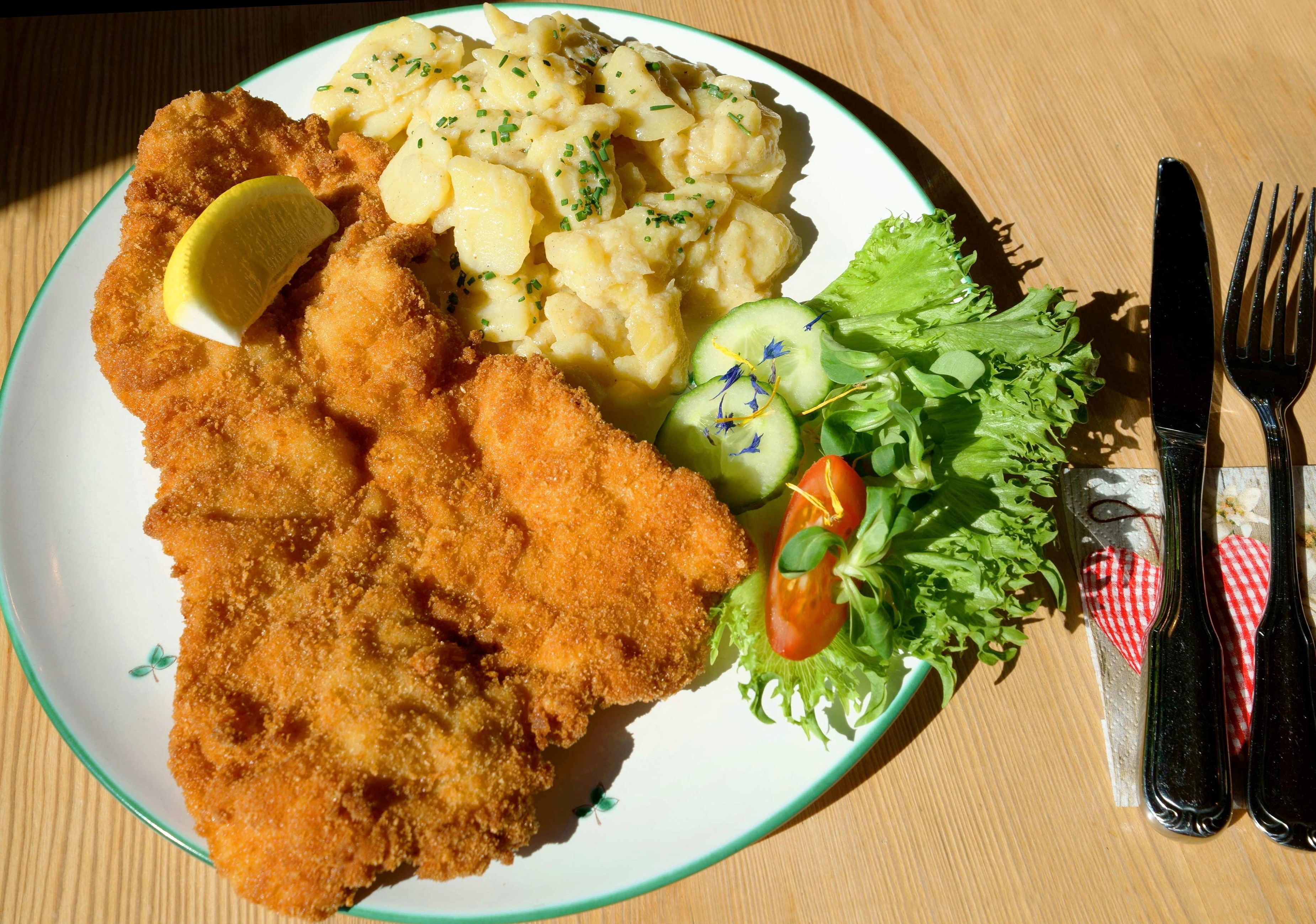
https://upload.wikimedia.org/wikipedia/commons/b/bc/Wiener_Schnitzel_2012.jpg

Wiener Schnitzel, Author Holger.Ellgaard (CC BY-SA 3.0 Unported)

Her children rise up and call her blessed…” (Prov. 31: 28).

My mother worked in the delicatessen she and my father owned.  Her  mother, my grandmother worked — less frequently than my mother — cleaning houses, downtown.

It was my mother who had convinced my father to purchase their small delicatessen in Harlem.  She thrived in the store, making countless friends over the years, despite her shyness and difficulties with language.  At the holidays, Ma lovingly placed hundreds of greeting cards into customer packages.

Grandma would tell us about her day and the swank Manhattan apartments she saw.  Mrs. Garland often said, “No one irons like you.”

Sometimes Grandma would share her concerns for her employers with us.  “Mrs. Garland has a girl older than you.  That one spends too much time alone.  I am going to ask if she can come and play with you.”  Little did we children realize who the famous Judy Garland was or her daughter, Liza.

The Kahls, another couple for whom Grandma cleaned, painted as a hobby.  A painting by the Kahls of the village where my mother spent her early life hung in a place of honor in our dining room, throughout my childhood.

Unlike Ma — always sweet, but ephemeral as smoke — Grandma was pragmatic and down to earth.  Where my mother was emotional, my grandmother was stoic.  Where Ma was silk, Grandma was steel.  Where my mother was yielding, my grandmother was highly organizational.

Lip Balm and Barrettes

Though Grandma was the more practical, Ma made sure to stock every variety of household item for us.

These were kept on hand in the garage:  lip balm, barrettes, contact paper, cold cream, glue, batteries, first aid ointment, hairspray, soap, scissors, cellophane tape, toothbrushes, hair brushes, baby powder, adhesive bandages, rubber bands, oak tag, markers, combs, headbands, suntan lotion, construction paper, crayons, stencils, sparkles, paper clips.  Like a genie, Ma would produce the necessary item at the critical moment.

Stationery, pens, and pencils were kept (along with socks) in a small cherry wood desk, in the living room. Continue reading

20 Comments

Filed under Child Abuse, Child Molestation, Christianity, Emotional Abuse, Neglect, Physical Abuse, Religion, Sexual Abuse

The Rose Garden, Chapter 5 – World War II

https://upload.wikimedia.org/wikipedia/commons/6/62/Displaced_Persons_and_Refugees_in_Germany_BU6635.jpg

Displaced Persons Camp (1945), Hamburg, Germany, Source/Author Imperial War Museum for UK Govt., (PD)

WARNING:  Graphic Images

The earth also was corrupt before God, and the earth was filled with violence” (Gen. 6: 11).

It is difficult to reconstruct the chronology of World War II from my parents’ notebooks.  I can only cobble together bits and pieces.  The times were chaotic.  Territory repeatedly changed hands.  My mother’s narrative is particularly fragmented.

My father saw farms abandoned or destroyed by artillery.  Bridges that had stood for generations were demolished.

Food grew scarce.  Livestock were confiscated without pay by passing troops or slaughtered  outright.  My father took a beloved horse up into the hills, in the hope of finding him again someday.

Two of my father’s brothers and an uncle were forcibly conscripted.  A second uncle was arrested for transporting contraband.

One of the conscripted brothers was finally reunited with the rest of the family in Germany in 1949, having been captured on the Eastern Front and imprisoned by the Russians all that time.  He was a shadow of his former self.

My father, also, witnessed Jews being deported to concentration camps by the Nazis.  He wrote in his notebook:

“The curse was on.  We saw the Jews from Yugoslavia by the thousand[s] in barbed wire wagons, their tongues on the windows and yelling, ‘Water, water!  Please!’  They threw beautiful money, the Yugoslavian dinars, and we picked it up.  This is [the ugliness of] war.  We were children and did not know any better…

[There were] also, German army trains by the dozens going to Yugoslavia fighting partisans.  On their way, [the soldiers] were shining sitting on their tanks, autos, trucks, etc.  On their way home, [they were] filthy, ragged, and flea [bitten].”

My mother was eleven years old when in 1944 the Nazis occupied Hungary.  The war abruptly ended her schooling.

My mother had a personal connection to the Jewish deportation.  The kindhearted woman who ran the local grocery — a woman who had let my mother stand on the counter, when she was a toddler; the very woman who had inspired my mother to dream of working in a food store — was Jewish.

That woman came under cover of darkness to the house one night, and begged for help.  All my grandmother could do was give her some food, and a little money.  The woman was never heard from again.

My mother and her parents, themselves, had to flee to the nearby woods for safety as first Nazi forces, then Russian forces swept through their area.  For a brief time, they went into service in a neighboring village.  But they were never permitted to reclaim their property, so were left homeless.

Expulsion

When Russian forces came through, one of my grandfather’s sisters falsely accused my grandmother of collaborating with the Nazis.  This was the result of a long-simmering grudge related to my great-grandfather.  Promising the village a financial windfall, he had decades earlier left for America with the village’s funds and never made restitution.

It was in this connection, as I understand matters, that my grandmother’s retention of the family’s Hungarian passports saved them.

As Germany’s defeat neared, the USSR urged a plan to evacuate ethnic Germans from Eastern European countries, as an excuse for land redistribution [1A].   In Hungary, many refused to leave the only home they had ever known.

A series of expulsions began in 1946.  As a result, 170,000 German Hungarians were ultimately transported to the American Zone in West Germany; 50,000 to the Soviet Zone in East Germany; and 15,000 to Austria [1B].

Both my parents experienced being transported by cattle car.  The trauma affected my mother so deeply she was unable to speak for a full year afterwards. Continue reading

13 Comments

Filed under Child Abuse, Child Molestation, Christianity, Emotional Abuse, Neglect, Physical Abuse, Religion, Sexual Abuse

The Rose Garden, Chapter 4 – Eden

https://upload.wikimedia.org/wikipedia/commons/3/3e/Yellow_Chrysanthemums.jpg

Yellow Chrysanthemums, Source https://flickr, Author Joe Lewis,
(CC BY-SA 2.0 Generic)

The Lord God planted a garden eastward in Eden, and there He put the man whom He had formed” (Gen. 2: 8).

I am told that at age three I was fearless — routinely toddling along in determined search of adventure, several steps ahead of my grandmother.

Roses

One particular day our path took us past a neighbor’s rose garden.  Evidently drawn to the blossoms, I entered the garden before my grandmother could stop me.

Entranced by the glorious shapes towering above me, I was only vaguely conscious of the heated discussion which ensued when the agitated neighbor rushed anxiously into her yard in defense of the roses.

At that moment, roses — in all shades from ivory to crimson — served to form one of my earliest recollections.

The Bronx

The Bronx is not widely known as a bucolic setting.  A borough of New York City originally named for Dutch settler Jonas Bronck, the Bronx by the 1970s had become a nationally recognized symbol of crime, urban poverty and decay, renowned for burned out buildings.

I was unaware of this growing up.  For me, the Bronx was host to a series of botanical marvels as cherished and familiar as family members.

A Peach Tree, An Apple Tree, and A Pear Tree

To begin with, there was the peach tree in the backyard, valiantly brandishing its fragile petals each spring.

Near that were the brilliant azalea bushes, and the apple tree whose graceful branches stretched past my second floor bedroom window.  Many a daydream was lazily conceived in view of those branches.  A stunted pear tree completed the picture.

Little did I realize that the peach, apple, and pear trees were mere shadows of the lush orchards my grandfather had to leave behind in Hungary.

The Neighbors’ Yards

In the next yard over to the right behind the house reigned a majestic oak, which in the summer months provided both shade and support for a hammock.  I was permitted to use this hammock when on speaking terms with the boy next door — the hammock, a definite incentive to peaceful coexistence or, at any rate, the temporary cessation of hostilities.

The oak truly came into its own in the fall at which point it dropped bushels of acorns before entirely losing its leaves.  The boy and I fought jealously over ownership of the fallen acorns while our fathers — from a rather different perspective — fought over the leaves

The yard to the rear and left of the house was occupied by our Italian neighbors’ carefully cultivated pepper, zucchini, and tomato plants.  Though looked upon with disdain by my Hungarian grandmother, these always grew with abandon.

Adjacent to them, in the yard belonging to my great aunt, grew hydrangea bushes with the mysterious ability to change from pink to blue depending on whether pennies or nickels were buried at their base by attentive children.

Two stately fir trees and a holly bush marked the boundaries of our small front yard.

An Extraordinary Woman

My Spartan grandmother’s garden, however, dominated the yard.  Her garden was one of the few indulgences Grandma allowed herself.  That she could allow herself anything approaching indulgence — given the many hardships she had known — was a testament to her strength.

My grandmother was an extraordinary woman.  In Hungary during World War II, Grandma had survived invasion first by German then Russian armies.  At risk of her life, she disobeyed a Nazi directive and avoided shipment to Siberia.

Though aware that the possession of Hungarian documents was cause for execution under the Nazi regime, my grandmother retained the family’s Hungarian passports throughout the Nazi occupation.

When Russian invaders supplanted Nazi, she was able to produce these passports.  From among some seventy-five persons, only my grandmother, my mother (then still a girl), and two or three others successfully avoided deportation to Siberia. Continue reading

18 Comments

Filed under Child Abuse, Child Molestation, Christianity, Emotional Abuse, Neglect, Physical Abuse, Religion, Sexual Abuse