Tag Archives: false guilt of abuse victims

False Guilt

Courtroom gavel, Author onaeg news agency, (CC BY-SA 4.0 International)

“There are two kinds of guilt.  One is true guilt, that is, it stems from sin against God; we are responsible for it and we have to deal with it.  The second is false guilt, which Satan places on us; this occurs when the devil accuses us of not living up to God’s standards.

Many people live countless years under such deceptive guilt.  They never feel as if they can quite get God’s acceptance; they think they never quite measure up and never quite please God; they believe they will never be all that God wants them to be.”

–Charles Stanley in How to Listen to God

Abuse victims are all too familiar with guilt. 

Told from childhood that we did not measure up, that everything wrong in the family was our fault, we grew up virtually enveloped in guilt.  This is compounded by the fact we are likely to believe we brought the abuse on ourselves (an outright lie, but one of which Satan is particularly fond).

All this is false guilt.

If confronted, we would have difficulty reciting our supposed “sins”.  This is because they do not exist.  Which is not to say that we do not commit real sins.  We are as fallible as the rest of mankind, in that regard.

But the guilt that is unrelenting – the guilt punishing, even crippling us – is false guilt.  We were not responsible for the abuse inflicted on us – whether it was emotional, physical, sexual or took the form of neglect.  We did not engender it.  We did not deserve it.

What we needed and deserved, but were deprived of, were love and care.

Unfortunately, what false guilt does is convince us we are still undeserving.  We labor under the weight of this lie, sometimes turning it into a self-fulfilling prophecy. Continue reading

9 Comments

Filed under Child Abuse, Child Molestation, Christianity, domestic abuse, domestic violence, Emotional Abuse, Neglect, Physical Abuse, Religion, Sexual Abuse

Punishing Ourselves, Part 2 – Emotional Hunger

File:Sarasota Mall at UTC corridor 6.jpg

Shopping mall, Sarasota, FL, Author PCHS-NJROTC (CC BY-SA 4.0 International)

 “But his brothers hated Joseph because their father loved him more than the rest” (Gen. 37: 4 NLT).

Human beings inherently crave connection.  When our basic need for relationship is denied, abuse victims can develop an intense emotional hunger.  Some of us attempt to satiate that hunger with food, others with possessions, still others with sex.

But these will not satisfy us.  So the emotional hunger returns, and the cycle begins all over again – each time destined to fail.

Punishment and Reward

“…the wandering of desire…is vanity and grasping for the wind” (Eccl. 6: 9)..

The reward – whether of food, material things, or sex – becomes punishment.  Each stop gap measure has negative consequences.  Each leaves us feeling empty [1].  Our sense of worthlessness resurfaces with renewed force.

Then the reward used to stem our emotional hunger becomes, itself, a source of shame.  It takes more and more food/things/sex to bring us even temporary relief.  Our desperation increases.

Punishment and Self-Forgiveness

These things I have spoken to you, that in Me you may have peace. In the world you will have tribulation; but be of good cheer, I have overcome the world” (John 16: 33).

Consciously or not, we ache for forgiveness, someone to take the guilt away.  And there is Someone who can do that.  In fact, He longs to do that.  He died on a cross to do that.

But we did nothing to “deserve” abuse.  We do not, therefore, need forgiveness for our abuse.  What Jesus Christ does to relieve us of the false guilt for which we have been punishing ourselves is reveal a truth it would have been too painful for us to accept as children, i.e. that our parents and caregivers were the ones at fault.

Where their love failed us, His will not.  And the life He offers us is everlasting.

[1]  Got Questions, “What does the Bible say about eating disorders?”, https://www.gotquestions.org/eating-disorders.html.

Originally posted 10/8/17

This series began last week with “Punishing Ourselves, Part 1 – Numbness and Deprivation”

FOR MORE OF MY ARTICLES ON POVERTY, POLITICS, AND MATTERS OF CONSCIENCE CHECK OUT MY BLOG A LAWYER’S PRAYERS AT: https://alawyersprayers.com

12 Comments

Filed under Child Abuse, Child Molestation, Christianity, Emotional Abuse, Neglect, Physical Abuse, Religion, Sexual Abuse

Punishing Ourselves, Part 1 – Numbness and Deprivation

File:Caïn venant de tuer son frère Abel by Henri Vidal, Tuileries Garden, 18 July 2017.jpg

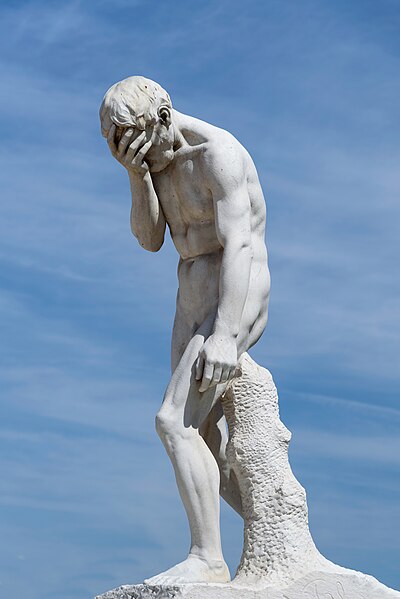
“Cain After Killing His Brother Abel”, Tuilleries Garden, Paris, France, Author Joe deSousa (CC0 1.0 Universal Public Domain Dedication)

WARNING:  Graphic Images

And Cain said to the Lord, ‘My punishment is greater than I can bear!’ ” (Gen. 4: 13).

Though there are some hideous punishments inflicted on children, I will not be focusing on those here.  I want instead to talk about the punishment we inflict on ourselves.  The two are linked.

As abuse victims, we come to believe ourselves deficient, sinful, unworthy of love.

We may be told this directly by curses, blows, and cigarette burns, or indirectly by food, warmth, and shelter denied; by affection, comfort, and encouragement withheld; by the absence of laughter, except at our expense; by the absence of protection from sexual predation; and, above all, by the absence of hope.

Whatever the details in our case, we come to see ourselves as guilty.  We may not be able to name the sins we committed to “deserve” our abuse.  But we are certain of our guilt.

It is as if we bear the mark of Cain without ever having committed the crime.

Punishment and Deprivation

My soul has been deprived of peace; I have forgotten what happiness is” (Lam. 3: 17).

Those of us who were deprived of the basic necessities as children may deprive ourselves the same way as adults.

We cannot keep the refrigerator full or the pantry stocked.  We have difficulty using the new sheets, and may prefer sleeping on the couch or floor.  We resist purchasing a favorite food or appealing item of clothing for ourselves.  We take time off from work only reluctantly for a vacation.

Collateral to this, abuse victims who were physically and/or emotionally starved may hide food (or money and valuables) in secret spots around the house or yard.

While it may be painful to us, none of this behavior is a sign of “insanity” on our part.  It is simply a residual scar of the abuse inflicted on us, the rational response to irrational circumstances. Continue reading

7 Comments

Filed under Child Abuse, Child Molestation, Christianity, Emotional Abuse, Neglect, Physical Abuse, Religion, Sexual Abuse

Unbiblical, Part 2 – Sin Nature v. Abuse-Related Guilt

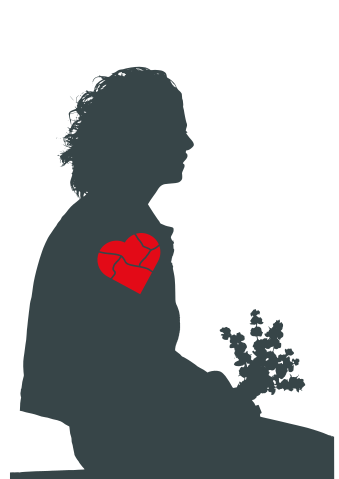
Woman with a broken heart, Author Nevit Dilmen, Source Sunset 02459.jpg and Broken Heart symbol.svg (CC BY-SA 3.0 Unported)

Christians speak regularly about the “sin nature” of mankind, the inclination by human beings to do wrong, as illustrated by wars and crime.

The following verses on the topic are typical:

“…[T]he imagination of man’s heart is evil from his youth…” (Gen. 8:21).

“ ‘The heart is deceitful above all things, and desperately wicked…’” (Jer. 17:9).

“ ‘Then I will…take the stony heart out of their flesh, and give them a heart of flesh that they may walk in My statutes…’ ” (Ezek. 11: 19-20).

“ ‘For out of the heart proceed evil thoughts, murders, adulteries, fornications, thefts, false witness, blasphemies’ ” (Matt. 15: 19).

If anyone has experienced that sin nature, abuse victims have.  Victims, however, have been more sinned against than sinning.

Unfortunately, the continuous emphasis on sin is likely to sound like condemnation to victims, when what they need is love, encouragement, and hope.

Christians should remember that abuse leaves behind deep scars.  Victims of abuse may struggle with gender identification, sexual addiction or dysfunction, self-neglect, anxiety, depression, dissociation and related amnesia, drug or alcohol addiction, cutting, anorexia, bulimia, bingeing, and other issues.  The majority of prostitutes are thought to be runaways, with a history of abuse.

Dealing with major problems like these is not for the faint of heart.  Nor is it for the self-righteous.  Merely living ordinary lives can take enormous effort and enormous courage by abuse victims.  That victims, for the most part, accomplish this is amazing.

Victims should not be made a topic of gossip.  Nor should they be subjected to snap judgments, whether about their morality or mental state.

Above all, victims should be reassured that they were not the guilty party in abuse; that, as children, they were wholly incapable of consent to whatever was done to them; and that God still loves them, despite all they have been through.

Originally posted 3/15/15

This series will continue next week with Humility v. Lack of Worth

FOR MORE OF MY ARTICLES ON POVERTY, POLITICS, AND MATTERS OF CONSCIENCE CHECK OUT MY BLOG A LAWYER’S PRAYERS AT: https://alawyersprayers.com


20 Comments

Filed under Abuse of Power, Child Abuse, Christianity, Emotional Abuse, Neglect, Physical Abuse, Prostitution, Religion, Sexual Abuse

In the Aftermath of Abuse, Part 2 – Guilt and Shame

Crying child, Author Asad Amjad ChangEzi (CC BY-SA 4.0 International)

‘If anyone causes one of these little ones—those who believe in Me—to stumble, it would be better for them to have a large millstone hung around their neck and to be drowned in the depths of the sea’ ” (Matt. 18: 6).

It is easier for children to believe they “deserve” the evil done to them, than to take in the fact an adult who should care for them actually has little or no regard for their well-being.

The Statute of Limitations and other obstacles can make it difficult to hold child abusers and molesters accountable legally.  Even with a conviction, however, the feeling of “sinfulness” may rebound from an abuser to his victims.

This in no way implies that they were at fault.  Victims, however, relive the trauma of having been treated as worthless. They are often left with a vague sense of unworthiness that can permeate their lives, and undermine subsequent relationships.

Though this feeling of their own “sinfulness” can be overwhelming to abuse victims, the conclusions they draw from it are not accurate.  Victims did not warrant or invite the abuse.  They remain deserving of love.

The feeling of “sinfulness” is just one of the scars left in the wake of abuse.  Other symptoms can include anxiety, depression, alcohol or drug addiction, eating disorders, and sexual dysfunction.  These behaviors either stem from the pain or are attempts to numb it.  All of them “punish” the victim, who was never at fault in the first place!

The symptoms of abuse may, themselves, become a cause of shame to victims.  Self-destructive behaviors shift the focus away from the abuse, while silently declaring it to the world.  Imperfect as coping mechanisms, these behaviors can have dire consequences but are, in effect, a cry for help.

Originally posted 7/7/13

Of NoteA Vatican tribunal has found Archbishop Anthony Apuron of Guam guilty of abusing minors and removed him from office.  Apuron was suspended in June 2016 following accusations that he sexually abused altar boys as a parish priest during the 1970s.

Thus far, the Archdiocese of Guam has been named in 159 sex abuse lawsuits involving Apuron and others.

FOR MORE OF MY ARTICLES ON POVERTY, POLITICS, AND MATTERS OF CONSCIENCE CHECK OUT MY BLOG A LAWYER’S PRAYERS AT:  https://alawyersprayers.com

12 Comments

Filed under Child Abuse, Child Molestation, Emotional Abuse, Neglect, Physical Abuse, Sexual Abuse

Punishing Ourselves, Part 2 – Emotional Hunger

“Joseph’s Coat of Many Colors Brought to Jacob after Joseph Is Sold into Slavery” by Diego Velazquez (1630), El Escorial (PD-Art l Old-100)

But his brothers hated Joseph because their father loved him more than the rest” (Gen. 37: 4 NLT).

Human beings inherently crave connection.  When our basic need for relationship is denied, abuse victims can develop an intense emotional hunger.  Some of us attempt to satiate that hunger with food, others with possessions, still others with sex.

But these will not satisfy us.  So the emotional hunger returns, and the cycle begins all over again – each time destined to fail.

Punishment and Reward

“…the wandering of desire…is vanity and grasping for the wind” (Eccl. 6: 9).

The reward – whether of food, material things, or sex – becomes punishment.  Each stop gap measure has negative consequences.  Each leaves us feeling empty [1].  Our sense of worthlessness resurfaces with renewed force.

Then the reward used to stem our emotional hunger becomes, itself, a source of shame.  It takes more and more food/things/sex to bring us even temporary relief.  Our desperation increases.

Punishment and Self-Forgiveness

These things I have spoken to you, that in Me you may have peace.  In the world you will have tribulation; but be of good cheer, I have overcome the world” (John 16: 33).

Consciously or not, we ache for forgiveness, someone to take the guilt away.  And there is Someone who can do that.  In fact, He longs to do that.  He died on a cross to do that.

But we did nothing to “deserve” abuse.  We do not, therefore, need forgiveness for our abuse.  What Jesus Christ does to relieve us of the false guilt for which we have been punishing ourselves is reveal a truth it would have been too painful for us to accept as children, i.e. that our parents and caregivers were the ones at fault.

Where their love failed us, His will not.  And the life He offers us is everlasting.

[1]  Got Questions, “What does the Bible say about eating disorders?”, https://www.gotquestions.org/eating-disorders.html.

This series began last week with “Punishing Ourselves, Part 1 – Numbness and Deprivation”

FOR MORE OF MY ARTICLES ON POVERTY, POLITICS, AND MATTERS OF CONSCIENCE CHECK OUT MY BLOG A LAWYER’S PRAYERS AT: https://alawyersprayers.com

5 Comments

Filed under Child Abuse, Child Molestation, Christianity, Emotional Abuse, Neglect, Physical Abuse, Religion, Sexual Abuse

Punishing Ourselves, Part 1 – Numbness and Deprivation

Isolation cells at Fremantle Prison, Australia, Author Gnangarra (CC-BY-2.5-AU)

WARNING:  Graphic Images

And Cain said to the Lord, ‘My punishment is greater than I can bear!’ ” (Gen. 4: 13).

Though there are some hideous punishments inflicted on children, I will not be focusing on those here.  I want instead to talk about the punishment we inflict on ourselves.  The two are linked.

As abuse victims, we come to believe ourselves deficient, sinful, unworthy of love.

We may be told this directly by curses, blows, and cigarette burns, or indirectly by food, warmth, and shelter denied; by affection, comfort, and encouragement withheld; by the absence of laughter, except at our expense; by the absence of protection from sexual predation; and, above all, by the absence of hope.

Whatever the details in our case, we come to see ourselves as guilty.  We may not be able to name the sins we committed to “deserve” our abuse.  But we are certain of our guilt.

It is as if we bear the mark of Cain without ever having committed the crime.

Punishment and Deprivation

My soul has been deprived of peace; I have forgotten what happiness is” (Lam. 3: 17).

Those of us who were deprived of the basic necessities as children may deprive ourselves the same way as adults.

We cannot keep the refrigerator full or the pantry stocked.  We have difficulty using the new sheets, and may prefer sleeping on the couch or floor.  We resist purchasing a favorite food or appealing item of clothing for ourselves.  We take time off from work only reluctantly for a vacation.

Collateral to this, abuse victims who were physically and/or emotionally starved may hide food (or money and valuables) in secret spots around the house or yard.

While it may be painful to us, none of this behavior is a sign of “insanity” on our part.  It is simply a residual scar of the abuse inflicted on us, the rational response to irrational circumstances. Continue reading

13 Comments

Filed under Child Abuse, Child Molestation, Christianity, Emotional Abuse, Neglect, Physical Abuse, Religion, Sexual Abuse

“Never, Never, Ever, say these 15 comments to a Victim of Abuse” by Sue Cass

Sue Cass is an abuse survivor and Christian author.  She blogs at Cyber Support Group https://cybersupportgroup.org, Elah Ministries Inc. http://www.elahministries.com, and Sue’s Pen2PaperBlog https://suespen2paper.com .  I recommend her books and blogs to you.

“There’s a difference between still being a victim of abuse and a survivor of abuse.

A person that still carries the shame, guilt, unforgiveness, has not healed the emotional issues from abuse, or is still being abused is continuing to be a victim.

The person that can stand tall, speak out with no shame, no guilt, and has walked the healing path is a survivor of the abuse that was perpetrated in the past. It isn’t just having ‘lived through the abuse.’ It is a matter of having walked the healing path and by God’s grace has over come the emotional issues and is walking in freedom from the past.

Many people want to be helpful and many think that their questions and statements are innocent and do not affect those that have been abused, be it childhood sexual abuse or spousal rape and abuse, or physical and emotional abuse.

Over the years I have heard many testimonies of the added pain inflicted upon victims and survivors of these types of abuse. I have experienced many of them myself and I can tell you from experience the survivor of abuse may steal herself/himself for the onslaught of ‘innocent’ questions and statements but these questions and/or statements are knives deeply imbedding in the heart of the one who has survived the horrors of abuse.

Never, never, never, ever say these things to a victim/survivor of abuse: 

  1. ‘You could have done something to defend yourself.’

Let me ask you how a small child can defend herself against an adult? Or how can a wife defend herself against a husband that is bigger, stronger and wields some object, including his fist, at her? Or a teen girl or boy defend themselves against an angry father or mother? Children are taught to obey! Obey no matter what the parent says to do! Wives are taught to be ‘submissive’ to their husband.

  1. ‘Why didn’t you just leave?’

In the case of a small child, where would they go? A two-year old cannot support themselves, nor a 5-year-old or 7, 10, or 12-year-old. Teenagers? Some do leave and they end up on the street, homeless, the property of a pimp, or within a gang doing drugs, robbing, stealing, scavenging for food in dumpsters, and the Lord only knows what else. Many do not have relatives that will sympathize and take them in. For the grown woman, some are threatened with death if she ever leaves, she has children to consider, a homeless shelter may be a temporary answer IF they are not full, she may not have ever held a job in her life and has no means of support. The list can go on and on and on. I highly recommend the book, “The Walking Wounded: The Path from Brokenness to Wholeness” by Secret Angel for a better understanding of a wife and mother living with an abusive husband.  Available at: www.amazon.com.

  1. “Why didn’t you tell someone!” 

Many have, most won’t. With young children some have been told to “keep the secret no matter what!” Many were accused of lying, blamed for the assaults, beaten for “telling such lies,” ignored, threatened with family members being killed (and many other guilt-ridden consequences) Most have been subject to mind control from an early age, manipulated and controlled, blamed for the abuse by the abuser. One of the things I was told over and over as a young child, “Just stay away from him!” At two and three years old I was told, “If you wouldn’t sit on your dad’s lap…” We are made to feel it is all our fault! For teenagers some have been actually thrown out of the house at fifteen or sixteen years old or have run away because no-one believed them and the abuse continued. Some married the first guy to come along only to be abused now by a husband. Victims are seldom believed! Males are laughed at. “Men can’t be raped!” If that’s your attitude then read, “Unhelpful Myths About the Sexual Assault and Rape of Men.” Posted on this blog, June 10, 2015.

  1. ‘Well you should have……’ or ‘Why didn’t you…..?’

Unless you have been in our shoes there is no way you can even begin to understand or comprehend the dynamics that are or were going on in an abusive home. To lay this kind of condemnation on a victim is to jab the knife in real deep, smile sweetly, and then twist it!

  1. ‘Did you call the police?’

Young children don’t know to do that.  Some teenagers do and end up in foster care only to be abused again or bounced from one place to another to another to another. Some, when the police arrive the abuser convinces the police the teen “has some mental problems.” Unless there are obvious bruises and cuts the police will file a report and leave.  With adults, many do but out of a false sense of “I love him” or “He loves me” they refuse to press charges once the police have come. Many do not get that opportunity for the control is so great there may not even be a phone available in the home. Continue reading

52 Comments

Filed under Child Abuse, Child Molestation, Christianity, Emotional Abuse, Neglect, Physical Abuse, Prostitution, Rape, Religion, Sexual Abuse, Sexual Assault, Violence Against Women

Unbiblical, Part 2 – Sin Nature v. Abuse-Related Guilt

Christians speak regularly about the “sin nature” of mankind, the inclination by human beings to do wrong, as illustrated by wars and crime.

The following verses on the topic are typical:

“…[T]he imagination of man’s heart is evil from his youth…” (Gen. 8:21).

“ ‘The heart is deceitful above all things, and desperately wicked…’” (Jer. 17:9).

“ ‘Then I will…take the stony heart out of their flesh, and give them a heart of flesh that they may walk in My statutes…’ ” (Ezek. 11: 19-20).

“ ‘For out of the heart proceed evil thoughts, murders, adulteries, fornications, thefts, false witness, blasphemies’ ” (Matt. 15: 19).

If anyone has experienced that sin nature, abuse victims have. Victims, however, have been more sinned against than sinning.

Unfortunately, the continuous emphasis on sin is likely to sound like condemnation to victims, when what they need is love, encouragement, and hope.

Christians should remember that abuse leaves behind deep scars. Victims of abuse may struggle with gender identification, sexual addiction or dysfunction, self-neglect, anxiety, depression, dissociation and related amnesia, drug or alcohol addiction, cutting, anorexia, bulimia, binging, and other issues. The majority of prostitutes are thought to be runaways, with a history of abuse.

Dealing with major problems like these is not for the faint of heart. Nor is it for the self-righteous. Merely living ordinary lives can take enormous effort and enormous courage by abuse victims. That victims, for the most part, accomplish this is amazing.

Victims should not be made a topic of gossip. Nor should they be subjected to snap judgments, whether about their morality or mental state.

Above all, victims should be reassured that they were not the guilty party in abuse; that, as children, they were wholly incapable of consent to whatever was done to them; and that God still loves them, despite all they have been through.

This series will continue next week with Humility v. Lack of Worth

 FOR MORE OF MY ARTICLES ON POVERTY, POLITICS, AND MATTERS OF CONSCIENCE CHECK OUT MY BLOG A LAWYER’S PRAYERS AT: http://www.alawyersprayers.com


15 Comments

Filed under Abuse of Power, Child Abuse, Christianity, Emotional Abuse, Neglect, Physical Abuse, Prostitution, Religion, Sexual Abuse

In the Aftermath of Abuse, Part 2 – Guilt and Shame

Sexually abused child (1910), Author Dr. P. Langenscheidt, Source “Der Sexualverbrecher” [“The Sexual Criminal”], (PD, published before 1/1/23)

‘If anyone causes one of these little ones—those who believe in Me—to stumble, it would be better for them to have a large millstone hung around their neck and to be drowned in the depths of the sea’ ” (Matt. 18: 6).

It is easier for children to believe they “deserve” the evil done to them, than to take in the fact an adult who should care for them actually has little or no regard for their well-being.

The Statute of Limitations and other obstacles can make it difficult to hold child abusers and molesters accountable legally.  Even with a conviction, however, the feeling of “sinfulness” may rebound from an abuser to his victims.

This in no way implies that they were at fault. Victims, however, relive the trauma of having been treated as worthless. They are often left with a vague sense of unworthiness that can permeate their lives, and undermine subsequent relationships.

Though this feeling of their own “sinfulness” can be overwhelming to abuse victims, the conclusions they draw from it are not accurate.  Victims did not warrant or invite the abuse.  They remain deserving of love.

The feeling of “sinfulness” is just one of the scars left in the wake of abuse.  Other symptoms can include anxiety, depression, alcohol or drug addiction, eating disorders, and sexual dysfunction.  These behaviors either stem from the pain or are attempts to numb it.  All of them “punish” the victim, who was never at fault in the first place!

The symptoms of abuse may, themselves, become a cause of shame to victims.  Self-destructive behaviors shift the focus away from the abuse, while silently declaring it to the world.  Imperfect as coping mechanisms, these behaviors can have dire consequences but are, in effect, a cry for help.

FOR MORE OF MY ARTICLES ON POVERTY, POLITICS, AND MATTERS OF CONSCIENCE CHECK OUT MY BLOG A LAWYER’S PRAYERS AT:  https://alawyersprayers.com

6 Comments

Filed under Child Abuse, Child Molestation, Emotional Abuse, Neglect, Physical Abuse, Sexual Abuse