Tag Archives: codependence

The Rose Garden, Chapter 18 – Love and Loss

File:Venice Carnival - Masked Lovers (2010).jpg

Venice Carnival – Masked Lovers, Source https://flickr.com, Author Frank Kovalchek, Anchorage, AK, (Creative Commons Attribution 2.0 Generic)

WARNING:  Graphic Images

He heals the brokenhearted And binds up their wounds” (Ps. 147: 3).

The hotel clock reads 4:30 AM.  I can see from the bed that it is still dark outside.  Unable to sleep, unable to bear the thought of spending another day in Los Angeles, I pick up the phone and reschedule my flight. 

That done, I move around the room, gathering and throwing things carelessly into my bag.  I walk over to the closet, stare briefly at the blue silk dress I had hoped to wear on Mulholland Drive, but decide to leave to it behind.  

Downstairs in the rental car, I head on unfamiliar freeways to the airport.  The trip is a blur.  I veer sharply to the right, across two lanes, to make my exit.  Horns blare. 

Once on the plane, I stare blindly forward.  My chest heaving, I begin to sob.

I have been fortunate in both male and female friends, but have loved three men deeply in my life.  Whether lanky, wiry, or muscular, all three were men of integrity and high intelligence.  All three were incapable of commitment, at least to me.

All three were lawyers, heaven help me.

How does the heart choose?  We seek out what we have known, try as we may not to do this.  The choice (unconscious though it may be) is an attempt to correct for past mistakes, to erase the scars.

I sought out emotionally elusive men — men unable to love me.  As a result, love caused me far more grief than joy.  What kept me in the relationships was not that these men loved me, but that they might.  I was familiar — in a sense comfortable —  with being loved only marginally.

The other characteristics I selected for were kindness and a history of suffering.  I wanted to ease pain, but justified behavior toward myself other women would not have tolerated.  I never considered whether I deserved a healthy and fulfilling relationship.

Both sexual abuse and codependence played a role in this.

I settled for little, believing I deserved less.  In fact, I did not see myself as deserving of love at all.  I simply assumed a normal, stable man would reject me; would be unable either to understand or put up with my pain.

My hope, my unspoken prayer, was that someone capable of kindness and with his own knowledge of loss might be better equipped.

It was to such men I was drawn.  One lost his father early to serious illness.  Another suffered at the hands of a cold and critical mother.  The last was abandoned by his father following divorce.

The problem with my approach was that I sought out men as wounded as myself.  Though not worth any less, those deeply wounded early in life may find it difficult to love or be loved.

There is too much risk involved in revealing the true self.  Instead, they repeat unhealthy patterns, and inflict damage of their own.

Certainly I did.  As an example, at a college concert my sister had looked forward to attending with me, I opted to sit near the object of my affection and his date, rather than with my sister.  That verges on masochism.  Yet, had he told me he loved me, my own love would likely have evaporated.

My sister remained steadfast.  I remember standing in the front hall, nervously checking my reflection before heading out for the evening.  “You look beautiful,” my sister said.  “If he doesn’t love you, he’s an idiot.”

Though I cannot say with any certainty, I suspect now that two of the men I loved may, themselves, have been victims of emotional or covert incest.

Fear of intimacy can be well-founded.  Those of us who suffer from it seek out difficult or impossible relationships.  Normalcy is perceived as boring; intimacy, as suffocation.

The goal of healing the beloved can become the justification for our existence.  Paradoxically, the beloved is chosen for his or her inability to heal.  It is the resulting tension that constitutes the real glue of the relationship.

“You have a wonderfully feminine quality.” “I love your body.  It’s so responsive.” “Any man in his right mind would want you.”  All lies men tell women.  All lies I have cherished.

When our relationship ended, I packed and shipped for safekeeping to a friend the emails one man and I had exchanged.  Though the dream had died, I could not bear to part entirely with the words. Continue reading

23 Comments

Filed under Child Abuse, Child Molestation, Christianity, Emotional Abuse, Justice, Neglect, Physical Abuse, Religion, Sexual Abuse

The Rose Garden, Chapter 16 – The Weight of Sorrow

File:Clothing Rack of Jeans.jpg

Clothing rack of women’s jeans, Source https://www.publicdomainpictures.net, Author Peter Griffin, (CC0 1.0 Universal Public Domain Dedication)

Man shall not live by bread alone, but by every word that proceeds from the mouth of God” (Matt. 4: 4).

It is late in the season.  I wander from one clothing rack to another, searching for my size.  The coats have been picked through.  There are few remaining.  It is unlikely I will be able to find a coat that fits, let alone flatters, me.

Please, God, I pray.  Please, let me find something.  I promise to lose weight.  I promise to try harder.

One scar of the incest has been of such magnitude in my life that it warrants separate discussion.  This is weight control.  I have prayed as fervently in the Women’s Department as in any cathedral.

For an abuse victim, the difference between size 8 and size 18 is no mere matter of discipline.  A child who is molested feels like offal.  Whatever impulses drive her abuser, she is less than nothing in his eyes, and — despite his soothing words to the contrary — she knows it.

Against this backdrop, weight often becomes a problem.  Eating disorders are common — anorexia, bulimia, binge eating, etc. [1][2][3][4].  In this, I am typical.

Distress, Defense, Punishment, and Shame

Food is a natural source of comfort for the sexually abused child, maladaptive when weight becomes an issue.

Weight serves many purposes.  It is a distress signal:  silent evidence of the molestation, the secret exposed.  It is a defense, the child’s feeble attempt to create a physical barrier against the predator; later, an emotional barrier to adult relationships.

Increased weight is a psychological way of hiding from rejection.  Failed relationships can be blamed on weight.  However painful this approach may be, it is less painful than rejection of the “true self.”

Weight is punishment for misplaced guilt.  The little girl cannot be forgiven for having engendered the violation (as if she did), and cannot forgive herself for being “unlovable.”  So her anger turns inward, with depression the result.

The cycle repeats itself — over and over — as weight is gained, lost, and regained.   In the process, weight becomes an alternate focus for the shame of the abuse.

All this is unconscious.

A Symbol of Rage and A Test

As the child grows into a woman, weight takes on even more shades of meaning.  It embodies rage at men; shouts, in effect, “Damn them all!  They’re vapid and shallow, anyway — unable to recognize real worth.”

It serves as a test for the woman.  It serves as a test for the man she hopes will love her.  It serves as punishment for the woman’s failure to be lovable, yet again.

Food as Love – An Analgesic and An Anesthetic

Food offers instant gratification while love, in her experience, does not.

Food is, of course, nourishment.  As the body requires food, so the soul requires love.  Love is vital.  The soul craves it.  Deprived of love, the soul starves.  Food becomes the unsatisfactory substitute for love denied, an analgesic against the pain.

In terms of our anger at having been abused, food is more like an anesthetic.  Unable to express that anger appropriately at the time, we forced it down with food, then “forgot” why we were eating (or denying ourselves food) so compulsively.  Attempts to diet are futile because they do not address the underlying rage.

Distrust of God

While we may not think in such terms, at a deeper level, a disordered relationship with food by abuse victims reflects a distrust of God.

Since our needs were not met as children by those who stood in God’s shoes, we have little reason to believe that God will meet them now.  So we try to meet them ourselves, try to assure that we will at least have as much (or little) food as we want.

But we cannot satisfy our hunger — our desire not only for love and justice, but for control over our own lives — since that hunger is emotional rather than physical.

God is capable of filling our needs.  However, we must first put our trust in Him.  For abuse victims, that can be a lifelong challenge.

All this applied to me; took me decades to decipher.  Continue reading

16 Comments

Filed under Child Abuse, Child Molestation, Christianity, Emotional Abuse, Neglect, Physical Abuse, Religion, Sexual Abuse

The Rose Garden, Chapter 15 – Chocolate or Vanilla

File:Vegan Double Chocolate Brownie Chunk Ice Cream (4869832969).jpg

Brownie and Ice Cream, Source https://flickr.com, Author Veganbaking.net

The day for building your walls will come, the day for extending your boundaries” (Micah 7: 11).

A commentary in The Woman’s Study Bible makes an essential distinction between guilt and shame:

“Guilt is a God-given emotion that occurs when a woman’s mistakes and faults are brought to her own mind or publicly exposed…

Shame, however, says that the person herself is bad…that she is hopelessly defective, unlovable, inferior, and worthless.  Shame begins externally with a subtle implication through silence and neglect or verbal denunciation through words of abuse.  When such messages are repeated often enough, whether through words or actions, they become internalized into a false belief:  I must be bad to deserve such terrible treatment.  This becomes the core identity and the basis of thousands of future, flawed choices for the one suffering from shame [1A].”

The Study Bible goes on to say:

Healing of shame begins when a woman identifies the lies she believed about herself…

Sometimes [however] the victimizing acts done to a person may be so shame-producing that she is still emotionally bound by that shame, though she understands mentally her [true] worth in God’s eyes.  In these situations, she must bring her shame…to Jesus.  Ultimately, only He can bring full emotional cleansing and freedom [1B].”

This is not easy for me, even today.  It is an ongoing process.

As victims, we are not the guilty parties.  However, it mistakenly feels that way.  Therefore, we punish ourselves.  Self-deprivation is one means.

Self-Deprivation

The victims of abuse will often deny themselves the essentials.  Some children will not wash.  They feel dirty and, at an unconscious level, want the world to know.  Other children become obsessed with cleanliness, as I did.

Since expiation cannot be accomplished (it is the wrong party being punished), the behavior is difficult to overcome.

My sister and I have more than once bought for each other the blouse, skirt, or coveted bangle we could not bring ourselves to buy.  As a result of her early trauma, my mother could not choose between chocolate and vanilla ice cream.

“Which would you like, Ma?”

“Either one is okay.”

“Really, it’s no trouble.  I have both.”

“You choose.”

“Do you want both, Ma?  A little of both, maybe?”

“Doesn’t matter.  You choose.”

This excessive desire to please on my mother’s part may have been the result of codependence.  But self-deprivation, also, played a role.  We kept for years in a plastic bag at the back of the refrigerator, behind the vegetable bin, a small fox stole my great aunt had given us.  It was, after all, too good to wear.

I have, myself, slept on the couch because there were new sheets on the bed.  Clothes are somehow more perfect hanging in the closet, clean and untouched.  New lingerie can stay in the drawer for months.  I have difficulty even today allowing myself the small luxury of a manicure.

There are echoes of my grandmother in this.

I can count on one hand the number of full-fledged vacations I have taken.  A friend called mine “Waldherrian” vacations.  These are never actualized:  all fantasy, no fun.

The best of my vacations — to England — was actually arranged as a surprise by my mother and sister for my 30th birthday.  To her great credit, my mother, also, paid for a school trip to Italy which lingers sweetly in memory.

When my grandfather died, college friends called with their condolences.

“We were so sorry to hear, Anna.  Is there anything you need?  Anything we can do?”

“No, thank you.  Not really.”

“We’re calling to find out where the wake is being held.”

“The wake?  You want to come to the wake?!”

“Of course.  We want to be there for you.”

“It’s all the way up in the Bronx.  I don’t want to put you guys to all that trouble.  Really, you don’t have to come.”

“But we want to.  Everyone’s here.  Everyone.  Dressed and ready.  We just need directions to the funeral parlor.”

“Thank you.  I’m grateful.  Truly I am.  But it’s better if you don’t.”

And so it goes.  Our instinct is to deny ourselves comfort in any form. Continue reading

21 Comments

Filed under Child Abuse, Child Molestation, Christianity, Emotional Abuse, Neglect, Physical Abuse, Religion, Sexual Abuse, Sexual Assault

The Rose Garden, Chapter 7 – The Snow Fort

File:Snow Fort 2009.jpg

Snow fort, Author Andrew Wiseman (CC BY-SA 3.0 Unported)

For He says to the snow, ‘Fall on the earth’; Likewise to the gentle rain and the heavy rain of His strength” (Job 37: 6).

Winter followed summer, and one year another.  With time I acquired logic and organizational skills from my grandmother.  From my grandfather, I learned to dance.

My grandfather reveled in music.  Where my grandmother’s taste ran to hymns, he enjoyed livelier music — polkas, waltzes, mazurkas, csárdáses.  I first learned to dance to these standing on the sofa, supported in Grandpa’s arms.

As I grew older, he chided me sternly to dance in a ladylike manner — “Small steps, small steps!” — something I never quite mastered.  Absorbing my grandfather’s passion for life more readily than his instructions on decorum, I was routinely swept away by the music.

Grandpa taught me the difference between pints and quarts, patiently pouring paint from one can to another for me.

Grandpa was, also, the one to part my hair on the left.  I would stand between his knees, as he carefully plied the comb.  “No, not on the right, Annalein.  Never on the right.  Hitler parted his hair on the right.”

It was my father who cut my hair.  Since it was usually kept short, I worried that strangers might mistake me for a boy.

Evenings the family would sit contentedly listening to my grandfather’s large collection of records or watching televised wrestling with him.

Sunday afternoons, we would all listen to Strauss on the radio with its rotating display of vinyl fish.  My sister and I would lie on the living room rug on these afternoons, drawing or coloring as the sun spilled through the windows.

My recollection of Grandpa is of a smiling, mustachioed man in a white cotton undershirt — a glass of beer and a box of crackers at his side. Continue reading

15 Comments

Filed under Child Abuse, Child Molestation, Christianity, Emotional Abuse, Neglect, Physical Abuse, Religion, Sexual Abuse

“People Pleasing” Behavior, Part 2

Foto Removing the mask. Fotografia tirada por Luciano Moreira inserida na categoria arte-digital
Saved from junior.fineart-portugal.com

Those of us who are “people pleasers” as the result of childhood abuse and/or domestic violence have our reasons.  Deprived of affection, we long for acceptance.  Often cruelly punished when we did not conform to the expectations of others, we fear rejection.

Saying “no” to a request is difficult for us.  Putting boundaries in place, since it was never allowed, feels foreign and selfish.  We may even have been taught that it was “unchristian”.

Unfortunately, “people pleasing” behavior is not productive in the long run.  It is likely to leave us overworked and overwhelmed – often angry with ourselves for having failed to speak out.  Over time, we can lose sight of who we really are.

Inauthenticity drains the joy from living.  How then do we change this behavior?

Continue reading

13 Comments

Filed under Child Abuse, Child Molestation, Christianity, domestic abuse, domestic violence, Emotional Abuse, Neglect, Physical Abuse, Religion, Sexual Abuse, Violence Against Women

“People Pleasing” Behavior, Part 1

Traffic jam, Author Mario Roberto Duran Ortiz Mariordo (GFDL, CC Attribution 3.0 Unported)

  • You make a left-hand turn at an intersection, with your signal on well in advance.  The driver behind you stops in mid-roadway, and exits her vehicle to shout at you.  You can see her in your rearview mirror, gesturing wildly.   Puzzled, you re-examine your actions for several hours, in a fruitless effort to identify what you did wrong.
  • The vehicle behind yours persists in tailgating.  You can feel the sweat break out on your brow.  You check and re-check your speed.  Finally, the other driver tears past, and you breathe a sigh of relief.
  • Alone at night, in a deserted area, you nervously speed up after the vehicle behind yours repeatedly flashes its high beams.  When you do stop at a lit plaza, the other driver pulls alongside to berate you.  You are mortified, at a loss how to respond.

Admittedly, there are bullies and lunatics on the road these days.  And all of us make occasional mistakes, whether driving or otherwise.

The truth is that we cannot please everyone, even when we adhere perfectly to the rules of the road or the rules of civil society.  Unlike the rules of the road, of course, the rules of society are often ambiguous.

But the inability to please others is extraordinarily painful for those of us who are “people pleasers” as a consequence of child abuse.  Domestic violence only adds another layer to our distress.

We long for peace, and try to achieve it through compromise.  We twist ourselves into pretzels trying to please.

The problem is that we have deep reservoirs of undeserved shame.  Our first assumption, in the face of any confrontation, is that we must be in error.

Since all human beings are fallible, we can generally find flaws in ourselves.  These do not, however, justify abusive behavior by those with whom we come in contact.

This series will conclude next week.

FOR MORE OF MY ARTICLES ON POVERTY, POLITICS, AND MATTERS OF CONSCIENCE CHECK OUT MY BLOG A LAWYER’S PRAYERS AT: https://alawyersprayers.com

21 Comments

Filed under Child Abuse, Child Molestation, domestic abuse, domestic violence, Emotional Abuse, Neglect, Physical Abuse, Sexual Abuse, Violence Against Women

“13 Characteristics of Adult Children of Alcoholics” by Buddy T and Dr. Steven Gans

traits of children of alcoholics

Illustration by JR Bee, Verywell

The following is excerpted from “13 Characteristics of Adult Children of Alcoholics” on VeryWellMind.  The full article may be found at:  https://www.verywellmind.com/common-traits-of-adult-children-of-alcoholics-66557.

“If you grew up in an alcoholic home, you’re probably familiar with the feeling of never knowing what to expect from one day to the next.  When one or both parents struggle with addiction, the home environment is predictably unpredictable.  Argument, inconsistency, unreliability, and chaos tend to run rampant…

Continue reading

9 Comments

Filed under Child Abuse, Child Molestation, Emotional Abuse, Neglect, Physical Abuse, Sexual Abuse

Gomer – A Study in Self-Sabotage

“Head of a Woman with Her Hair Loose” by Vincent van Gogh, Van Gogh Museum, Amsterdam, Author Dennis Jarvis (CC BY-SA 2.0 Generic)

The biblical prophet Hosea lived during a dark period in Israel’s history, around the 8th Century BC.  Though prosperous, the Northern Kingdom had turned away from the one true God, instead worshipping idols.

Against this backdrop, God’s puzzling direction to Hosea was that he should marry a prostitute:

Go, take yourself a wife of harlotry And children of harlotry, For the land has committed great harlotry By departing from the Lord” (Hosea 1: 2).

Hosea’s troubled relationship with his wife, Gomer, becomes a metaphor for God’s relationship with Israel [1].

Gomer bears Hosea three children, whose names are symbolic of the spiritual deterioration of Israel [2].  But Gomer is repeatedly unfaithful.  Hosea even questions the paternity of the younger children.

Despite that, Hosea is commanded by God to love Gomer (Hosea 3: 1).  God warns Israel of terrible chastisement to come for its sin [3].  Hosea is not though described as punishing Gomer.  Rather, he ransoms her out of slavery.

We can infer that Hosea provides Gomer food and clothing, and treats her tenderly.  Ultimately, Hosea forgives Gomer’s infidelity as God forgives Israel’s.

Motivation

Since Gomer does not speak, we are left to wonder about her motivation.  Here she is, rescued from a life of degradation.  Yet she does not – or cannot – remain faithful.  Did she feel ignored by Hosea?  Did she long for male attention and admiration?  For the excitement of the streets (or the sensuality of pagan worship)?

Self-Sabotage

Why can what we know is wrong sometimes feel so “right”?  For abuse victims, self-sabotage may be part of the answer.

Self-sabotage is the expression of low self-esteem.  Any behavior which undermines our success can fall into this category.  Examples include binge drinking, engaging in unprotected sex, and selecting an alcoholic life partner.  The behavior may be conscious or unconscious.

“Typically, one’s pattern of self-sabotage is closely related to one’s personal issues and family history.   Survivors who grew up in addictive families may self-sabotage by driving while drunk… Survivors from violent families may…[be] beaten or injured.   Survivors from wealthy families often find themselves losing money, getting swindled or making bad investments.  Studies have shown that survivors of child sexual abuse are more likely to be assaulted as adults [4].”

This is not to suggest that abuse victims are responsible for the abuse inflicted on them.  Nor is it meant to imply that victims want to be re-victimized. Continue reading

14 Comments

Filed under Child Abuse, Christianity, Emotional Abuse, Neglect, Physical Abuse, Prostitution, Religion, Sexual Abuse, Violence Against Women

Finding Ourselves

In the day that God created man, He made him in the likeness of God.   He created them male and female, and blessed them…” (Gen. 5: 1-2).

Each of us is made in the image of God, and each unique.  Abuse can bury that knowledge, along with our hopes and dreams.  We can lose ourselves – can feel so downtrodden, so crushed, that we believe we are worthless.  But that is a lie.

The challenge for abuse victims is to find ourselves again.  To find ourselves and reclaim our lives.

A song like Kelsea Ballerini’s “Miss Me More” may lift our spirits (a step in the right direction).  Even high heels and red lipstick may help.  Scripture, however, serves as a more reliable guide.

Accepted

Accept one another, then, just as Christ accepted you, in order to bring praise to God” (Rom. 15: 7 NIV).

In Christ, we are accepted.  After a lifetime of rejection, this is an astonishing experience.

Loved

“…just as He chose us in Him before the foundation of the world, that we should be holy and without blame before Him in love, having predestined us to adoption as sons by Jesus Christ to Himself…” (Eph. 1: 4-5).

In Christ, we are God’s beloved children, members of His own family, selected from the beginning of the world. Continue reading

14 Comments

Filed under Child Abuse, Child Molestation, Christianity, domestic abuse, domestic violence, Emotional Abuse, Neglect, Physical Abuse, Religion, Sexual Abuse, Violence Against Women

Unbiblical, Part 5 – Self-Sacrifice v. Codependence

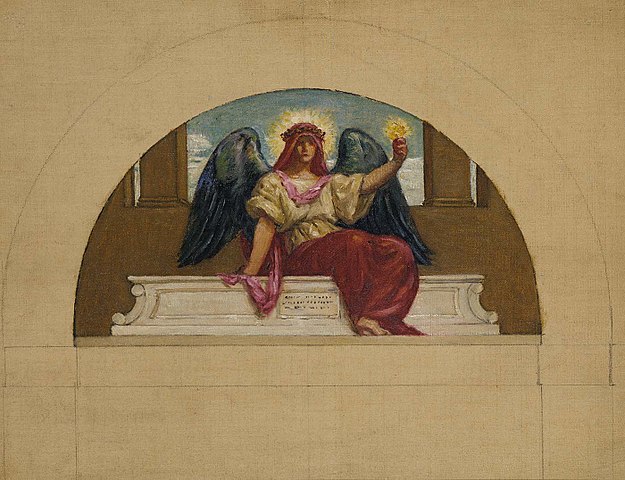
Sketch for mural “The Spirit of Self-Sacrificing Love” by Kenyon Cox at Oberlin College, Smithsonian Museum (1983.114.15), Source https://americanart.si.edu (PD-Art, PD-Old-95)

“The poverty of being unwanted, unloved and uncared for is the greatest poverty.  We must start in our own homes to remedy this kind of poverty.”

– Mother Teresa

Self-sacrifice is natural to Christians, and encouraged.  Christians are to put the legitimate needs of others ahead of their own, in imitation of Christ.  Mother Teresa was a shining example of this.  For abuse victims, however, self-sacrifice can become confused with codependence.

Codependence as an After-Effect of Abuse

Individuals suffering from codependence will allow the emotions and behavior of others to dictate their view of themselves.  Those with codependence will tolerate – even, unconsciously, seek out – relationships that are “one-sided, emotionally destructive and/or abusive verbally or physically” [1].

Codependent characteristics include low self-esteem; fear of anger; denial of any problems with the relationship; and an exaggerated sense of responsibility for the feelings, choices, and actions of the loved one [2].

While on its face, codependence may resemble Christian self-sacrifice, there are distinct differences between the two.

The codependent individual may forego his/her goals and desires to meet the perceived “needs” of a loved one.  But the underlying motive for this is not the welfare of the loved one.  It is fear.

Actually, the codependent individual is attempting to shore up his/her fragile sense of worth, strike an unspoken bargain for love and affection, and maintain the relationship at all costs (however abusive or unsatisfying it may be).  An overly solicitous mother might be a crude illustration.

By comparison, Christian self-sacrifice is not the attempt to manipulate (or placate) an individual perceived as more “important” or powerful.  It is, or should be, truly selfless.

Clinging to an Imitation

None of this is meant to imply that abuse victims cannot love and love intensely.  The problem lies in the fact victims have not seen healthy love modeled.  What feels familiar is a flawed version of love, an imitation.  The real love and support victims need seem out of reach, so we cling to the imitation with all our might, confusing pain for passion. Continue reading

18 Comments

Filed under Child Abuse, Christianity, Emotional Abuse, Neglect, Physical Abuse, Religion, Sexual Abuse