Category Archives: Religion

Invalidation

Distressed woman, Source https://pixaby.com, Author pixaby user “Free-photos” (Creative Commons CC0 1.0 Universal Public Domain Dedication)

“You’re overreacting.”

“You’re being overly sensitive.”

“You shouldn’t take things so personally.”

“You make a big deal out of everything.”

“I’m sure it wasn’t that bad.”

“You probably misunderstood.”

“It never happened that way.  You’re making things up.”

“You shouldn’t be angry [or hurt or sad].”

Invalidation of our feelings, when it becomes a pattern of behavior, is a form of emotional abuse [1A].  Depending on our upbringing, it can begin in childhood, occur during an adult friendship or romantic relationship, or both.

Feelings As Valid

We are born with the capacity to feel in response to our environment and those in it.  Emotions are an important source of information for us [1B].  They help us identify danger, and protect ourselves against it.

Feelings, in themselves, are not right or wrong.  They are the result of thoughts, prior life events, and perceptions unique to ourselves [1C].  Two people can legitimately have different emotional responses to the same situation.

Emotional validation is a critical communication tool, particularly in families [2A].  It helps sustain emotional connection, making us feel safe and secure.  Its absence has the opposite effect.

Mechanism of Invalidation

At various times our feelings may be [1D]:

  • Minimized as excessive for a given situation;
  • Dismissed as inappropriate or groundless, because our assessment of the situation is supposedly inaccurate; or
  • Ignored entirely, as if we were invisible and not experiencing them (or our experience was irrelevant to the abuser which – sad to say – it frequently is).

This can cause enormous shame, over and above the emotion we are actually experiencing and attempting to convey.

Impact on Children

Children who regularly experience emotional invalidation may learn to ignore, hide, or distrust their own emotions, while striving ever harder to please others [2B].  This leaves them dependent on and vulnerable to external validation. 

Invalidation can lead to emotional detachment or, in extreme cases, borderline personality or narcissism.  It is, also, a tool used by narcissists on children and adults alike.

Adult “Gaslighting”

Among adults, invalidation is a powerful if subtle means of manipulation known as “gaslighting” which allows the abuser to alter the victim’s reality.  Abusers routinely use it to blame the victim, and diminish their responsibility for the harm they have done [1E]. Continue reading

24 Comments

Filed under Child Abuse, Child Molestation, Christianity, domestic abuse, domestic violence, Emotional Abuse, Neglect, Physical Abuse, Religion, Sexual Abuse

Light from Darkness, Part 2

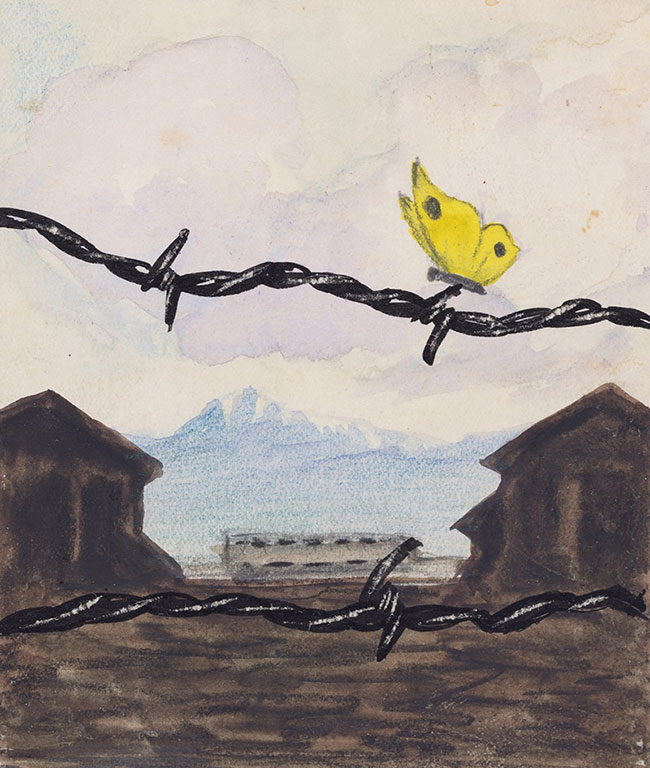
“One Spring, Gurs Camp” (1941) by Karl Robert Bodek and Kurt Low, Yad Vashem Museum, Israel, Image courtesy of Yad Vashem Collection

WARNING:  Graphic Images

Abuse comes in many forms.  From 1933 to 1945 in Nazi Germany it was governmental, with the goal being complete extermination of the Jews [1].

The artworks comprising the Yad Vashem Collection were created by artists (Jewish and non-Jewish) between 1939 and 1945 to provide a living testament of the Holocaust [2A].  A hundred works from the collection were exhibited in Germany in 2016, just three years after the Alternative for Germany (AfD) was founded – a far Right party whose leader, Björn Höcke denigrated the Memorial to Murdered Jews of Europe [3][4].

Art in the concentration camps served simultaneously as a witness, a means of self-assertion, and an expression of optimism [2B].

The works are both heart wrenching and awe inspiring.  In “One Spring, Gurs Camp” (above), the barbed wire depicts imprisonment and loneliness.  The butterfly and the mountains in the background, however, suggest hope. 

One of the two artists who collaborated on “One Spring”, 28 y.o. Kurt Low, was released and able to flee to Switzerland.  The other, 37 y.o. Karl Bodek, was ultimately murdered at Auschwitz. Continue reading

15 Comments

Filed under Abuse of Power, Child Abuse, Child Molestation, Christianity, domestic abuse, domestic violence, Emotional Abuse, human trafficking, Neglect, Physical Abuse, Rape, Religion, sex trafficking, Sexual Abuse, Sexual Assault, Slavery, Violence Against Women

Loneliness

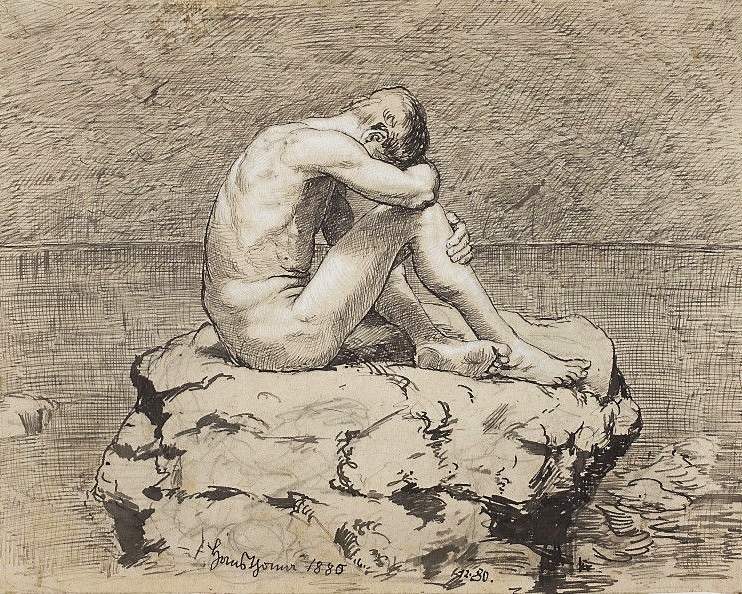
“Loneliness” (1880) by Hans Thoma, National Museum in Warsaw (Accession No. 192915/22), Source cyfrowe.mnw.art.pl (PD)

“Turn to me and be gracious to me for I am lonely and afflicted.  Relieve the troubles of my heart and free me from my anguish” (Ps. 25: 16-17).

Loneliness is a feeling of isolation, detachment, and lack of social connection – an emotional state now so common it has its own Wikipedia page [1].  An argument might easily be made that there is, in fact, a loneliness epidemic.  Across the globe, there are some 740,000 suicide deaths annually [2].

All human beings experience loneliness, at one time or another, particularly when we have lost someone or ended a relationship.  In some sense, loneliness characterizes our species.  But the feeling can be particularly intense for abuse victims.

Empty Goals

Part of this is due to the pursuit of empty goals by our culture. 

Ours is a materialistic society.  We are encouraged to be shallow, to seek fame and wealth above all things.  Yet these do not guarantee happiness.  In fact, avid pursuit of them may increase our loneliness.  

Fame for its own sake is meaningless.  And no number of McMansions (or villas on the Riviera, for that matter) can fill an empty heart.

Broken Families

Broken families are another cause for loneliness, and these are endemic in our society. 

At least 40% of American children are today born out of wedlock [3A].  The percentage among African Americans is much higher [3B].  This means children do not have the financial support – and regular presence – of both a mother and father.  As a consequence, 59% will live in poverty [4]. 

Half the remaining children will experience divorce, which means that fully 70% of American children will not live in a two parent household, for at least some part of their childhood [5]. Continue reading

20 Comments

Filed under Child Abuse, Child Molestation, Christianity, domestic abuse, domestic violence, Emotional Abuse, Neglect, Physical Abuse, Religion, Sexual Abuse, Violence Against Women

Vigilance, Part 4 – Sexual Abuse

“Bless Me Child for I Have Sinned” (2010-2013) by Trina McKillen, Image courtesy of AMA Journal of Ethics https://journalofethics.ama-assn.org/

These days, children can become victims of sexual exploitation in a variety of ways.  If the sexual predator is a parent, the incest is likely to be a closely held secret.  Whoever the predator, sexual abuse has long-term, devastating consequences.

The warning signs of sexual abuse include the following [1]:

  • A young child who suddenly has difficulty sitting or walking, suggesting injury to the genital area.
  • A child who suddenly refuses to change for gym or take part in other physical activities at school.
  • A child whose hygiene changes suddenly, since children who have been sexually abused may feel “dirty” and stop bathing (or become obsessed with cleanliness, and wash constantly).
  • A child who demonstrates unusual knowledge of sex or sexualized behavior.
  • A child who becomes pregnant or contracts a venereal disease, especially under the age of fourteen.
  • A child who says s/he has been sexually abused by a parent or caregiver.

We assume that the predator parent or caregiver (uncle, boyfriend, etc.) is likely to be secretive and isolated.  This is not always, however, the case.

The sexual predator may be unusually “protective” of the abused child, often sharply restricting a child’s contact with other children – particularly those of the opposite sex.

Guardians

We are the only guardians children have against the darkness of this world.  It is vital that we remain vigilant on their behalf.

Be sober, be vigilant; because your adversary the devil walks about like a roaring lion, seeking whom he may devour” (1 Peter 5: 8).

[1]  Prevent Child Abuse America, “Recognizing Child Abuse:  What Parents Should Know”,   https://preventchildabuse.org/resource/recognizing-child-abuse-what-parents-should-know/.

Originally posted 1/26/20

FOR MORE OF MY ARTICLES ON POVERTY, POLITICS, AND MATTERS OF CONSCIENCE CHECK OUT MY BLOG A LAWYER’S PRAYERS AT: https://alawyersprayers.com

10 Comments

Filed under Child Abuse, Child Molestation, Christianity, Emotional Abuse, Neglect, Physical Abuse, Religion, Sexual Abuse

Dreadful Sins

Portrait of Gisèle Pelicot by Ann-Sophie Qvarnström as an illustration for Wikipedia (CC BY-SA 4.O International)

WARNING:  Graphic Images

“Madam, we the women of East London feel horror at the dreadful sins that have been lately committed in our midst.”

–Petition to Queen Victoria by 4000 impoverished women of Whitechapel

In fear for their lives, the women of London’s Whitechapel petitioned Queen Victoria for relief when Jack the Ripper was at large [1][2].  The Ripper is known to have murdered 5 women, but the exact number of his victims is uncertain [3].  These women were all characterized as prostitutes, though they may simply have been destitute women.

Serial Killings

Despite his infamy, Jack the Ripper was not the first serial killer of women.  Nor will he be the last.  The savagery of such attacks will not be addressed here. 

There are, however, men who have no compassion for women — whether they ever become serial killers or not.  They do not recognize women as human beings, and feel entitled to use and degrade them.  A few celebrity predators come to mind, though fame is not a prerequisite.

Sex Trafficking

Worldwide, of course, there are sex traffickers who exploit women by force, fraud, and coercion for their own financial gain.  Drugs are commonly employed to secure control over women in the sex trade. 

Rape by Proxy

Dominique Pelicot, aged 71, went a step further.  Pelicot was recently convicted in France of repeatedly drugging Gisele (his wife of 50 years), then recruiting 50 different men to rape her over a 10 year period [4A].  The men (who, themselves, ranged in age from 26 to 68) were likewise convicted, though some claim they believed they were taking part in an erotic game [5].

Pelicot took thousands of videos of these men abusing his unconscious wife.  Though she was asleep during the assaults, Gisele Pelicot suffered large gaps in memory, hair and weight loss, as side effects of the drugs her husband was surreptitiously administering to her [4B].  She feared she was developing Alzheimer’s Disease or a brain tumor. Continue reading

24 Comments

Filed under Abuse of Power, Child Abuse, Child Molestation, Christianity, domestic abuse, domestic violence, Emotional Abuse, Justice, Law, Neglect, Physical Abuse, Poverty, Prostitution, Rape, Religion, sex trafficking, Sexual Abuse, Sexual Assault, Violence Against Women

The Rose Garden – Afterword

https://upload.wikimedia.org/wikipedia/commons/7/72/Rosa_%27Charisma%27%2C_Bad_W%C3%B6rishofen%2C_Alemania%2C_2019-06-20%2C_DD_05.jpg

“Charisma” Rose, Author Diego Delso (CC BY-SA 4.0 International)

who comforts us in all our tribulation, that we may be able to comfort those who are in any trouble, with the comfort with which we ourselves are comforted by God” (2 Cor. 1: 4).

I have tried to paint an accurate and nuanced picture of people and events.  This is in no way intended to excuse abuse.  Whatever his or her personal history, the adult in a situation of child abuse remains the responsible party.

Ultimately, my story is not one of incest — or even loss — but love.  I was blessed with a loving sister, mother, grandmother and grandfather; and saved by Love Incarnate.

I had access to great books and great teachers.  I had the help of fine physicians and psychologists.  I had the opportunity to work in a field I loved passionately — in the process becoming the person I was intended to be.  I have always been surrounded by loving friends.

Not all children in the world are as fortunate.  Worldwide, millions each year are the victims of physical, emotional, and/or sexual abuse or neglect, with devastating consequences.  My case is just one among many.

The National Child Abuse and Neglect Data System (NCANDS) reports that there were 558,899 cases of documented abuse or neglect in 2022.  That equates to one in seven children in the United States abused or neglected each year [1][2].  Since abuse and neglect are underreported, experts believe the true number is far higher [3].

Thankfully, there is now a much greater awareness of the problem than when I was a child.

Each child’s life is precious, a banner waiting to unfurl.  But God values the worn and battle-scarred banner no less.

If there is a lesson to be drawn from my experience and family history, it is that — with God’s help — we endure.  Bitterness is not an answer to life.  We all bear scars.  Whatever our personal sorrows, we each of us have something inside only we can give.

And we have a choice.  To lift a finger, light a candle, lend a hand…or not.  Opportunities for good abound.

Defeat is a temporary condition.  It is a greater triumph to have struggled against failure and rejection, than never to have failed for fear of making the attempt.  Even in loss there is honor.

Take that chance.  The world is waiting.  The roses are in bloom.


[1]  Children’s Bureau, Administration for Children and Families, “Child Maltreatment 2022”, https://www.acf.hhs.gov/sites/default/files/documents/cb/cm2022.pdf.

[2]   McLean Hospital, “Understanding Child Abuse and Its Effects on Mental Health”, 8/18/23, https://www.mcleanhospital.org/essential/effects-child-abuse.

[3]  National Institutes of Health, National Library of Congress, National Biotechnology Information Center, “New Directions in Child Abuse and Neglect Research” by National Research Council, et al, 3/25/14, https://www.ncbi.nlm.nih.gov/books/NBK195982/ and https://nap.nationalacademies.org/catalog/18331/new-directions-in-child-abuse-and-neglect-research.

Copyright © 2008 – Present Anna Waldherr.  All rights reserved.
ISBN: 978-1-60247-890-9

FOR MORE OF MY ARTICLES ON POVERTY, POLITICS, AND MATTERS OF CONSCIENCE CHECK OUT MY BLOG A LAWYER’S PRAYERS AT: https://alawyersprayers.com

13 Comments

Filed under Child Abuse, Child Molestation, Christianity, Emotional Abuse, Neglect, Physical Abuse, Religion, Sexual Abuse

The Rose Garden, Chapter 22 – A Voice Reclaimed

File:Justice scale and flag.jpg

Scales of Justice, Author St. Louis Circuit Attorney’s Office, (CC BY-SA 4.0 International)

WARNING:  Graphic Images

we also glory in tribulations, knowing that tribulation produces perseverance; and perseverance, character; and character, hope” (Rom. 5: 3-4).

The American Psychiatric Association defines three major dissociative disorders [1]:

  • Depersonalization/derealization disorder — a sense of separation from self;
  • Dissociative amnesia — suppressed memories; and
  • Dissociative identity disorder — alternate identities.

These conditions arise from shocking, distressing, and/or painful events, including severe neglect or repetitive physical, emotional, and/or sexual abuse.  Symptoms can range from memory loss to disconnected identities.

Thankfully, I never, myself, suffered from suppressed memories or alternate identities.  There were, however, three aspects to my personality as a result of the incest:  an inner child; a capable woman; and a cynic.  By the grace of God, I have since managed to integrate these aspects with one another.

What purpose, I ask myself, did these aspects of my personality serve?

The Inner Child

The inner child preserved the feelings I experienced as a child.  She represented my lost innocence.

The child made a rare public appearance on the one occasion I was required to testify at trial, on my own behalf.  All legal knowledge on my part evaporated.  I leaned tensely forward on the witness stand, responding to each question precisely and with extreme care, my eyes fixed on opposing counsel.

Jurors commented afterwards that I seemed too sincere for an attorney, must have been holding some part of myself back.  Little did they realize how much I had actually revealed.

The Capable Woman

The woman was the attorney — competent, dignified.  She predominated.  Although heavily focused on work, she was able to function.

The Cynic

The cynic was a source of passion and strength.  She had no problem expressing anger.  And the cynic had a voice that the child did not.

Surprisingly, it was foul language which first allowed me access to that voice.  Not having heard such language as a child, I was not denied it.  That was the key.

The equipment necessary to the practice of law is located above the neck.  I acquired profanity as a way of conveying that fact to fools in the legal profession who actually believed gutter language a demonstration of strength.

Profanity is a weapon denied women, if they are to be considered ladies by our culture. Though I do not endorse it, I ask to be judged by the same standards applied to men for utilizing that weapon.

I never aspired to be a lady.  I aspired to be a hero. Continue reading

15 Comments

Filed under Child Abuse, Child Molestation, Christianity, Emotional Abuse, Justice, Law, Neglect, Physical Abuse, Rape, Religion, Sexual Abuse

The Rose Garden, Chapter 21 – He Knows My Name

“Storm on the Sea of Galilee” by Rembrandt (1633), stolen from Isabella Stewart Gardner Museum (1990) (PD)

“…I know you by name” (Ex. 33: 17).

If I had abandoned God, He had not abandoned me.

By His grace, the college I attended required theology classes among its core requirements.  I will never forget the professor who taught the majority of those classes.  Not only was I impressed by the faith of the biblical authors of whom he spoke, he at last took my questions about meaning seriously.

I still have one of the papers that professor graded.  On it he commented about my “religious irreligiosity.”  To my doubts about God, he responded:

“I hope that the uncertainty will be the gate to a richer level of life — but every horizon means death to the past, and that is hard.  Yet that is the price of growth.  You must trust in your own worth, and build from there.”

When I began to practice law, I became acutely aware of my limitations.  There was a church nearby one of the courthouses, and I would regularly stop in.  Sure that I had no right to ask, I would beg the Lord for courage, beseech Him to watch over my clients.  Praying for my clients became a habit.

Faith Restored

Still my faith wavered.  Then in 1999, a couple of evangelical friends suggested we have Sunday brunch following their church service.  I assumed the service would be harmless, so agreed.  My life has not been the same since.

The sermon was from the Book of Ruth, always a favorite of mine.  Ruth, a young widow, chooses not to abandon her, also, widowed mother-in-law.

Reduced to poverty, Ruth is permitted by a distant kinsman to gather the grain left in his fields.  He comes to love her.  It is from this story that we derive the beautiful lines:  “Wherever you go, I will go; and wherever you lodge, I will lodge.  Your people shall be my people; and your God, my God” (Ruth 1: 15-17).

It was one of the hymns that brought me to tears.  Entitled “He Knows My Name” the song went, in part:

“He knows my name.
He knows my every thought.
He sees each tear that falls,
And hears me when I call.

I have a Father.
He calls me His own.
He’ll never leave me,
No matter where I go.”

Suddenly, I was suffused in love; overwhelmed with the reality of Christ’s presence and the knowledge that He had been with me all the times I thought I had been forsaken and alone.  I felt cleansed and forgiven.

By the time the song ended, I was sobbing so hard I could not make it forward for the altar call.

We see God through the clouded lens of our experience.  Having been molested, I rejected what I saw as a harsh Father.  Life had distorted the lens.  But Christ from the cross said, “Father, forgive them, for they do not know what they do” (Luke 23: 34).

Thankfully, I had the opportunity to forgive my father.

Storm

Initially, it was my mother we were concerned about.  In 1999, we were told by my mother’s internist that her condition was terminal.  My mother had developed mitral prolapse.  In light of the fact she was on blood thinners, surgery to replace the heart valve would not be possible.

For more than a year, we labored under that assumption, as my mother’s condition worsened.  My parents had lost the store when her heart first failed.

In trying to sort things out at the time, I dug through twenty years’ worth of Blue Cross records she had accumulated.  Paper was everywhere, except in the cabinet I have given her for that purpose.  In shoeboxes, under the couch, beneath seat cushions.  Evidence of her own scars.

When matters reached a head, I left my job in order spend time with Ma.  The doctor reversed himself.  Ma had a heart valve successfully installed.

I commuted for months from Pennsylvania to New York before, during, and after.  I spent hours on the turnpike weeping (having, also, ended a relationship with someone I loved at this time).

Somewhere in heaven there must be a silver lake of tears.

For a short period, it was necessary for me to stay at my parents’ house.  There were no hotels in the area at the time.  My sister was by now married and living on Staten Island, well over an hour away.  The moment to moment emergent conditions and New York City traffic did not make staying with her a realistic option.

The thought of being alone in the house with my father was unbearable.  The day I arrived, I sat parked in front of the house trembling, and could not bring myself to go in.

I drove up to the water; sat there for awhile, trying to compose myself.  I drove back to the house, but still could not go in.  I would be sleeping upstairs; my father, downstairs.  There were no locks, however, on the doors between us.

Finally, I determined, if he made an advance toward me, I would kill him.  I had no idea how.  But I was so distraught I could see no other option.  Thankfully, it never came to that.

Instead, my father’s health began to deteriorate.  He experienced a series of strokes and was briefly hospitalized.  I had by this point started another position.

Again, I commuted.  When he was released, his memory, balance, and impulse control could no longer be relied on.

My father had vehemently resisted discharge to a rehabilitation facility.  “Please, please, let me go home!”  Hoping to assist Ma (who was still, herself, recuperating from surgery), and fearful he might leave the stove on at the house or somehow injure himself, we arranged home care.

The practical nurse who arrived was an older woman.  When my father introduced us, he said, “This is my daughter, Annie.  Doesn’t she have a great figure?”  I felt mortified.  Flayed.  The nurse and I exchanged looks — hers, knowing; mine, that of a trapped animal.

My parents discharged her within two days.  They did not feel comfortable having a stranger in the house.  No amount of convincing could change their minds.

Confronting the Abuser

Though I returned home to Pennsylvania, I kept in close touch.  One phone call was pivotal.

I was in increasing distress during the call; kept trying to hold back, in light of my father’s now physical and mental limitations; kept trying to get off the phone.  The blood was pounding in my ears.

How exactly we got on the topic, I cannot say.  It was the sex scandal in the Roman Catholic Church, I think, that set him off.  My father’s mind had always ranged widely.

“Those priests were something, weren’t they?  Imagine hurting a child!”

“Mmm.”

“Animals.  They should all be shot!”

“They certainly caused a lot of harm.”

“We had priests at home in Hungary like that, too.  The old fat one ate like a pig.  Everyone knew he slept with his housekeeper.”

“Mmm.”

“You remember.  I told you.  Whenever we served at the mass, the young one would say, ‘No. No, that’s enough wine.  Just a drop.’  The old one would get pissed off, if we didn’t keep pouring.”

“Yes, you said.”

“What a shame you have to live so far away, honey.  I always imagined we would all live together under one roof.”

“I like it in Philadelphia, Pop.”

“And it’s a shame you never married.  A pretty girl like you.”

“Pop, I have to go run errands now.”

“You know, I have time on my hands these days.  I look back.  If we had only pushed you a little to that guy at the beach.  Maybe things would be different.”

“No, Pop.  They wouldn’t.”

“Come on, honey.  A little sex would have been good for you.”

“Please, stop, Daddy.  Let’s talk about something else.”

“I tried to teach you.  You were always so interested in sex as a little girl.”

“That’s a lie, Daddy.  You did to me what those priests did.  It influenced every relationship I had with a man.  It hurts me to this day!”

“But you wanted it.”

“No!  That’s another lie!!  You can tell yourself whatever you want.  But it’s a lie!”

“Does Margaret know?”

“Yes.”

“Don’t tell Mommy.  Please.  Whatever you do, don’t tell Mommy.”

As with my statement to the anesthesiologist, it was a plea, not a threat.

Heading back to New York the day my father was returned to the hospital, I was caught in an enormous traffic jam at the George Washington Bridge.  He had suffered a stroke at home in the early hours of the morning, been intubated, and taken away by ambulance.  I sat at the bridge, sobbing.

The doctors tried everything.  Fluid continued to build up in my father’s lungs.  He remained in the Intensive Care Unit.  The tube could not be removed without endangering his life.  Unable to communicate, my father became increasingly agitated, gesticulating in frustration.

Weeks went by before we remembered the health care proxy he had executed.  That he and my mother would actively pursue health care proxies had come as a surprise.  Neither my sister nor I had suggested the idea.  We agreed to it only at our parents’ insistence.

All of us knew how much my father feared hospitals and hated doctors.  It suddenly came to us that he had been making writing gestures, referring to the proxy.  Despite our best intentions, we had been ignoring his wishes.  The ICU confinement had been torture for him.

We consulted my father’s physicians about a prognosis.  Short of exploratory surgery (with risk of greater harm and very little hope for success), they had no more ideas.  We contacted and spoke at length with the ethicist on duty.  The ethicist met with my father and laid this all out for him.

In our presence, my father repeatedly confirmed that he wanted the breathing tube removed.  He was conscious and aware; nodded or shook his head at appropriate times.  Asked if he wanted to die, my father mournfully shrugged his shoulders—clearly unhappy at that prospect.   His intentions now, however, were clear.  Plans were made to remove the tube.

The evening the procedure was to take place, our family gathered in the ICU, outside my father’s cubicle.  Within earshot, not ten feet away, a group of physicians were discussing the case, and disparaging the decision.  I went ballistic.

“How long have you known this man?!  Do you have any idea how much love for him there is represented by the three of us?  Well over a hundred years!  Do you think you can match that?  Your arrogance is appalling.  How dare you!”

They backed off, visibly shaken by the madwoman.

When I was last alone with my father, he looked pleadingly at me and reached out his hand — the first two fingers extended; thumb, ring finger, and little finger curled under.

I was immediately certain what he meant.  I knew what he was asking, as clearly as if he had spoken aloud.  But I did not trust my judgment.  I could not risk hurting him, in that final moment.  So, I told him only that I loved him.

He died the next morning, having slipped into a restful sleep.  The nurse let us know she had rarely seen such a peaceful end.

“F” is for forgiveness.  It is the letter of the alphabet my father was attempting to form.

Waiting in a friend’s living room, some weeks later, I had time to contemplate the picture on her wall.  It was of a boat in a storm — suggesting that storm on the Sea of Galilee, when the Lord calmed the wind and the waters.  My storm had been raging so long.  I felt so battered; felt I had so little left to offer.

Softly, slowly, I felt an idea unfold.  Only the craft tested by storms do we know to be seaworthy.  Those new and brightly painted boats bobbing by the shore are untried.

Peace settled over me.

Generational Abuse

Since child molestation can be generational, I have asked myself whether my paternal grandfather ever molested one of his daughters.  I have my suspicions, but no actual proof.

There is mention in my father’s notebook of an uncle who seemed overly familiar with his own daughter.  That makes the hair on the back of my neck stand on end.  

What I believe happened is that my father imitated the actions of his father and/or uncle.  He took such behavior as his right, without any thought as to the impact on his victim.  I confess that this is sheer speculation on my part.  Child abuse victims can, as adults, see abuse where it does not exist.  So I may be wrong.

Was my father, himself, molested?  By a priest perhaps?  If so, he never said.  And my father was not one to remain silent about such a violation, if he had suffered it. 

Either way, I suspect the cramped physical conditions and enforced intimacy of my father’s childhood surroundings, together with the emotional unavailability of his own father, led to a situation of covert incest between my father and his mother.  She relied on her son too heavily and too early for emotional support.

World War I left its mark on my paternal grandfather.  World War II left its mark on my father.

His father’s harsh treatment diminished my father’s view of himself.  The war experience increased the weight of responsibility on my father’s shoulders, making him feel yet more vulnerable and small.  A boy in a man’s body.

Those same two factors combined to blunt my father’s sensitivity toward others.  He carried those scars forward.  My mother’s fragile emotional make-up set the stage for a repeat scenario.

Millions have endured war without becoming child molesters.  On the other hand, if my parents had not been deported, they would never even have met.

An Admission of Guilt

Did my father realize what he was doing was wrong?  Yes, without doubt.  Evil may find rationalizations.  All his denials aside, my father’s request that I not tell my mother was an admission of guilt.

Did my father molest additional children?  This is another question I cannot answer.  I think his actions were confined to the family setting.  I hope and pray they were.

The Existence of Evil

Evil exists in the world, even if the lines between right and wrong are today being blurred.  Any assertion that sexual contact between an adult and child can benefit the child is a despicable lie.  I can state that unequivocally.

Whatever our background, we are not a mere conglomeration of impulses.  We make choices.  And choices have consequences — for the victim and abuser, both.

There is a distinction under the law between rights and privileges.  Rights are entitlements.  Privileges — for instance, the privilege of living in vicinity to a school — can be revoked.  And they should be forfeit, even if an offender has otherwise served his or her time.

There can be no other course, if a society is to protect its weakest members.

Forgiveness for the Sake of the Victim

About a month after my father died, I dreamed of him.  I could see him standing outside the house, his face childlike and alight with wonder.

How can pedophilia ever be forgiven?  Forgiveness is not a feeling.  It is a deliberate decision to put something aside.  I have heard it described as an act of will, with a prayer attached.

Had I not been able to forgive my father, my scars would be even deeper than they are.  But I do not presume to grant all pedophiles a blanket pardon. 

God is amazing.  I can think of my father today with almost the love I felt for him as a child.  The sight of an older man on a bicycle without fail will bring a smile to my face.

Now an evangelical Christian, myself, I had the chance to co-found and lead a volunteer organization providing legal aid to the inner city poor.  I know the joy of mentoring underprivileged children.  I laugh as hard and often as I can.

The giant is no more, but a Japanese cherry tree stands just off my balcony.  I still love the wind in my hair.  I write on the desk we used to keep socks in.

Young or old, rich or poor, captive or free, priest or judge, physician or fisherman, the authors of the Bible all concluded that God is a good and holy God — doing so even in the face of suffering, as Job and the prophet, Jeremiah, testify.

It was Jeremiah, you may remember, who was thrown into the pit (Jer. 38: 6-7).  It was Jeremiah who cried out in despair, “Cursed be the day in which I was born!” (Jer. 20: 14).  Yet, it was Jeremiah who wrote to the captives in Babylon who felt they had been forsaken:

Then you will call upon Me and go and pray to Me, and I will listen to you.  And you will seek Me and find Me, when you search for Me with all your heart” (Jer. 29: 12-13).

Job declared of God, “Though He slay me, yet will I trust Him” (Job 13: 15).

In suffering or loss, I simply follow in the footsteps of my Lord and Savior.  With a cloud of witnesses like my mother and grandmother as encouragement, how can I do otherwise?

Copyright © 2008 – Present Anna Waldherr.  All rights reserved.
ISBN: 978-1-60247-890-9

20 Comments

Filed under Child Abuse, Child Molestation, Christianity, Emotional Abuse, Justice, Law, Neglect, Physical Abuse, Religion, Sexual Abuse

The Rose Garden, Chapter 20 – Progress

File:Golden Christmas Tree Ornament.jpg

Christmas tree ornament, Author Noah Wulf, (CC BY-SA 4.0 International)

For I know the thoughts that I think toward you, says the Lord, thoughts of peace and not of evil, to give you a future and a hope” (Jer. 29: 11).

I decide I want to put a tree up this year, after all.  One by one, I pull the boxes out of the closet.  Joni Mitchell sings about skating away on a river, as I gently lift the ornaments from their places.  This one with Ziggy on it is twenty-five years old.  How rapidly our lives rush by.  Here are Snoopy and the rest of the Peanuts gang.  Here are the Looney Tunes characters — Porky Pig, Tweety Bird, Bugs Bunny.

Angels, rocking horses, pipers, drummers, partridges and their kin, Santas (both lean and stout), reindeer, shepherds, teddy bears.  They crowd one upon another, each a memory, some bittersweet.

I used to dread going to my parents’ for the holidays.  The thought of pretending we were a cheerful, trouble-free family, in the same room where my father had so often molested me, would make me want to retch.  Christmas, Easter, birthdays, no excuse could justify an absence.

We would sit at the dining room table, my father in his underwear, my mother hurrying to and fro with the plates, despite repeated offers of assistance.  My father would dismember the turkey, portions enormous, notwithstanding, our protests about diet.

Without fail, at some point during dinner my father would look over at me and remark in a bemused tone, “I just can’t see you as a lawyer, Annie.”  Without fail, at some point he would make a racial comment.  On schedule, an argument would follow.

My sister and I would hurry upstairs soon after dinner, as far away from Ma and Dad as possible.  Back at my apartment after the visit, I would empty my suitcase into the hamper, strip off my clothes, then shower to remove any remaining taint.

My sister’s husband, a kind and decent man, helped change the dynamic.  Not that he was easily accepted into the family.  When they first announced their engagement, there was dead silence at the table.

Both my mother and father grew to love their son-in-law.  My father genuinely admired his skills at carpentry and household repairs.  Pop enjoyed talking with him about sports, history, and — surprisingly enough — the “old country.”

Conversation at the dinner table expanded to cover these topics.  Tensions eased. Continue reading

15 Comments

Filed under Child Abuse, Child Molestation, Christianity, Emotional Abuse, Neglect, Physical Abuse, Religion, Sexual Abuse

The Rose Garden, Chapter 19 – In the Wilderness

File:Employment Law Office.jpg
Law office boardroom, Source https://www.htwlaw.ca, Author Tony Wong (Free Use)

“Behold, I will do a new thing, Now it shall spring forth; Shall you not know it?  I will even make a road in the wilderness And rivers in the desert ” (Isa. 43: 19).

Kite flying was something I did not do well as a child.  Still, I tried every summer to make a successful kite, one that would soar overhead.

I was aware that kites could be purchased at the local five and dime, but did not think to ask for one.  It was clear such frivolities were beyond the family’s means.  Instead, I constructed my kites of the materials at hand:  loose-leaf paper and cardboard, bakery string, and rags.

The kites did rise briefly, but never very high, resolutely though I ran with them down the hill in front of our house.   I dreamed occasionally, myself, of flying — capable in dreams of rising effortlessly off the ground, like a bird, whenever I wished.

I was not very adept at sledding either.  Snow did not fall often enough in the Bronx to allow much opportunity for practice, and the hill in front of our house was not particularly steep.  I did not view these conditions as bearing on my sledding abilities.  Despite them, I persisted.

Emotional Transparency

The situation was much the same at the first legal firm at which I worked.  This was a medical malpractice firm.  I had not heard of malpractice before; knew only that I wanted litigation.  Suddenly, the biology major I had pursued made sense.

My first firm specialized in brain-damaged infant cases. These are among the most serious and difficult, with large monetary value.  Because of that, trials in this specialty are hard for a young attorney to come by.  One of the first principles driven home to me was that the attorney’s ego must be secondary to the clients’ good.

Trial work here was the Holy Grail, the measure of an attorney, but always something mysterious, as well. As young attorneys, we jockeyed over the few available trial opportunities.  Little by little, we acquired the necessary skills.

I, however, made a fundamental mistake.  I let my feelings of insecurity show at the office.

Fear is a natural component of trial work.  Those who have done it for any length will confirm this.  We carry the responsibility of the clients’ welfare.  The full force of risk falls upon us.

We have high rates of alcoholism and substance abuse; are prone to depression; die of heart failure and stroke, sometimes in the courtroom.

We are an irreverent bunch.  Some of this is due to the fact our jobs require us to push the envelope.  Some of it is a reaction to the stress — a response that, as children, my sister and I used to call “laughing in the face of death.”

Unfortunately, my emotional transparency (a consequence of boundary violation) was viewed as a vulnerability.  No matter how hard I worked, I was passed over.

As young attorneys, we often had to request the rescheduling of trial dates by the courts.  We joked that our cards should read, impressively, “Adjournments in All Courts.”

With litigation as common as it is in this country, court calendars are heavy.  Judges are impatient to move cases along.  Adjournments were not always easy to secure.

On one particular occasion, I was instructed by the Office Manager to obtain a short adjournment on a case already marked “final.”  On the way to court, I had an accident on the parkway.

It was a rainy day.  Traffic was heavy, but moving.  A vehicle entering from the right caused the driver ahead of me to stop suddenly.  I slammed on the brakes in order to avoid a collision, and went into a spin on the wet pavement.

Time seemed to stand still.  A huge truck came into view.  I closed my eyes and gripped the wheel, anticipating impact.  Expecting to die.

Instead, my vehicle came to a soft stop.  I opened my eyes to find I had spun 180 degrees and was facing the vehicle originally behind mine, our bumpers barely touching.

None of us in the vehicles involved had been injured.  The police took a report, but we decided as a group to go on with the day.  As far as I know, no litigation ever resulted.

My concern at that moment was getting to court on time.  I got back in my car, drove the rest of way, and managed to get the necessary adjournment.

To my dismay, the Managing Partner was unhappy with my efforts.  Though my inadvertent mentor, he accused me of having manipulated the situation, so that no other attorneys would be available on the adjourned date, and I could try the case.

I was stunned.  Thankfully, I could point to the Office Manager’s written instructions.

I never mentioned the accident.  There seemed no point.

Things reached such a level of frustration for me at the firm that I found myself crying in the office bathroom one day.  As I sat on the edge of the tub, it suddenly dawned on me that I deserved better.  I dried my tears, walked out, and gave notice. Continue reading

15 Comments

Filed under Child Abuse, Child Molestation, Christianity, Emotional Abuse, Law, Neglect, Physical Abuse, Rape, Religion, Sexual Abuse