
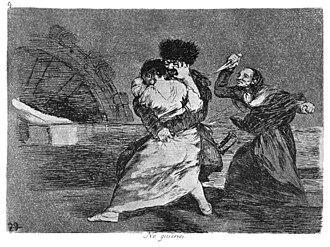
Plate No. 9 (“They Do Not Want To”) from the series “The Disasters of War” by Francisco Goya (1810s), Source Arno Schmidt Reference Library (PD)
The impact of witnessing trauma of any kind is profound. This is known as secondary or vicarious trauma. It leaves a scar on the psyche. Symptoms can range from sadness, fear, and guilt, to anxiety and emotional numbness [1A].
Secondary Trauma
Of course, trauma takes many forms and is not limited to abuse. We may, for instance, witness an auto accident, seeing victims removed from the scene. Those in law enforcement, emergency care, and frontline journalism frequently experience this [1B][2].
But many of us will encounter secondary trauma simply through life experience.
A. Domestic Violence
Children who witness domestic violence in the home are exposed to evil firsthand, and are most vulnerable to the effects of vicarious trauma. It shapes their character and their view of the world even if they, themselves, are not the victims.
Boys are far more likely to become abusers; girls, to seek out abusers as partners. The statistics are appalling [3].
B. Bullying
We may as children have seen others bullied, feeling powerless, ourselves, to intervene.
C. Vicarious Abuse
Whether as children or adults, we may see a beloved friend or relative gradually worn away by domestic violence, her self-esteem eroded.
Though we may never actually see the blows struck, this is for us, in effect, vicarious abuse. If we try unsuccessfully to persuade that friend or relative to leave her situation, we are bound to feel frustrated, angry, and helpless.
What We Can Do
If we do lose a loved one to abuse, we are not as helpless as we may feel.
A few of us may become advocates, as a result, in or out of the courtroom. Far more will go on to interact with countless other women we can educate about domestic violence. While we may never give formal lectures, we can share our experience with friends, coworkers, and a host of others.
As important, we can treat them the way they should be treated. And we can raise our own children to know they deserve better from a relationship.
That has the power to save lives.
—
[1A and 1B] Office for Victims of Crime (OVC), “The Vicarious Trauma Tool Kit — What Is Vicarious Trauam?”, https://ovc.ojp.gov/program/vtt/what-is-vicarious-trauma.
[2] ACLS, “Understanding Secondary Trauma: The Impact of Witnessing Traumatic Events” by Melanie Kolmetz, DFAAPA, EMT-P, https://acls.com/articles/the-impact-of-witnessing-traumatic events/.
[3] Domestic Shelters, “Children and Domestic Violence”, 1/17/15, https://domesticshelters.org/resources/statistics/children-and-domestic-violence.
The US Supreme Court has ruled against a Colorado law which prohibited so called “conversion therapy” in cases of gender dysphoria. The Supreme Court considers such counseling “free speech,” therefore, protected.
Some 23 states have prohibited licensed Christian counselors from exploring underlying issues with patients suffering from this condition, or advising how they might align their perceived gender and biological sex.
FOR MORE OF MY ARTICLES ON POVERTY, POLITICS, AND MATTERS OF CONSCIENCE CHECK OUT MY BLOG A LAWYER’S PRAYERS AT: https://alawyersprayers.com

 A Voice Reclaimed, Surviving Child Abuse and More
Some of the things you’ve touched on previously regarding this type of topic (trying to help, being there for others) has been helpful to me. For me, it can be very difficult to know the ‘right’ way to help.
According to the Maryland State Medical Society, a third party should report domestic violence whenever he or she witnesses or has credible evidence of it.
The problem w/ attempting as an outsider to convince the victims of domestic violence to leave their abusive situations is that such victims feel powerless over their own lives, caught in a vise. Urging them to leave is not likely to be productive. At best, they will vacillate.
Surprisingly, the ministry of presence, as Christians call it, can be helpful to such victims. We sit. We listen. We show that we care. In the process, we convey that the victims of domestic violence are worth caring about. That is critical.
Only when domestic violence victims begin to recognize they have value can they begin to make decisions that will improve their lives. Unfortunately, regaining self-esteem can be a long and slow process for victims, characterized by regression.
This does not preclude our laying out for victims what their options may be. We must, however, keep in mind that leaving an abusive situation is extremely dangerous for women.
Moreover, when a couple has children, the abusive partner is likely to threaten that he will retain custody of them, kidnap or kill them, if the woman does not return to the relationship.
Providing information to the victims of domestic violence about helplines and women’s shelters in the area may be the best we can do. Victims may not have the means or strength to access such information on their own.
I had been made aware of an ugly situation once and didn’t know what to do. My inclination was to help, to “do something”, make it stop. Not knowing what to do, I sought professional guidance. I was advised, as you’ve said before, that my instinct was all wrong; that I should just support and let the victim guide the process. In the end, I did.
I would not agree that your instinct was wrong. Your instinct was to intervene, to rescue. That is not wrong. It is precisely what law enforcement does.
The professional advice you rec’d related to the longer term process of healing. A woman abruptly rescued from an abusive situation is likely either to return to the same relationship or fall into another, if she does not receive counseling. That is part of the tragedy of domestic violence.
The entire situation though is fraught w/ danger for the victim and her children. As long as the woman remains in her abusive relationship she is at risk. As the cycle of domestic violence continues the violence becomes increasingly brutal, ending in serious bodily harm or death. Yet, when a woman leaves such a relationship, she remains at risk of retaliation from the abuser.
This is best addressed by law enforcement.
I have found that from a personal standpoint, oftentimes simply caring enough to listen and provide a shoulder to lean upon can make a world of difference. Yes, it may not remove the threat of violence or abuse, but acts of empathy and kindness are very powerful encouragers.
Oh, you always tackle such tricky topics kindly. Thank you, Linda x
A very real issue
When we travel at night I often wonder and pray when I see a house with no other house around with lights on, I pray that there is no abuse going on in the house. Nights were the worst in our house cause Dad always came home drunk and got us all up which meant we never got enough sleep for school the next day. My anxiety is always worst at night and I am 79 still dealing with it, but praise God with the help of a great therapist I am dealing with it, not putting it off as something else. Just having understanding about what the abuse did to my mind and to my body and how those wounds can still hurt after all these years , but I now know how to help them become a scar and not a bleeding wound. I bleed in silent for too many years, with God’s help I am not bleeding anymore. Thank you, thank you for the great post you put on your site. Blessings.
I am so glad you are at last getting help. Thank you for sharing.
I always feel wiser, Anna, after I read your words spoken from a place of experience and knowledge. May we be vessels of peace wherever our Lord Jesus sends us even as He as He has promised goes with us.
You are so kind, Dora. Yes, may the Lord make us instruments of His peace. ❤
Anna, your post highlights a painful reality: leaving an abusive situation is often only the first step, not the end of the struggle. Without support, people often go back to what feels familiar, even when it’s harmful (been there done that). I think of it as “familiar spirits” in relationships, not literally, but the patterns we’ve learned that pull us toward the same dynamics. That’s why counseling matters so much, it helps break that cycle. Breaking that cycle takes awareness, but also compassion, for others and for ourselves. Great post as always.
Thank you for sharing, Mary. I’m glad you are no longer in an abusive situation, yourself. ❤
Thank you, Anna, It took me a minute, but yeah, praise God that I am not!