Tag Archives: sin

Depravity II

File:Cooling Off - 7583784354.jpg

Source https://www.flickr.com, Image Author Bob Haarmans (CC BY-SA 2.0 Generic)

WARNING:  Graphic Images

Depravity has risen to a new high.

Psychologist Christopher Ryan, the author of Sex at Dawn proposes that human beings are sexual omnivores, designed and entitled to have sex with anyone, at any time, in any way, anywhere [1][2].  In fact, there are those who advocate sex with children and with animals [3][4].

There is no guilt, no shame associated with this.  Morality is an illusion.  There should be no artificial restrictions placed on human behavior.  

After all, human beings are just animals, themselves, only slightly more evolved than apes.  Unrealistic expectations that they exhibit loyalty, trustworthiness, and commitment are the real reason relationships fail.  According to Ryan, at any rate.  

Unfortunately, Ryan is not alone in his belief [5].  Well known celebrities and influencers are taking up the cause.  These individuals are being hailed for their courage in “changing the conversation” [6].

A Sordid Lie

That we are sexual omnivores is a sordid lie about human nature, a rationalization for sin. Continue reading

10 Comments

Filed under Child Abuse, Child Molestation, Christianity, domestic abuse, domestic violence, Emotional Abuse, Neglect, Physical Abuse, Religion, Sexual Abuse, Violence Against Women

Rom-Coms

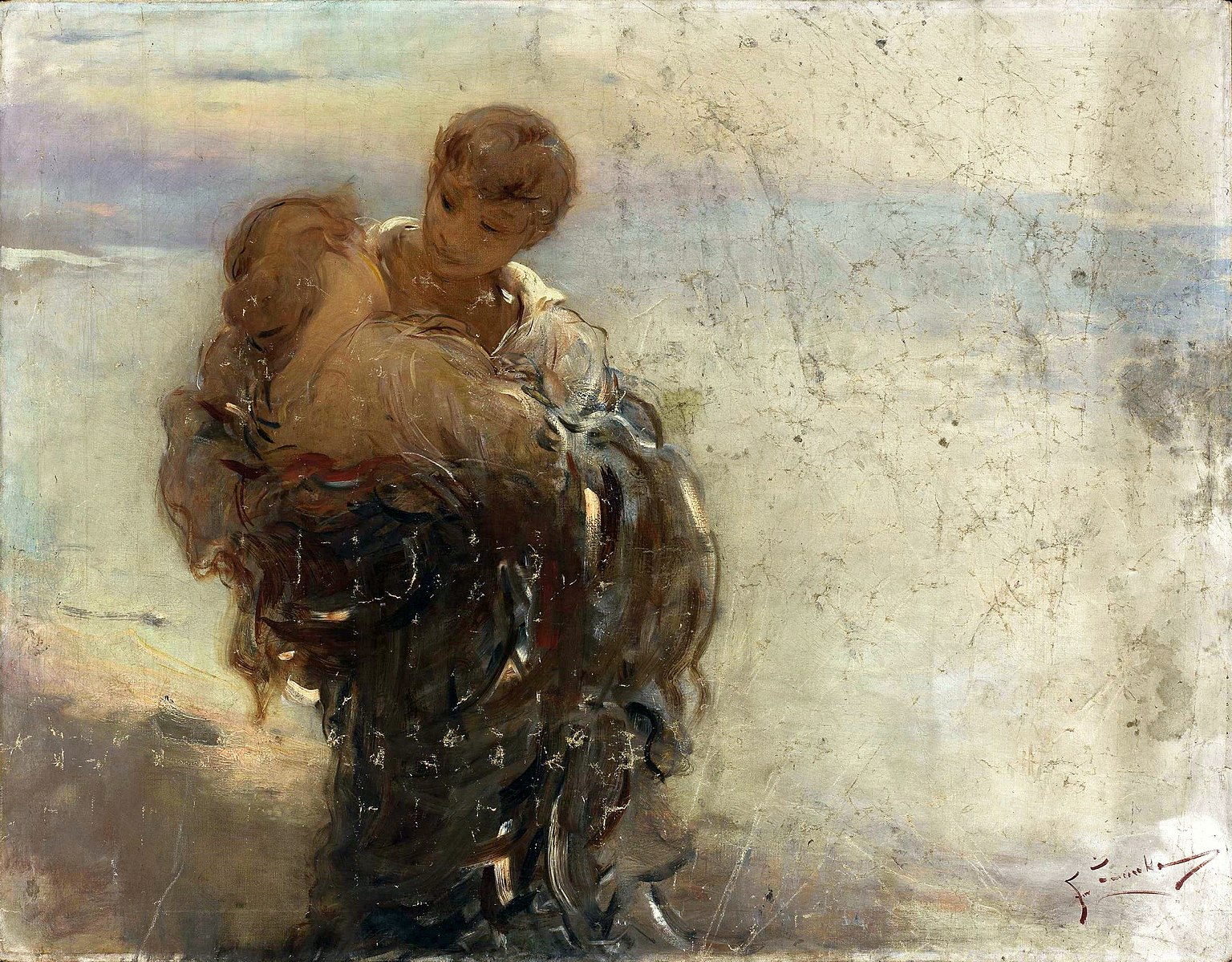
“In Rapture” by Franciszek Zmurko (c. 1900), National Museum in Warsaw (Accession No. MP 3946), Source/Author cyfrowe.mnw.art.pl/pl/zbiory/453259, (PD)

“Rose Castorini:  Listen, Johnny.  There’s a question I want to ask.  I want you to tell me the truth, if you can.  Why do men chase women?

Johnny Cammareri:  Well, there’s the Bible story.  God.  God took a rib from Adam and made Eve.  Now, maybe men chase women because they want the rib back.  When God took the rib, He left a big hole there, a place where there used to be something.  And the women have that.  Now maybe, just maybe, a man isn’t complete as a man without a woman.”

Moonstruck

Many of us enjoy romantic comedies or rom-coms as they are called.  Moonstruck happens to be a favorite of mine.  Boy meets girl.  Boy loses girl.  Boy gets girl.  And they both live happily ever after.

Trite as many rom-com plots are, they contain a kernel of truth about the importance and the power of love.  At some level we all recognize that.  It is the reason we find the boy’s pursuit of the girl engaging.

Sadly, as survivors of childhood abuse, we may settle for unresponsive partners or avoid relationships entirely.  We may not, therefore, have known the sweetness of courtship.  Or perhaps courtship was followed by the horrors of domestic violence. 

How much more meaningful then is God’s pursuit of us?  That pursuit began in the Garden, when sin first separated man from God.

Then the Lord God called to Adam and said to him, ‘Where are you?’” (Gen. 3: 9).

Continue reading

7 Comments

Filed under Child Abuse, Child Molestation, Christianity, domestic abuse, domestic violence, Emotional Abuse, Neglect, Physical Abuse, Religion, Sexual Abuse, Violence Against Women

Gnosticism and Pedophilia

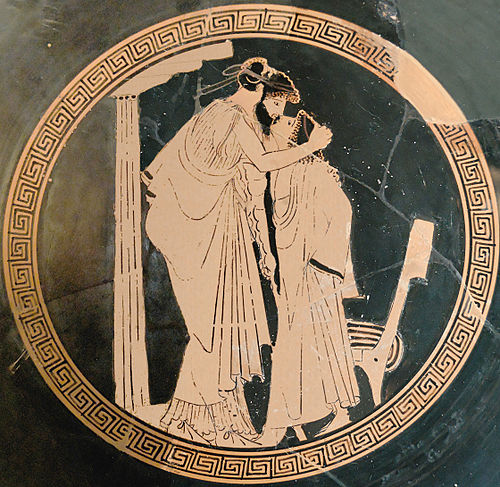
Ancient Greek pederast kissing a young boy (4th Century BC), Louvre Museum (Accession No. G 278), Author Marie-Lan Nguyen (PD)

Many today are adherents of a pernicious philosophy, a false religion, whose name they do not know [1].  It masquerades as ancient wisdom, secret knowledge, a path to self-fulfillment.  But it incorporates Satan’s oldest and most effective lies.

Gnosticism is a heresy that seeks to undermine Christian doctrine.  It promises that men can become godlike, and exalts inner “perception” over outer reality.  Its beliefs are at the root of the Transgender Movement, and are paving the way for the normalization of pedophilia [2][3][4].

This is not to say that Gnostics are pedophiles or even aware of the connection to pedophilia.  Most Gnostics would undoubtedly dispute the connection.  Not that pedophiles need much help in normalizing their perversion.

Legitimizing Pedophilia

B4U-ACT is part of a growing movement to legitimize sexual attraction to children [5].  Founded by social worker Russell Dick and convicted child sex offender Michael Melsheimer, this Maryland group maintains that sexual attraction to children is not a psychiatric disorder, but an identity to be affirmed. 

A list of pedophilia advocacy groups can be found on Wikipedia [6].  Like B4U-ACT, they hold that attempts to reduce or control pedophiles’ attraction to children through cognitive behavior therapy or drugs are not only pointless, but unethical.

Never mind the lasting harm pedophiles do to children. Continue reading

18 Comments

Filed under Child Abuse, Child Molestation, Christianity, Emotional Abuse, Justice, Law, Neglect, Physical Abuse, Religion, Sexual Abuse

MAPs – Normalizing Pedophilia

boy with hands on his shoulders Painting by Rian Lemaire Smulders | Saatchi Art

“Boy with Hands on His Shoulders” by Rian Lemaire Smulders c/o Saatchi Art

The El Paso School District has begun the termination of Amber Parker, an English teacher at Franklin High School, for instructing her students to refer to pedophiles as MAPs or “minor-attracted persons” in a viral video which her supporters maintain was taken out of context [1].  Parker is purported to have said, “So don’t judge people just because they want to have sex with a 5 y.o.”

Dr. Allyn Walker, a professor at Virginia’s Old Dominion University, resigned after having stressed at a panel the importance of pedophiles being treated with “dignity” [2][6].

These are not isolated incidents.  There are pedophile advocacy organizations worldwide [3].

The acronym MAP is apparently preferred by pedophiles over the label “child molester”.  It represents an attempt to normalize pedophilia, and is increasingly being adopted as politically correct, particularly in the LGBT context.

Seeking to remove any negative connotation from the term pederast, there are even pedophiles now characterizing themselves as virtuous [4].  Such individuals view their twisted desires as mere symptoms of a fallen world — somewhere along the spectrum of normal human sexuality (neither aberrant, nor evil). Continue reading

24 Comments

Filed under Child Abuse, Child Molestation, Christianity, Community, Emotional Abuse, Neglect, Physical Abuse, Religion, Sexual Abuse

Hallelujah

The poet Leonard Cohen spoke of love more powerfully than I ever will.  His ode to lost love, “Hallelujah”, seems somehow appropriate to these difficult times.

Abused or not, we have all known heartbreak.  The pain can be so bad we find it difficult to breath.  But keeping faith is the hard part.  Faith in love.  Faith in God.  Faith that life will once more be worth living.

It is that kind of faith we must find within ourselves right now.

It is easy to shout “hallelujah” when we are in love.  Easy to praise God when times are good…though often those are the very times we forget Him.  We have to dig deeper when times are tough. Continue reading

5 Comments

Filed under Child Abuse, Child Molestation, Christianity, Emotional Abuse, Neglect, Physical Abuse, Religion, Sexual Abuse

Poison

King Cobra, Author Vishnukanayathil (CC BY-SA 4.0 International)

Their wine is the poison of serpents, and the cruel venom of cobras”(Deut. 32: 33).

Across time and across the globe, women have been harassed, threatened, imprisoned, violated, and put to death for seeking equality with their male counterparts.

There have been political, cultural, and religious reasons given for this inequality.  But at heart is the matter of poison.  Not a chemical or biological agent of warfare (though there is a kind of war being fought), this is instead an insidious poison of the mind.

Simply put, many consider half the population of the earth – the female half, the very mothers who bore them – less worthy than the other, male half.  This toxic belief corrodes nations and cultures, along with relationships and individuals.  It establishes and enforces a power differential in favor of the male members of society which is a temptation toward abuse.

More than that, the inequality violates the laws of God.

So God created man in His own image; in the image of God He created him; male and female He created them” (Gen. 1: 27).  

“There is neither Jew nor Greek, there is neither slave nor free, there is neither male nor female; for you are all one in Christ Jesus” (Gal. 3:28).

Sin has, throughout history, distorted the relationship between men and women.

Though the Old Testament prophetess, Deborah, more than capably judged Israel; though women were faithful at the cross, and the first to arrive at the empty tomb; though Mary, Persis, Priscilla, Tryphena, and Tryphosa were just a few of the women who ministered in the early church; and though God pours out His spirit on sons and daughters alike (Joel 2: 28-29; Acts 2: 17-18), Christianity has not been immune to this distortion.

There has been a great deal of emphasis on the submission of wives to their husbands (Eph. 5: 22-24; Col. 3: 18), and very little on the requisite love by husbands for their wives (Eph. 5: 25-26, 28-29, 31; Col. 3: 19, 1 Pet. 3: 7).

This skewed emphasis by the church has done greatest damage – both spiritually and physically – in regard to abuse.  Over the centuries, women have again and again been counseled by their priests and ministers to remain in abusive marriages, even at the risk of their lives.  For many of these women, the poisonous belief that they were of less value than men proved lethal.

Abuse is, of course, biblically prohibited.  Submission to another flawed human being was never intended to supersede the right of self-defense [1].

Nor does forgiveness by the victim necessarily restore trust.  That may be lost forever.  Certainly, an abused woman is not required to return to a situation she perceives as dangerous.

Christianity is the antidote to this and other poisons like it.  Male and female, let us live our faith as Christ would have us do.  Let us treat one another with kindness and respect that the warfare between the sexes may end, and the world may see in us — men and women alike — the image of Christ.

_____

[1] The Christian concept of “headship” (Ephesians 5: 22-33) is best assessed vis a vis the servant leadership modeled by the Lord (Mark 10: 42-45).

Originally posted 5/30/12

FOR MORE OF MY ARTICLES ON POVERTY, POLITICS, AND MATTERS OF CONSCIENCE CHECK OUT MY BLOG A LAWYER’S PRAYERS AT: https://alawyersprayers.com


22 Comments

Filed under Abuse of Power, Christianity, domestic abuse, domestic violence, Justice, Rape, Religion, Sexual Assault, Violence Against Women

In the Aftermath of Abuse, Part 6 – Restoring the Relationship with God

Open Bible, Author “The Photographer” (CC0 1.0 Universal Public Domain Dedication)

The abuse experience can warp the lens through which victims see themselves and the world.  It skews even their view of God, since He – perhaps more so than the predator – is blamed for the abuse.

Abuse victims must be permitted to vent the full range of emotions elicited by the violation, if their faith in God and relationship with Him are to be restored.

God’s continuing love for abuse victims is more powerful than any symptoms or shame.  This does not necessarily mean that the scars of abuse will be erased.  Victims are likely to need frequent reminders, both of God’s love and His mercy.

He hath not dealt with us after our sins; nor rewarded us according to our iniquities. For as the heaven is high above the earth, so great is His mercy toward them that fear Him. As far as the east is from the west, so far hath He removed our transgressions from us” (Psalm 103: 10-12).

” ‘Come now, let us reason together,’ says the Lord. ‘Though your sins are like scarlet, they shall be as white as snow; though they are red as crimson, they shall be like wool’ “  (Isaiah 1: 18).

” ‘I, even I, am He who blots out your transgressions, for My own sake, and remembers your sins no more’ ”  (Isaiah 43: 25).

Victims might ask themselves whether they would judge another exploited child by the same harsh standards they have applied to themselves; whether the thoughts and behaviors they now characterize as defective on their part would have occurred at all, if they had not been abused.

Originally posed 8/18/13

Of note, the Sex Trafficking Act was this week signed into law.  The “Allow States and Victims to Fight Online Sex Trafficking Act of 2017” (often referred to as FOSTA) creates a new federal offense which prohibits owning or operating a website or other technology platform with the intent to facilitate prostitution.  Penalties can run as high as 25 years in prison. 

Sex trafficking victims may, in addition, bring civil suits against the websites that hosted ads that enabled their trafficking.

FOR MORE OF MY ARTICLES ON POVERTY, POLITICS, AND MATTERS OF CONSCIENCE CHECK OUT MY BLOG A LAWYER’S PRAYERS AT:  https://alawyersprayers.com

8 Comments

Filed under Child Abuse, Child Molestation, Christianity, Emotional Abuse, Neglect, Physical Abuse, Religion, Sexual Abuse

In the Aftermath of Abuse, Part 4 – Scriptural Consolation

“Agnus Dei (The Lamb of God)” by Francisco de Zurbaran (c. 1638), San Diego Museum of Art, Photographer Daderot (CC0 1.0 Universal Public Domain Dedication)

While abuse victims have not sinned, it can be helpful for them to recall that God encourages even sinners. He sent His Son to save, not condemn us.

For God sent not his Son into the world to condemn the world; but that the world through Him might be saved. He that believeth on Him is not condemned…” (John 3: 17-18).

There is therefore now no condemnation to them which are in Christ Jesus, who walk not after the flesh, but after the Spirit” (Romans 8: 1).

It is the adversary who condemns the saints, his goal being to paralyze them.  It is his voice that victims hear when the darkness presses in on them, not God’s.  But the adversary is a liar.  Lies are his stock in trade.  Abuse victims are the more vulnerable, since early in life they did not receive the nurturing that God intended.

And I heard a loud voice saying in heaven, ‘Now is come salvation, and strength, and the kingdom of our God, and the power of His Christ: for the accuser of our brethren is cast down, which accused them before our God day and night. And they overcame him by the blood of the Lamb, and by the word of their testimony…’ ” (Revelation 12: 10-11).

Originally posted 7/21/13

Wishing You All a Happy Easter!

FOR MORE OF MY ARTICLES ON POVERTY, POLITICS, AND MATTERS OF CONSCIENCE CHECK OUT MY BLOG A LAWYER’S PRAYERS AT:  https://alawyersprayers.com

13 Comments

Filed under Child Abuse, Child Molestation, Christianity, Emotional Abuse, Neglect, Physical Abuse, Religion, Sexual Abuse

Blue on Blue, Part 2 – Despair

This is a highly personal post.  Like most abuse victims and many depression sufferers, I am well familiar with despair.  Having been grievously wounded, we cannot help but wonder whether God has turned His back on us, whether He exists at all.

There are Christian denominations which view despair as sinful.  Not all Church Fathers (influential early theologians) would, however, agree [1].  Neither do I, for that matter.  This post was written to demonstrate that the despair abuse victims experience is NOT sinful, even from that strict perspective.

Out of the depths I have cried to You, O Lord; Lord, hear my voice!” (Ps. 130: 1-2).

Depression sufferers often face condemnation from their well-meaning Christian friends.  Such condemnation is misplaced.  Depression should not be confused with despair.   And for despair to be considered “sinful”, certain conditions must be met.

Depression v. Despair

Depression can arise despite our circumstances.  Despair stems from our circumstances.  Depression is the manifestation of a medical condition.  Despair is the spiritual conclusion we draw about an eternal reality.

Both will make us unhappy.  Only despair, however, can be seen as “sin” [2].

Despair as “Sin”

When we despair – as most of us use the term today – we view our suffering as pointless, and God as powerless (or uninterested) to intervene.  This is situational despair.

For our hopelessness to qualify as “sinful”, we must have a genuine understanding of God; must be above the age of reason; must be in sound mind; and — in the strictest sense — must despair not about our circumstances, but about our Salvation.

Abuse victims (and depression sufferers) simply do not satisfy these conditions.

Judas and Suicide

Judas Iscariot’s suicide is often put forward as the classic act of despair.  The apostles had daily close contact with Christ.  Judas had experienced firsthand Christ’s infinite holiness, infinite power, and infinite love.

All these Judas is said to have rejected by his self-destructive act [3][4].  Judas viewed his betrayal of Christ as so heinous it was beyond God’s capacity to forgive.  He despaired, in other words, of his Salvation.

Abuse Contrasted

By contrast, the child who is daily abused and gives up hope is not guilty of the sin of despair.  For one thing, the child may not yet have reached the age of reason.  S/he may not, therefore, be capable of forming the necessary intent.

For another thing, a child who is abused is likely to have little or no understanding of God’s true nature.   S/he has no reason to believe in a just and loving God, so cannot be penalized for the failure to trust Him.  At worst, the child rejects a flawed image of God based on tragic experience with a hostile and painful world.

As important, the abused child despairs of his/her situation (not his/her eternal Salvation).  Hell is here and now.  If anything, unfounded accusations – in reality, out and out lies – about the child’s responsibility for the abuse and overall lack of worth may make death appear inviting.

Depression and the Will

Finally, adult or child, our capacity to sin is reduced when our will is compromised as, for instance, by the brain chemistry associated with depression.

God is hardly likely to condemn us for the sins committed against us, or the scars stemming from them.  That, at least, is the opinion of this lawyer.

May the God of hope fill you with all joy and peace in believing, that you may abound in hope by the power of the Holy Spirit” (Rom. 15: 13).

[1]  Augustine believed that despair was not a sin.  Thomas Aquinas argued the point, seeing despair as a variant of pride.  Aquinas, however, distinguished hopelessness about our Salvation from hopelessness about our situation.  He explained that a physician might despair of curing a patient without committing sin.  Aquinas conceded that God could forgive despair, by way of a miracle.

[2]  It should be emphasized that not all Christian denominations view despair as equally sinful.  Unlike Catholics, Presbyterians and Baptists reject outright the concept of “mortal” sin, i.e. sin so serious it has the potential to cost us our Salvation.

[3]  Suicide has frequently been described as the “unpardonable” sin (Matt. 12: 31-32).  This though is an error.  According to Scripture, it is speaking against the Holy Spirit which will not be forgiven.  Since the Holy Spirit descended in the form of a dove when Christ’s divinity was revealed (Matt. 3: 16-17), the consensus now seems to be that the unpardonable sin actually signifies rejection of Christ’s offer of Salvation.

[4]  Even those who never publicly acknowledge Christ as their Savior may accept Him in their hearts, during their final moments.  “But do not forget this one thing dear friends:  With the Lord a day is like a thousand years, and a thousand years are like a day” (2 Peter 3: 8).

ANYONE WITH THOUGHTS OF VIOLENCE OR SELF-HARM SHOULD SEEK IMMEDIATE MEDICAL ATTENTION

FOR MORE OF MY ARTICLES ON POVERTY, POLITICS, AND MATTERS OF CONSCIENCE CHECK OUT MY BLOG A LAWYER’S PRAYERS AT: http://www.alawyersprayers.com

27 Comments

Filed under Child Abuse, Child Molestation, Christianity, Emotional Abuse, Neglect, Physical Abuse, Rape, Religion, Sexual Abuse, Sexual Assault, Violence Against Women

Ugliness, Part 2

As abuse victims, it is not uncommon for us to despise ourselves.  Whether physically, emotionally, or sexually abused and/or neglected as children or battered as adults, we are likely to have concluded on a visceral level that we are unfit, undeserving of love and affection.

Ugly and Bad

Young children equate ugliness with evil.  The two are for them one and the same, which is what makes ugliness so frightening to children.  The Wicked Stepmother needs daily confirmation of her good looks from a magic mirror.  Snow White has no such insecurities.  Snow White’s goodness informs her good looks, and vice versa.

Children who are physically or emotionally abused may draw the conclusion they are ugly — inside and out.  Believing themselves “responsible” for the abuse to which they are subjected, children may conclude that they are being punished deservedly, as both ugly and bad.

The Monsters Inc. and Shrek series of children’s films used humor to challenge this correlation.  Shrek considers Fiona genuinely beautiful, even in her true form as an ogre.  The classically handsome Prince Charming is actually a villain.

Self-Contempt

But for abuse victims challenging the correlation between beauty and goodness can be extremely difficult. By the time we reach adulthood, chances are that self-contempt has become part of our emotional make-up.

Contempt is a feeling of scorn. It can be a reaction not only to something concrete, but something wholly imagined. And contempt can deepen in intensity with time.

Countering Deficiencies

Abuse victims, generally, take one of three approaches, in their attempts to counter supposed deficiencies:

A.  Overachievement

Some of us become overachievers, driving ourselves relentlessly.  External awards are used as the measure of this group’s inherent value.

Unfortunately, worldly achievements are a poor substitute for such value.  The emptiness inside cannot be filled by material rewards, even those earned through great effort. The process of chasing tangible proof of intangible value is a futile task. Continue reading

1 Comment

Filed under Child Abuse, Christianity, Emotional Abuse, Neglect, Physical Abuse, Religion, Sexual Abuse, Violence Against Women