Category Archives: Violence Against Women

The Twins, Part 2 – Perfectionism

File:Twins (Qajar art, Art Museum of Georgia).jpg

“Twins” (Late 18th – Early 19th Century) by unknown Iranian artist, Art Museum of Georgia (PD)

This post was written in collaboration with Marie Williams whose remarks are highlighted.  Marie, a dear friend, has since gone home to be with the Lord.

We return to the topic of procrastination and perfectionism, related patterns of behavior in which many abuse victims find themselves trapped.

The part we play in creating our own dilemmas – the large and small crises in our lives stemming from procrastination – was discussed in Part 1 of this series.

Chance for Failure (Imperfection)

“…for God gave us a spirit not of fear but of power and love and self-control” (2 Tim. 1: 7).

Apart from the problems it would generate for anyone, failure – defined by many abuse victims as imperfection, to any small degree – results in shame and self-revilement for us.  Since creating these dilemmas greatly increases our chance for failure, the question arises why we persist in creating them.

“The whole time I was procrastinating, I thought myself foolish, an idiot, a dunce, a failure, because who in their right mind, sees a fire starting or about to start, purposely hides the fire extinguisher, forgets where she has put it and then goes and reads a book, deciding to deal with the fire when it becomes bigger and more unmanageable?  Because that is what procrastination amounts to when you come to think of it in rational terms.  Yet I could not help myself.”

-Marie Williams

The obvious answer is that we do not believe ourselves capable of accomplishing the task at hand.  Putting it off defers the painful acknowledgment of our own inadequacy.  And it provides us an excuse for failure.  Had conditions been right, had we started on the task sooner, perhaps we might have succeeded after all.

Again, the question is why.  Why are we so certain of failure?  This goes directly to our childhood abuse. On an unconscious level, we create these dilemmas to replicate the abuse which is what gives them such power over us. 

We were told repeatedly how inadequate we were.  Told how ugly, stupid, skinny, fat, or retarded we were.  Told that we would never amount to anything.  Or we were ignored entirely, starved for food and affection both.

No shock that we doubt and second guess ourselves, wrestling over decisions.

“I floundered when faced with choices.  Wanting to please and be approved of ALL THE TIME, I became lost in my own lack of confidence.  This, I think, was due to the fact that I couldn’t manage the abuse.  I adopted the same response to situations which generated that same confusion in me.”

-Marie Williams

Failure becomes a self-fulfilling prophecy.  Our abusers are “proven” right.  So it seems to us.  Our failure couldn’t possibly have anything to do with the damage they inflicted on us.  Nooo. Continue reading

4 Comments

Filed under Child Abuse, Child Molestation, Christianity, Emotional Abuse, Neglect, Physical Abuse, Rape, Religion, Sexual Abuse, Sexual Assault, Violence Against Women

The Twins, Part 1 – Procrastination

File:Twin-tailed Siren or Mermaid, Hortus Sanitatis.jpg

“Twin-Tailed Siren” (c. 1501), illustration from Hortus Sanitatis published by Jacob Meydenbach, Source https://wwportal.com/ (PD)

This post was written in collaboration with Marie Williams whose remarks are highlighted.  Marie, a dear friend, has since gone home to be with the Lord.

“Most of my life has been spent circling or avoiding important things that I need to do and I get very frustrated with myself.  Sometimes, I find myself trying to locate passports or important papers at the 11th hour, when I’ve had ample time to deal with matters like this.”

-Marie Williams

Procrastination and perfectionism are patterns of behavior well familiar to abuse victims, twin destructive forces that have deep meaning for those who have suffered abuse.

We invest the necessary (the “shoulds” and “musts” of life) with the power to annihilate us, or at least demolish the fragile image we have of ourselves.  Then we defer, delay, and defer again – certain that we will fail to meet our own expectations.

Failure is a foregone conclusion, given that our expectations are, by definition, unattainable.

Let’s unpack that dynamic.

Real Deadline/Chaotic Life

To everything there is a season, A time for every purpose under heaven…” (Eccl. 3: 1 NKJV).

Federal income taxes are due April 15.  This is a real deadline – not a secret and not a surprise.  Still, we delay gathering our tax receipts and other records together.

“You live in a state of confusion, and therefore mundane ‘every day’ matters become muddled and murky.  You cannot quite get to grips with simple but important tasks.  You know that you have to present your driving licence for identity and you know it’s in a box somewhere, but it really is too much trouble trying to locate it in good time.  So you (at the last minute) hunt around like crazy trying to find it – it happens not to be in the box you thought it was in, and you have to turn everything upside down to find it – and all this adds to the chaos of your already chaotic life.”

-Marie Williams

Created Dilemma

Anxiety in a man’s heart weighs him down…” (Prov. 12: 25 ESV).

We may dither over whether to rely on our long-time accountant; visit a less costly tax preparation agency; or use one of the computer programs which now allow us to do the taxes, ourselves.  We may put off making copies or doing something else insignificant, related to tax preparation.  What that is does not matter.

We, in other words, create the dilemma. Continue reading

4 Comments

Filed under Child Abuse, Child Molestation, Christianity, Emotional Abuse, Neglect, Physical Abuse, Rape, Religion, Sexual Abuse, Sexual Assault, Violence Against Women

Japanese Reforms

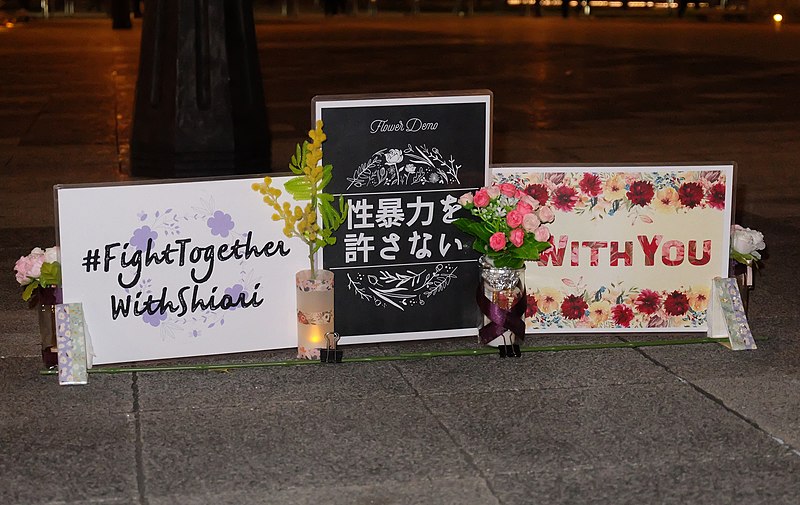
File:Flower demo Tokyo 2020-11-11.jpg

Appeal board made by participants in Flower Demo, Tokyo, Japan (2020), Author Breaklily (CC BY-SA 4.0 International)

Sexual violence against women has historically been associated with shame and stigma in Japan.  The laws were drawn in such a way as to excuse the behavior of male defendants, while simultaneously disregarding women’s rights.

At last, however, the country has raised the age of consent from 13 to 16 years, and redefined rape to include non-consensual intercourse [1].  Proof of force is no longer a prerequisite to conviction.  Photo voyeurism (including upskirting) has, also, been criminalized.

These long overdue reforms were prompted by Flower Demo, a Japanese movement protesting sexual violence against women [2][3].  Those taking part carried flowers to reflect their empathy for victims.

Several scandalous rape cases brought attention to the issue, drawing public outrage.  One involved a highly intoxicated woman.  Another involved a 15 y.o. her assailant had held pinned to a wall.  Still another involved incest ongoing for a period of years.

Sin Nature

Violence against women is a byproduct of the sin nature of mankind.  It is perpetuated by an attitude that women are mere sex objects, by the use of disparaging sexist language, and by the glorification of sexual assault.

Rape, in this context, is not just a notch on the assailant’s belt.  It is an act of machismo, proof of masculinity (albeit toxic).

Any shame associated with the act is displaced to the victim.

This is not what God intended.  When He created men and women, He created them as equals.

[1]  BBC, “Japan redefines rape and raises age of consent in landmark move” by Kelly Ng, 6/16/23, https://www.bbc.com/news/world-asia-65887198.

[2]  Wikipedia, “Flower Demo”, https://en.wikipedia.org/wiki/Flower_Demo.

[3]  Zenbird, “Flower Demo, the protests battling Japan’s sexual violence against women” by Kirsty Kawano, 11/25/20, https://zenbird.media/flower-demo-the-protests-battling-japans-sexual-violence-against-women/.

FOR MORE OF MY ARTICLES ON POVERTY, POLITICS, AND MATTERS OF CONSCIENCE CHECK OUT MY BLOG A LAWYER’S PRAYERS AT: https://alawyersprayers.com
15 Comments

Filed under Child Abuse, Child Molestation, Christianity, domestic abuse, Emotional Abuse, Justice, Law, Rape, Religion, Sexual Abuse, Sexual Assault, Violence Against Women

Gilgo Beach

File:SCPD Gilgo Death Investigation.jpg

Map indicating location of bodies discovered at Gilgo Beach, Author Atiru
(CC BY-SA 4.0 International)

WARNING:  Graphic Images

Gilgo Beach is a quiet stretch of sandy coastline on Long Island, NY, made infamous by the serial killings which have been uncovered there [1].

Shockingly, the remains of up to 18 victims, murdered between 1996 and 2011, have been found in the general area.  For the most part, these victims — the majority of them women — are believed to have been sex workers.

Serial Predator

Rex Heuermann — a 59 y.o. married architect and father of two — has been charged in the murders of three such victims (Melissa Barthelemy, Amber Costello, and Megan Waterman) [2].  He is the prime suspect in the murder of a fourth (Maureen Brainard-Barnes).  There is speculation that he may be responsible for many more.

Investigative Delay

The identification of victims was necessarily a lengthy and complex process.

However, the FBI did not become officially involved in this investigation until 5 years after the first remains were located by Suffolk County Police [3].  For reasons of his own, former Police Chief James Burke is said actually to have blocked that involvement [4].

There is, also, widespread suspicion among family members of the victims that Suffolk Police did not prioritize the investigation because these women were prostitutes, rather than “upstanding” members of the community.

Child Abuse and Prostitution
A. Sexual Abuse

What is particularly tragic about this story is that there is every likelihood the women had already been the victims of childhood sexual abuse. Continue reading

11 Comments

Filed under Abuse of Power, Child Abuse, Child Molestation, Christianity, domestic abuse, domestic violence, Emotional Abuse, Justice, Law, Neglect, Physical Abuse, Prostitution, Rape, Religion, sex trafficking, Sexual Abuse, Sexual Assault, Violence Against Women

Family Annihilators

File:Ours.JPG

Author Pic-Puce at French Wikipedia (CC BY-SA 3.0 Unported)

WARNING:  Graphic Images

A young girl runs down the street screaming that her father is killing everyone [1].  In fact, the father is found to have murdered his sons — ages 3, 4, and 7 — as well as attempting to murder his wife.

The term “family annihilators” (those who kill their families) was first coined by psychiatrist Park Dietz in 1980 [2A].  Tragically, such individuals are becoming increasingly common [4A].

Family annihilators are primarily, though not exclusively, men [3A][4B].  They tend to fall into one of four categories [4C]:

  • Self-Righteous:  Those who are self-righteous, for instance, blaming their spouses for the break-up of a family and angry about diminished access to children.  Infidelity and the desire to punish can set off this type.  Alcohol can, also, play a role [2B].
  • Ashamed/Disappointed:  Those who are ashamed of themselves or disappointed with their families.  Cultural honor killings fall into this category.  Alex Murdaugh, convicted of murdering his wife and son after Murdaugh’s own corruption came to light, is an illustration [3B].
  • Paranoid:  Those who are paranoid and motivated by a desire to “protect” their families from a perceived threat, such as the removal of children by social services.  This type of family annihilator may believe family members are wholly dependent on him/her for their survival, and rationalize he/she is acting mercifully to “save” them from a cruel world.  Depression can, also, be a factor [2C].  Until the killing spree, such an individual may be perceived by outsiders as dedicated to the family.  Andrea Yates is an illustration [5].
  • Sociopathic:  Those who are socially alienated or outright sociopathic, killing their families for monetary gain or similar cold blooded motives.  Family members are viewed as objects, mere means to an end, by such individuals.  Greed and other narcissistic purposes can motivate this type.  Susan Smith, who drowned her two sons to further a romantic relationship, is an illustration [6].

Continue reading

8 Comments

Filed under Child Abuse, Christianity, domestic abuse, domestic violence, Emotional Abuse, Physical Abuse, Religion, Violence Against Women

Precious

File:SAKURAKO. (3710281438).jpg

Great grandmother and baby girl, Source Sakurako, Author MIKI Yoshihito (CC BY-SA 2.0 Generic)

A good-for-nothing man is an evil-doer; he goes on his way causing trouble with false words…” (Prov. 6: 12).

Baby girl, you are so precious.  You are so precious, you don’t even know.  Your Mama and I loved you from the moment she brought you into this world.  Even before that.  Your Daddy left early on, but we loved you just the same.

We rocked you, walked the floors with you when you were teething, saw you take your first step.  We cooked for you, we mended your clothes.  We saw you on the bus that first day of school.  You were so pretty, your hair all done up in ribbons.  Maybe you can’t remember, but I do.

You and I, we lost your Mama to hard work, then no work, then those devil drugs.  You must have asked me a million times where she was, on those nights she didn’t come home to us.  But she loved you.  She tried her best.  It just wasn’t enough in this cruel world.

Your Mama tried to help you with your lessons, in the beginning, taught you one and one makes two.  Do you remember that?  It was just that the lessons she had to learn were harder – lessons about hard men, and the hard road a woman faces alone.

Now you want to run after this man!  This good-for-nothing man?!  You think he’s going to give you something you don’t already have?  He doesn’t want to give.  All he wants to do is take from you.  Take your hips, take your fresh young face, take your smile.  But you believe his promises, promises as empty as noise.

Is it because your Daddy wasn’t there to tell you how special you are?  Is it because you didn’t see yourself in his eyes?  We tried, your Mama and I, tried to tell you that, tried to show you every which way we could.  Try and remember, baby girl. Continue reading

16 Comments

Filed under Christianity, Poverty, Prostitution, Religion, Violence Against Women

Continuing FLDS Tragedy

https://upload.wikimedia.org/wikipedia/commons/1/15/Ira_Eldredge_and_his_three_wives_circa_1864_%28restored%29.png

Retouched portrait of Mormon Bishop Ira Eldredge with his three wives (Nancy, Hannah, and Helvig), (c. 1864)

Public Domain as published before January 1, 1928

An offshoot of the infamous Fundamentalist Church of Jesus Christ of Latter-Day Saints (FLDS) is carrying on the heinous practices of Warren Jeffs, though Jeffs has now been incarcerated for over a decade [1].

Samuel Bateman, 47 y.o., the leader of this polygamous Mormon sect, claims to be Warren’s legitimate successor and a “prophet” in his own right [2A].

Bateman is alleged to have taken 20 or more wives, some as young as 8 or 9 y.o.  He is said to have traveled through Utah, Arizona, Colorado, and Nebraska in order to have sex with underage girls.  As a result, Bateman is facing state and federal charges which include kidnapping and child abuse.

A total of eleven members of Bateman’s splinter group have now been charged with transporting children across state lines for purposes of sexual activity, recording that activity, destroying evidence, and witness tampering.

Mormon Polygamy Historically

Though it is today prohibited by the mainstream LDS, polygamy was among the original teachings of Mormonism, and practiced till 1890 [2B][3].  Doctrinally, polygamy was actually viewed by Mormons as being essential to Salvation, and more significant than baptism.

Downsides of Polygamy for Women

Polygamy — most recently pitched to the public under the seductive guise of polyamory — necessarily creates tensions and inequities, whether practiced by Mormons, Muslims, or others [4].  Women in such an arrangement do not have equal rights with their male partner.

Some “wives” will be favored over or replaced by others, causing harmful friction not only among these women, but their children.  Emotional abuse, depression, severe financial restrictions (even outright destitution), and ultimate abandonment are not uncommon [5A].

Polygamous relationships are, also, prone to domestic violence and/or sexual abuse, not to mention the negative impact they have on children [5B].

Continue reading

8 Comments

Filed under Abuse of Power, Child Abuse, Child Molestation, Christianity, domestic abuse, domestic violence, Emotional Abuse, Justice, Law, Neglect, Physical Abuse, Rape, Religion, sex trafficking, Sexual Abuse, Sexual Assault, Violence Against Women

Troop 6000

File:Girl Scout cookies (Girl Scouts of the USA).jpg

Girl Scout Cookies, Author Photoguy439 (CC BY-SA 3.0 Unported)

New York City’s Girl Scout Troop 6000 has the unique mission of reaching out to girls experiencing homelessness or living in shelters for other reasons [1A].

Since its inception in 2017, Troop 6000 has raised over $1.6 million through the cookie sales for which the Girl Scouts are famous, and corporate matching donations.  These funds — which go toward trips, summer camp, and other adventures — have benefited some 2500 women and girls across 20 shelters throughout the New York City area.

This year, Troop 6000 was expanded to include the immigrants and asylum seekers at Emergency Response and Relief Centers.  Currently, there  are approximately 37,500 such migrants in the care of New York City’s Dept. of Homeless Services.

Troop 6000 is the brainchild of Giselle Burgess who was, herself, living in a shelter with her 5 children at the time.  Similar troops have now been started in Iowa, Tennessee, California, and Nevada.

“This population of young women has seen incredibly traumatic events.  And that is right at the core of what we need to do.  We need to take care of them and show them that they deserve the care.”

–Meridith Maskara, CEO of Girl Scouts of Greater New York [1B]

[1A and 1B]  CNN, “This New York Girl Scout troop is the first of its kind.  Here’s why” by Vanessa Yurkevich, 5/9/23, https://www.cnn.com/2023/05/09/business/girl-scouts-troop-6000/index.html.

FOR MORE OF MY ARTICLES ON POVERTY, POLITICS, AND MATTERS OF CONSCIENCE CHECK OUT MY BLOG A LAWYER’S PRAYERS AT:  https://alawyersprayers.com

12 Comments

Filed under Child Abuse, Child Molestation, Community, domestic abuse, domestic violence, Emotional Abuse, Neglect, Physical Abuse, sex trafficking, Sexual Abuse, Violence Against Women

“God Is Not Sick of Your Struggle” by Jennifer Arimborgo

https://upload.wikimedia.org/wikipedia/commons/thumb/a/a7/Bernhard_Plockhorst_-_Good_Shephard.jpg/326px-Bernhard_Plockhorst_-_Good_Shephard.jpg

“Good Shepherd” by Bernhard Plockhorst (c. 1889), Source allposters.com, (PD-Art, PD-old-100)

As abuse survivors dealing with the scars of our experience, we tend to repeat certain mistakes and despise ourselves for that fact…as if will power alone could overcome trauma.

Often, we imagine that God despises us, as well.  God does not, however, view our efforts with contempt.  Far from it.

Author Jennifer Arimborgo who blogs at Feeding on Jesus https://feedingonjesus.com explores this topic in a post titled “God Is Not Sick of Your Struggle” (excerpted below).

Jennifer’s books are available at Amazon.com.

“…We sometimes live under the false impression that God is repelled by our imperfections and brokenness…Scripture teaches us that the opposite is true…His heart does not despise it when we lay bare our worst failures before Him.  He is not disgusted with us.  On the contrary, He gets stirred up with deep compassion and a desire to restore us to a place of wholeness.

After all, that’s what He gave His life for.  Our gentle Shepherd submitted Himself to torture to redeem us.  If He was willing to pour out his life unto death, what wouldn’t He do for us?…”

Continue reading

14 Comments

Filed under Child Abuse, Child Molestation, Christianity, domestic abuse, domestic violence, Emotional Abuse, Neglect, Physical Abuse, Religion, Sexual Abuse, Violence Against Women

“What Is Toxic Shame?” by Ann Bale

While the following post by Ann Bale was directed to those harmed through a partner’s sexual addiction, it applies to all those suffering from toxic shame, therefore, all abuse victims.

Ann blogs at Don’t Lose Hope https://sexaddictionpartners.wordpress.com.

“…Toxic shame is the feeling that you’re worthless at your core – so you deserve to be rejected, mistreated and ignored, despised and punished by the people in your life. These are damaging, erroneous beliefs.

Shame develops in response to being abused and unloved, especially by the people who are close to you.

Toxic shame often takes the following forms:

1. Feeling bad (utterly shameful) about something terrible that was done to you.

2. Feeling bad (utterly shameful) about choices and actions that belong to someone else. Here, the shame is “guilt by association” – even where the choices and behaviours have nothing at all to do with you.

3. Feeling stigmatized, or experiencing some form of prejudice, where you feel judged and less than other people. Here, the shame generally relates to feelings of inadequacy related to something beyond your control.

4.  Experiencing shame in response to the way someone else sees and judges you.

5. Experiencing shame because you have different outlooks and values from someone else.

6. Feeling awful (and wrong) because you have set and/ or enforced appropriate and healthy boundaries – boundaries which another individual isn’t happy with (usually because they want to control you and the situation).

7. Feeling ashamed of having and expressing emotions, and especially intense and/ or negative emotions.

8. Feeling ashamed of having and expressing legitimate needs, and asking for those needs to be met.

How to Cope with Toxic Shame

Self-compassion is the key to getting free of toxic shame.  It is making the choice to show compassion to yourself in situations where you feel like a failure, or inadequate, or where you hurt, or are suffering, or are struggling, or weak. It is making every effort to be kind to yourself, and being gentle, understanding and patient with yourself.

Something to Think About

‘Having compassion starts and ends with having compassion for all those unwanted parts of ourself.’ – Pema Chodron

Could you start to show this compassion to yourself [1]?”


[1]  Don’t Lose Hope, “What Is Toxic Shame?” by Ann Bale, 3/4/23, https://sexaddictionpartners.wordpress.com/2023/03/04/what-is-toxic-shame/.

FOR MORE OF MY ARTICLES ON POVERTY, POLITICS, AND MATTERS OF CONSCIENCE CHECK OUT MY BLOG A LAWYER’S PRAYERS AT:  https://alawyersprayers.com

14 Comments

Filed under Child Abuse, Child Molestation, domestic abuse, domestic violence, Emotional Abuse, Neglect, Physical Abuse, Sexual Abuse, Sexual Assault, Violence Against Women