Category Archives: domestic abuse

Relapse

File:EB1911 Greek Art - Foot-race - Panathenaic Vase.jpg

Foot-race at the Panathenaea (c. 800 BC – 480 BC), reverse of an ancient Greek vase, Source Encyclopædia Britannica (11th ed.), (PD)

Despite decades of counseling, abuse victims may struggle with the scars of their trauma for a lifetime.  This is a discouraging truth whether applicable to alcohol or drug abuse, eating disorders, cutting, or other self-destructive behaviors stemming from the abuse.

When we do relapse the shame returns full force.  But the conclusions we draw from our relapse are important.

Not Worthless or Hopeless

That we have relapsed does not mean that we are worthless and our situation hopeless.  It simply means that we are human beings who have been deeply wounded.

Survival Skills

Nor does relapse mean that the survival skills we struggled to acquire have been proven useless.  We have simply set them aside, in favor of more familiar and more damaging behaviors [1]. Continue reading

6 Comments

Filed under Child Abuse, Child Molestation, Christianity, domestic abuse, domestic violence, Emotional Abuse, Neglect, Physical Abuse, Religion, Sexual Abuse

Greatness

Dorothy Height (2008), Author Adrian Hood (CC BY-SA 4.0 International)

Greatness is not measured by what a man or woman accomplishes, but by the opposition he or she has overcome to reach his goals.

-Dorothy Height

Dorothy Height was an African American social worker, journalist, politician, and civil rights advocate [1].  She served as Chairperson of the Leadership Conference on Civil and Human Rights, and was a founding member of the National Women’s Political Caucus.

At the National Council of Negro Women, Ms. Height worked to end lynching in the South, restructure the criminal justice system, and increase voter registration.  Presidents Dwight Eisenhower and Lyndon Johnson frequently sought her advice. Continue reading

4 Comments

Filed under Child Abuse, Child Molestation, Christianity, domestic abuse, domestic violence, Emotional Abuse, Justice, Neglect, Physical Abuse, Religion, Sexual Abuse, Violence Against Women

Not Love

File:Andrew Tate - James Tamim Upload (Cropped Wide Portrait).png

Andrew Tate on “Anything Goes with James English” podcast (2023).  Source https://www.youtube.com/watch?v=LjYjLJpzeas, Author Anything Goes with James English (CC Attribution 3.0 Unported)

The social media “influencer” Andrew Tate who once contended that the victims of rape should bear responsibility for their violation has, himself, been charged in Romania with rape, human trafficking, and the formation of a crime syndicate to sexually exploit women [1][2].

Evidence exists of Tate and his cohorts coercing women into sexual acts [3][4].  Tate contends that he is innocent.  Hopefully, the courts will sort this out, and the appropriate consequences will follow.

Another misogynist, even another rapist, is not news.

The larger question is why an egotist like Tate would have gained such popularity (particularly among young men), and why women so often fall prey to men like this.

Hypermasculinity

“Hypermasculinity” is the sociological term for a toxic form of masculinity characterized by the view that violence is virile; that danger is exciting; and that women should be treated with less regard than one would have for an animal [4].

To be a man, by this definition, is to be merciless and wholly self-centered. Continue reading

13 Comments

Filed under Child Abuse, Child Molestation, Christianity, domestic abuse, domestic violence, Emotional Abuse, human trafficking, Neglect, Physical Abuse, Prostitution, Rape, Religion, sex trafficking, Sexual Abuse, Violence Against Women

Japanese Reforms

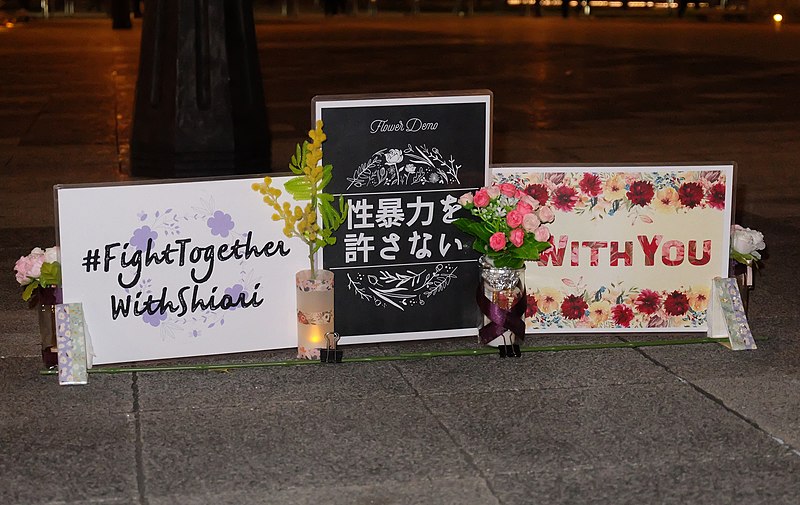
File:Flower demo Tokyo 2020-11-11.jpg

Appeal board made by participants in Flower Demo, Tokyo, Japan (2020), Author Breaklily (CC BY-SA 4.0 International)

Sexual violence against women has historically been associated with shame and stigma in Japan.  The laws were drawn in such a way as to excuse the behavior of male defendants, while simultaneously disregarding women’s rights.

At last, however, the country has raised the age of consent from 13 to 16 years, and redefined rape to include non-consensual intercourse [1].  Proof of force is no longer a prerequisite to conviction.  Photo voyeurism (including upskirting) has, also, been criminalized.

These long overdue reforms were prompted by Flower Demo, a Japanese movement protesting sexual violence against women [2][3].  Those taking part carried flowers to reflect their empathy for victims.

Several scandalous rape cases brought attention to the issue, drawing public outrage.  One involved a highly intoxicated woman.  Another involved a 15 y.o. her assailant had held pinned to a wall.  Still another involved incest ongoing for a period of years.

Sin Nature

Violence against women is a byproduct of the sin nature of mankind.  It is perpetuated by an attitude that women are mere sex objects, by the use of disparaging sexist language, and by the glorification of sexual assault.

Rape, in this context, is not just a notch on the assailant’s belt.  It is an act of machismo, proof of masculinity (albeit toxic).

Any shame associated with the act is displaced to the victim.

This is not what God intended.  When He created men and women, He created them as equals.

[1]  BBC, “Japan redefines rape and raises age of consent in landmark move” by Kelly Ng, 6/16/23, https://www.bbc.com/news/world-asia-65887198.

[2]  Wikipedia, “Flower Demo”, https://en.wikipedia.org/wiki/Flower_Demo.

[3]  Zenbird, “Flower Demo, the protests battling Japan’s sexual violence against women” by Kirsty Kawano, 11/25/20, https://zenbird.media/flower-demo-the-protests-battling-japans-sexual-violence-against-women/.

FOR MORE OF MY ARTICLES ON POVERTY, POLITICS, AND MATTERS OF CONSCIENCE CHECK OUT MY BLOG A LAWYER’S PRAYERS AT: https://alawyersprayers.com

15 Comments

Filed under Child Abuse, Child Molestation, Christianity, domestic abuse, Emotional Abuse, Justice, Law, Rape, Religion, Sexual Abuse, Sexual Assault, Violence Against Women

Gilgo Beach

File:SCPD Gilgo Death Investigation.jpg

Map indicating location of bodies discovered at Gilgo Beach, Author Atiru
(CC BY-SA 4.0 International)

WARNING:  Graphic Images

Gilgo Beach is a quiet stretch of sandy coastline on Long Island, NY, made infamous by the serial killings which have been uncovered there [1].

Shockingly, the remains of up to 18 victims, murdered between 1996 and 2011, have been found in the general area.  For the most part, these victims — the majority of them women — are believed to have been sex workers.

Serial Predator

Rex Heuermann — a 59 y.o. married architect and father of two — has been charged in the murders of three such victims (Melissa Barthelemy, Amber Costello, and Megan Waterman) [2].  He is the prime suspect in the murder of a fourth (Maureen Brainard-Barnes).  There is speculation that he may be responsible for many more.

Investigative Delay

The identification of victims was necessarily a lengthy and complex process.

However, the FBI did not become officially involved in this investigation until 5 years after the first remains were located by Suffolk County Police [3].  For reasons of his own, former Police Chief James Burke is said actually to have blocked that involvement [4].

There is, also, widespread suspicion among family members of the victims that Suffolk Police did not prioritize the investigation because these women were prostitutes, rather than “upstanding” members of the community.

Child Abuse and Prostitution
A. Sexual Abuse

What is particularly tragic about this story is that there is every likelihood the women had already been the victims of childhood sexual abuse. Continue reading

11 Comments

Filed under Abuse of Power, Child Abuse, Child Molestation, Christianity, domestic abuse, domestic violence, Emotional Abuse, Justice, Law, Neglect, Physical Abuse, Prostitution, Rape, Religion, sex trafficking, Sexual Abuse, Sexual Assault, Violence Against Women

Family Annihilators

File:Ours.JPG

Author Pic-Puce at French Wikipedia (CC BY-SA 3.0 Unported)

WARNING:  Graphic Images

A young girl runs down the street screaming that her father is killing everyone [1].  In fact, the father is found to have murdered his sons — ages 3, 4, and 7 — as well as attempting to murder his wife.

The term “family annihilators” (those who kill their families) was first coined by psychiatrist Park Dietz in 1980 [2A].  Tragically, such individuals are becoming increasingly common [4A].

Family annihilators are primarily, though not exclusively, men [3A][4B].  They tend to fall into one of four categories [4C]:

  • Self-Righteous:  Those who are self-righteous, for instance, blaming their spouses for the break-up of a family and angry about diminished access to children.  Infidelity and the desire to punish can set off this type.  Alcohol can, also, play a role [2B].
  • Ashamed/Disappointed:  Those who are ashamed of themselves or disappointed with their families.  Cultural honor killings fall into this category.  Alex Murdaugh, convicted of murdering his wife and son after Murdaugh’s own corruption came to light, is an illustration [3B].
  • Paranoid:  Those who are paranoid and motivated by a desire to “protect” their families from a perceived threat, such as the removal of children by social services.  This type of family annihilator may believe family members are wholly dependent on him/her for their survival, and rationalize he/she is acting mercifully to “save” them from a cruel world.  Depression can, also, be a factor [2C].  Until the killing spree, such an individual may be perceived by outsiders as dedicated to the family.  Andrea Yates is an illustration [5].
  • Sociopathic:  Those who are socially alienated or outright sociopathic, killing their families for monetary gain or similar cold blooded motives.  Family members are viewed as objects, mere means to an end, by such individuals.  Greed and other narcissistic purposes can motivate this type.  Susan Smith, who drowned her two sons to further a romantic relationship, is an illustration [6].

Continue reading

8 Comments

Filed under Child Abuse, Christianity, domestic abuse, domestic violence, Emotional Abuse, Physical Abuse, Religion, Violence Against Women

Abuse and Defensiveness, Part 2

https://upload.wikimedia.org/wikipedia/commons/d/dd/Cath%C3%A9drale_d%27Amiens%2C_fa%C3%A7ade_-_d%C3%A9tail.JPG

Depiction of Final Judgment on the facade of Amiens Cathedral, France, Author Savant-fou (CC BY- SA 3.0 Unported)

We continue our discussion of defensiveness with an examination of the impact of this psychological defense mechanism on relationships, and the tactics abuse victims can use to stop relying on it.

Impact of Defensiveness

When defensiveness is frequently employed by partners (romantic and otherwise), it is likely to become a vicious cycle with both parties critical and entrenched in their positions before any real discussion of an issue can take place [1A][2A].

Situations easily become tense and hostile.  Everything seems to escalate into a fight [2B].  Issues are never resolved.

In a business context, this is likely to cause isolation from colleagues, and may put a job in jeopardy [2C][3A].  In a romantic context, it will interfere with empathy and intimacy, ultimately becoming destructive to the relationship [1B][3B].

Tactics to Overcome Defensiveness

Professional counseling is one technique for overcoming defensiveness (along with underlying mental health issues like anxiety, depression, and PTSD), particularly as such counseling will increase our awareness of the problem [1C][4A].  Journaling can, also, assist, in this regard [4B].

Acknowledging (rather than attempting to deflect) our feelings can help validate them, and defuse a situation before it gets out of hand [4C].  This allows us to remain calm, listen, express empathy, and focus on the issue at hand without rushing to judgment [2D][4D].

Taking responsibility for something we may truly have done wrong is an opportunity for growth, not a sign of weakness [4E].

Other tactics include building self-esteem, and learning more beneficial communication skills [1D].  Assertiveness training is, for instance, available [5].

Once we recognize the triggers for our defensiveness and understand what may be prompting it, we can more readily ask ourselves what behaviors might be more effective in achieving the specific outcomes we desire while preserving the relationships we value [1E].

Recognition and Eternal Rewards

And whatever you do, do it heartily, as to the Lord and not to men, knowing that from the Lord you will receive the reward of the inheritance; for you serve the Lord Christ” (Col.  3: 23-24).

This is a flawed and broken world.  We will not always receive from it the justice we believe we deserve or the recognition we desire.  As followers of Christ, we will, in fact, be rejected, reviled, and persecuted (1 Peter 4: 12).

God, however, knows our hearts, as well as our failings.  He knows the experiences, positive and negative, which have shaped our lives.  He knows our pain, and our good intentions, whether we can fully express them or not.

Since He sees and knows all things — but loves us immeasurably, despite that — excuses before God are worthless (Luke 8: 17).  Imperfect as we are, He purchased us at the price of His blood.  This makes defensiveness with Him unnecessary, reducing the pressure on us to employ it with others.

God alone is the final Judge, in any case, the only One whose opinion of us really matters in the end.

[1A through 1E]  Healthy Love & Money, “What Is Defensiveness and How It Becomes a Vicious Cycle” by ED Coambs MBA, MA, MS, LMFT, 10/20/22, https://www.healthyloveandmoney.com/blog/what-is-defensiveness-and-how-it-becomes-a-vicious-cycle.

[2A through 2E]  Verywell Mind, “How to Stop Being Defensive” by Sanjana Gupta, https://www.verywellmind.com/how-to-stop-being-defensive-7187366.

[3A and 3B]  Wikipedia, “Defensive communication”, https://en.wikipedia.org/wiki/Defensive_communication.

[4A through 4E]  Verywell Mind, “What Is Defensiveness?” by Arlin Cuncic MA, https://www.verywellmind.com/what-is-defensiveness-5115075.

[5]  Wikipedia, “Assertiveness”, https://en.wikipedia.org/wiki/Assertiveness.

Part 1 in this series was posted last week.

FOR MORE OF MY ARTICLES ON POVERTY, POLITICS, AND MATTERS OF CONSCIENCE CHECK OUT MY BLOG A LAWYER’S PRAYERS AT: https://alawyersprayers.com

6 Comments

Filed under Child Abuse, Child Molestation, Christianity, domestic abuse, domestic violence, Emotional Abuse, Neglect, Physical Abuse, Religion, Sexual Abuse

Abuse and Defensiveness, Part 1

File:Richard Humphreys, the Boxer MET DP167133.jpg

“Richard Humphreys:  The Boxer” by John Hoppner (1778-1788), Metropolitan Museum of Art (Accession No. 53.113), Source/Photographer https://www.metmuseum.org/art/collection/search/436691 (Creative Commons CC0 1.0 Universal Public Donation)

“Defensiveness is where you try to convince the other person not to think negatively of you, where you defend yourself, where you try to make sure you don’t get found guilty by the court.  Assertiveness is merely stating the truth.”

-Dan Munro [1]

Defensiveness is a psychological defense mechanism which involves justifying our actions when we experience shame, sadness, and/or anger as the result of perceived criticism [2A][3A].

Defensiveness is distinct from assertiveness in the defense of our rights.  One is emotion driven, an attempt (conscious or unconscious) to deflect blame to our opponent, and often related to anxiety or low self-esteem.  The other is simply a confident and reasoned communication style, which stops short of aggression [4].

Connection to Abuse

Abuse — whether emotional, physical, sexual, or arising from neglect — is a recognized cause of defensiveness [2B][3B][5].  Since we were unable to protect ourselves against abuse as children, it is entirely possible that we may become reflexively defensive as adults.

Domestic abuse can, also, result in defensiveness.

Continue reading

20 Comments

Filed under Child Abuse, Child Molestation, domestic abuse, domestic violence, Emotional Abuse, Neglect, Physical Abuse, Sexual Abuse

Continuing FLDS Tragedy

https://upload.wikimedia.org/wikipedia/commons/1/15/Ira_Eldredge_and_his_three_wives_circa_1864_%28restored%29.png

Retouched portrait of Mormon Bishop Ira Eldredge with his three wives (Nancy, Hannah, and Helvig), (c. 1864)

Public Domain as published before January 1, 1928

An offshoot of the infamous Fundamentalist Church of Jesus Christ of Latter-Day Saints (FLDS) is carrying on the heinous practices of Warren Jeffs, though Jeffs has now been incarcerated for over a decade [1].

Samuel Bateman, 47 y.o., the leader of this polygamous Mormon sect, claims to be Warren’s legitimate successor and a “prophet” in his own right [2A].

Bateman is alleged to have taken 20 or more wives, some as young as 8 or 9 y.o.  He is said to have traveled through Utah, Arizona, Colorado, and Nebraska in order to have sex with underage girls.  As a result, Bateman is facing state and federal charges which include kidnapping and child abuse.

A total of eleven members of Bateman’s splinter group have now been charged with transporting children across state lines for purposes of sexual activity, recording that activity, destroying evidence, and witness tampering.

Mormon Polygamy Historically

Though it is today prohibited by the mainstream LDS, polygamy was among the original teachings of Mormonism, and practiced till 1890 [2B][3].  Doctrinally, polygamy was actually viewed by Mormons as being essential to Salvation, and more significant than baptism.

Downsides of Polygamy for Women

Polygamy — most recently pitched to the public under the seductive guise of polyamory — necessarily creates tensions and inequities, whether practiced by Mormons, Muslims, or others [4].  Women in such an arrangement do not have equal rights with their male partner.

Some “wives” will be favored over or replaced by others, causing harmful friction not only among these women, but their children.  Emotional abuse, depression, severe financial restrictions (even outright destitution), and ultimate abandonment are not uncommon [5A].

Polygamous relationships are, also, prone to domestic violence and/or sexual abuse, not to mention the negative impact they have on children [5B].

Continue reading

8 Comments

Filed under Abuse of Power, Child Abuse, Child Molestation, Christianity, domestic abuse, domestic violence, Emotional Abuse, Justice, Law, Neglect, Physical Abuse, Rape, Religion, sex trafficking, Sexual Abuse, Sexual Assault, Violence Against Women

Troop 6000

File:Girl Scout cookies (Girl Scouts of the USA).jpg

Girl Scout Cookies, Author Photoguy439 (CC BY-SA 3.0 Unported)

New York City’s Girl Scout Troop 6000 has the unique mission of reaching out to girls experiencing homelessness or living in shelters for other reasons [1A].

Since its inception in 2017, Troop 6000 has raised over $1.6 million through the cookie sales for which the Girl Scouts are famous, and corporate matching donations.  These funds — which go toward trips, summer camp, and other adventures — have benefited some 2500 women and girls across 20 shelters throughout the New York City area.

This year, Troop 6000 was expanded to include the immigrants and asylum seekers at Emergency Response and Relief Centers.  Currently, there  are approximately 37,500 such migrants in the care of New York City’s Dept. of Homeless Services.

Troop 6000 is the brainchild of Giselle Burgess who was, herself, living in a shelter with her 5 children at the time.  Similar troops have now been started in Iowa, Tennessee, California, and Nevada.

“This population of young women has seen incredibly traumatic events.  And that is right at the core of what we need to do.  We need to take care of them and show them that they deserve the care.”

–Meridith Maskara, CEO of Girl Scouts of Greater New York [1B]

[1A and 1B]  CNN, “This New York Girl Scout troop is the first of its kind.  Here’s why” by Vanessa Yurkevich, 5/9/23, https://www.cnn.com/2023/05/09/business/girl-scouts-troop-6000/index.html.

FOR MORE OF MY ARTICLES ON POVERTY, POLITICS, AND MATTERS OF CONSCIENCE CHECK OUT MY BLOG A LAWYER’S PRAYERS AT:  https://alawyersprayers.com

12 Comments

Filed under Child Abuse, Child Molestation, Community, domestic abuse, domestic violence, Emotional Abuse, Neglect, Physical Abuse, sex trafficking, Sexual Abuse, Violence Against Women