Tag Archives: child labor

Tiger Widows

File:THE CLOSE-UP.jpg

Tiger hiding in Bandavgarh National Park, India, Author Amitban77 (Creative Commons Atribution 4.0 International)

“…The Sundarbans [is] a vast mangrove forest straddling the border of India and Bangladesh…

In the coastal villages of the Sundarbans, many women have lost their husbands to tiger attacks.  These men — fishermen, honey collectors, and woodcutters — venture into the forest’s treacherous depths to earn a living.  When they don’t return, their wives are left to face not only grief but also a cruel and unjust blame.  They are branded as Apia (inauspicious) or even “husband-eaters.”

Branded as Cursed:  A Life of Blame and Ostracism

Superstition dictates that when a man enters the forest, his wife must observe strict rituals and vows for his safety.  However, if her husband falls prey to a tiger, the community immediately presumes that the wife must have failed in her duties or is inherently unlucky.  The responsibility for his death is placed squarely on her shoulders.

This social condemnation is just the beginning.  The women, now known as tiger widows, face severe ostracism.

  • Villagers may stop interacting with them.
  • They are refused work in agricultural fields or community fishing.
  • They are barred from attending social and religious ceremonies.

Forced into isolation, these women must raise their children alone, often in a separate hut on the outskirts of the village.  Crippled by poverty, many are forced to pull their children from school and send them to cities to work as child laborers. Worse still, their vulnerability is often exploited, and if a tiger widow is sexually assaulted, the finger of blame is, yet again, pointed at her…”  [Continued at:  https://shobdoneerin.com/2025/09/04/sundarbans-tiger-widows-blamed-for-the-kill-shunned-by-society/comment-page-1/?unapproved=79&moderation-hash=3fc82dcecf5c5cbb795093646fb5cb61#comment-79 ]

This post is courtesy of Samiran Mandal who blogs at https://shobdoneerin.com.

The Franciscan Sisters have returned land to the Lac du Flambeau tribe in an effort to repair the painful Native American boarding school legacy.  This is the first time a Catholic institution has returned Wisconsin tribal land as an act of reparation.

See, https://waow.com/news/top-stories/a-historic-first-catholic-institution-returns-tribal-land-back-to-lac-du-flambeau-tribe/article_0f59e30d-b3cb-4381-becd-959559d2ef3a.html.

FOR MORE OF MY ARTICLES ON POVERTY, POLITICS, AND MATTERS OF CONSCIENCE CHECK OUT MY BLOG A LAWYER’S PRAYERS AT: https://alawyersprayers.com

9 Comments

Filed under Community, domestic abuse, domestic violence, Poverty, Rape, Violence Against Women

Enslaved 2024 – Part 3

File:Human Trafficking.jpg

Human Trafficking, concept image by Tapas Kumar Halder, Author Tapas Kumar Halder, (CC BY-SA 4.0 International)

We conclude our discussion of the blight of human trafficking with suggestions as to how the public can prevent and respond to this profound evil [1].

What You Can Do

Concerned as they may be, most people are overwhelmed by the magnitude of human trafficking — at a loss for how they can make a difference.  But there are things the average person can do [2]:

  • Become educated about human trafficking, and stay alert to the situations people may be experiencing.
  • Share information about human trafficking with family, friends, neighbors, business associates, and fellow bloggers.
  • Support local anti-trafficking organizations, either financially or by volunteering.  Pro bono attorneys are especially needed.  An online directory of community organizations is available here:  https://humantraffickinghotline.org/en/find-local-services.
  • Buy with care.  Consider where (and by whom) food, clothing, jewelry, electronics, and other items were produced.  An extensive list of items made by forced labor or child labor can be found here:  https://www.dol.gov/agencies/ilab/reports/child-labor/list-of-goods.
  • Get help for a family member, co-worker, student, tenant, patient, or someone else in need.  The National Human Trafficking Hotline https://humantraffickinghotline.org/en/contact provides free confidential support, 24/7.  Call 1-888-373-7888 or text HELP to 233733 (BEFREE).
  • Partner with the schools, healthcare providers, and other institutions and professionals serving those experiencing human trafficking.  Together with them, craft student safety programs for children at risk, fair workplace protocols, and ethical procurement practices at places of employment.  Work for safe and affordable housing, and accessible healthcare.
  • Speak out.  Inquire what elected representatives are doing about human trafficking.  Urge that trafficking be made a priority.

Continue reading

10 Comments

Filed under Child Abuse, Child Molestation, Christianity, Community, domestic abuse, domestic violence, Emotional Abuse, human trafficking, Neglect, Physical Abuse, Poverty, Prostitution, Rape, Religion, sex trafficking, Sexual Abuse, Slavery, Violence Against Women

Enslaved 2024 – Part 2

As discussed in Part 1 of this series, human trafficking is the form slavery takes today [1].

Red Flags

The red flags for trafficking include the following [2]:

A.  In the Workplace, Generally

  • A job offer that seems to be too good to be true.
  • A job offer that requires a move far from family and friends, where the recruiter or prospective employer declines to provide detailed information about the job.
  • A prospective employer who refuses to provide a signed contract, or asks employees to sign a contract in a language they cannot read.
  • A prospective employer who collects fees from a potential employee for the mere “opportunity” to work at a particular job.
  • Promised pay withheld by a recruiter or employer after work has been done.
  • Dangerous work conditions without training, adequate breaks, safety gear, or other protections.
  • Inhumane living conditions provided by an employer.
  • Monitoring by an employer of all interaction with others.
  • Isolation by an employer from support systems.
  • Pressure by an employer to stay on the job.
  • Control by an employer of a passport and identity documents.
  • Threats of deportation or other harm by an employer.

Continue reading

9 Comments

Filed under Child Abuse, Child Molestation, domestic abuse, domestic violence, Emotional Abuse, human trafficking, Neglect, Physical Abuse, Poverty, Prostitution, Rape, sex trafficking, Sexual Abuse, Slavery, Violence Against Women

Enslaved 2024 – Part 1

File:ValentinGalochkin 1965 Slavery.jpg

“Slavery – A Study in Marble” by Valentin Galochkin, Author Valentin Galochkin, (PD)

The White House has proclaimed January as Slavery and Human Trafficking Prevention Month [1].

Scope

Over 40 million people are trafficked worldwide [2A].  Women and girls constitute about 71%  of all human trafficking victims [2B].  In fact, one in every four victims of modern slavery is a child [2C].

Geographic Distribution

Trafficking centers around areas with international travel hubs (airports and seaports), access to highways, seasonal work, a hospitality industry (often associated with tourism), a sharp disparity between rich and poor, and a large immigrant population [3A][8].

A. Overseas

According to the International Labor Organization, Asia and the Pacific region have the highest incidence of forced labor and forced marriages [5].

B. United States

In our country, experts estimate that there are over 199,000 instances of human trafficking (which includes sex trafficking) annually [4A].

The top ten states for trafficking in 2022 were Mississippi, Nevada, Missouri, Nebraska, Florida, Texas, California, Arkansas, Oregon, and Georgia [2D]. Continue reading

14 Comments

Filed under Child Abuse, Child Molestation, domestic abuse, domestic violence, Emotional Abuse, human trafficking, Neglect, Physical Abuse, Poverty, Prostitution, Rape, sex trafficking, Sexual Abuse, Slavery, Violence Against Women

Child Labor in the United States

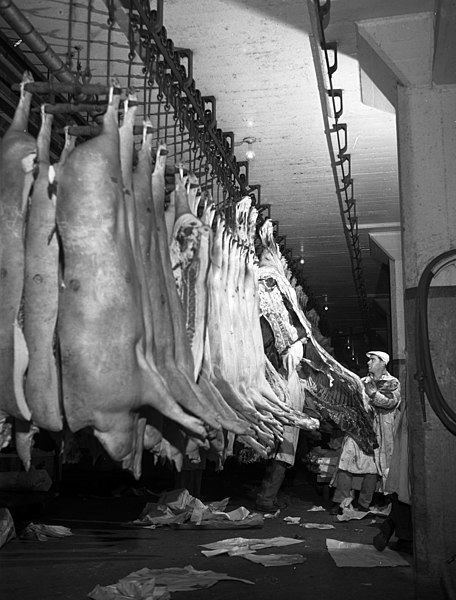
File:Pig carcasses in a Los Angeles meat packing plant.jpg

Workers with pig carcasses at Los Angeles meat packing plant (1945), Source https://digital.library.ucla.edu/catalog/ark:/21198/zz0002qn8w, Author Los Angeles Daily News (CC-BY-4.0 International)

The term “child labor” conjures up images of 19th Century sweat shops.  If meat packing plants are mentioned, some of us may recall Upton Sinclair’s 1905 expose The Jungle [1].

Few of us would imagine that child labor practices are still engaged in today.  Unfortunately, that is the case.

Cleaning Slaughterhouses

The Labor Dept. in December settled a civil suit against Packers Sanitation Services Inc. (PSSI) for the violation of child labor laws [2].

Investigators had found some 50 children (one as young as 13 y.o.) employed by PSSI cleaning slaughterhouses at 5 different locations in Nebraska and Michigan.  An earlier investigation in Kansas was dropped when necessary records could not be obtained.

“Oppressive Child Labor” Standards

The Fair Labor Standards Act prohibits “oppressive child labor” [3].  Labor Dept. regulations identify many positions in slaughterhouses and meat packing plants as hazardous for minors.

In particular, the “kill floors” in meat packing facilities are known to have slippery surfaces from animal fat, hot water, and soap [4A].  Though safety equipment is required for their use, strong cleaning chemicals can cause caustic burns from exposure.

No Penalties or Fines

Despite all this, the Labor Dept. issued no penalties or fines to PSSI [4B]. Continue reading

18 Comments

Filed under Child Abuse, Child Molestation, Community, Emotional Abuse, human trafficking, Justice, Law, Neglect, Physical Abuse, Sexual Abuse, Slavery

Modern Slavery

Incomprehensible as it may be, millions today live out a modern version of slavery.  Men, women, and children are sold as if they were brute animals or inanimate objects, forced to work for little or nothing, and subjected to physical, emotional, and sexual abuse. 

Human trafficking for sexual exploitation focuses heavily on women and girls.  Children (some as young as 5 or 6) may, also, labor as domestic or agricultural workers.  As many as 53 million children under the age of 15 routinely perform extremely hazardous tasks.

William Wilberforce, an English politician, philanthropist, and abolitionist, spearheaded the parliamentary campaign against the British slave trade for over twenty five years, until passage of the Slave Trade Act in 1807.  Wilberforce then continued his efforts for over twenty five additional years, ultimately achieving passage of the Slavery Abolition Act of 1833.  His health had by then entirely failed, but his devotion takes one’s breath away.

That we are still addressing fundamental questions of liberty, justice, and equality nearly two centuries later – some 3500 years after they were first addressed in the Bible – is a reflection of what Christians would call the “sin nature” of man.  Our flawed human nature does not change from one generation to the next.  The same problems recur, albeit in different guise, one generation after another.

This might seem discouraging to non-believers, an argument for complacency.  Nothing could be further from the truth.  These are the front lines of the battle between good and evil, a battle each generation must fight for itself.  Christians know something that non-believers do not.  Though the battle may rage on, the war has been won.  It was won for us by Jesus’ death and resurrection.

Even the battle is not fought by our strength, but His.  That knowledge is empowering.  It carries us forward to accomplish the impossible.

Make no mistake.  This remains a tragedy.  We should be moved.  We should weep for these children, should pray, advocate, and fight for them.  We may not win the battle.  But our empathy, our common humanity, should be yet more threads drawing us together.

— Excerpt from Connecting Threads

FOR MORE OF MY ARTICLES ON POVERTY, POLITICS, AND MATTERS OF CONSCIENCE CHECK OUT MY BLOG A LAWYER’S PRAYERS AT:  http://www.alawyersprayers.com

2 Comments

Filed under Child Abuse, Emotional Abuse, Justice, Law, Physical Abuse, Poverty, Prostitution, Religion, Sexual Abuse, Slavery, Violence Against Women