Tag Archives: abuse and nightmares

The Rose Garden, Chapter 20 – Progress

File:Golden Christmas Tree Ornament.jpg

Christmas tree ornament, Author Noah Wulf, (CC BY-SA 4.0 International)

For I know the thoughts that I think toward you, says the Lord, thoughts of peace and not of evil, to give you a future and a hope” (Jer. 29: 11).

I decide I want to put a tree up this year, after all.  One by one, I pull the boxes out of the closet.  Joni Mitchell sings about skating away on a river, as I gently lift the ornaments from their places.  This one with Ziggy on it is twenty-five years old.  How rapidly our lives rush by.  Here are Snoopy and the rest of the Peanuts gang.  Here are the Looney Tunes characters — Porky Pig, Tweety Bird, Bugs Bunny.

Angels, rocking horses, pipers, drummers, partridges and their kin, Santas (both lean and stout), reindeer, shepherds, teddy bears.  They crowd one upon another, each a memory, some bittersweet.

I used to dread going to my parents’ for the holidays.  The thought of pretending we were a cheerful, trouble-free family, in the same room where my father had so often molested me, would make me want to retch.  Christmas, Easter, birthdays, no excuse could justify an absence.

We would sit at the dining room table, my father in his underwear, my mother hurrying to and fro with the plates, despite repeated offers of assistance.  My father would dismember the turkey, portions enormous, notwithstanding, our protests about diet.

Without fail, at some point during dinner my father would look over at me and remark in a bemused tone, “I just can’t see you as a lawyer, Annie.”  Without fail, at some point he would make a racial comment.  On schedule, an argument would follow.

My sister and I would hurry upstairs soon after dinner, as far away from Ma and Dad as possible.  Back at my apartment after the visit, I would empty my suitcase into the hamper, strip off my clothes, then shower to remove any remaining taint.

My sister’s husband, a kind and decent man, helped change the dynamic.  Not that he was easily accepted into the family.  When they first announced their engagement, there was dead silence at the table.

Both my mother and father grew to love their son-in-law.  My father genuinely admired his skills at carpentry and household repairs.  Pop enjoyed talking with him about sports, history, and — surprisingly enough — the “old country.”

Conversation at the dinner table expanded to cover these topics.  Tensions eased. Continue reading

15 Comments

Filed under Child Abuse, Child Molestation, Christianity, Emotional Abuse, Neglect, Physical Abuse, Religion, Sexual Abuse

The Rose Garden, Chapter 17 – Illness

File:MarkhamStouffvilleHospital23.jpg

Emergency Room, Markham Stouffville Hospital, Ontario, Author Raysonho @ Open Grid Scheduler/Grid Engine, (CC0 1.0 Universal Public Domain Dedication)

“…rejoicing in hope, patient in tribulation, continuing steadfastly in prayer…” (Rom. 12: 12).

There may be an abuse-related dimension common to all the major illnesses from which I have suffered over the years, disparate though at first they appear.

The mechanism of this is not fully understood, but is thought to involve somatization, i.e. the expression of psychological or emotional factors as physical symptoms [1].  The pain associated with somatization is a physiologic response to the stress and trauma of abuse, but all too real [2].

Abuse and Autoimmune Disease

Around the age of twelve, I suffered a major attack of hives.  Though I did not know it then, this presaged the chronic urticaria (CU) from which I suffer today.  In effect, the body does not recognize, and so attacks itself.

A growing body of research suggests a link between childhood abuse and the development of autoimmune disease [3].

At the time of the initial hives, I was repeatedly bathed in ice water as I writhed.  Since they had been on the phone to a physician, it was twenty-four hours before my mother or grandmother considered taking me to an emergency room.

Of course, my mother had gone to work with a second degree sunburn.  Her enormous blisters burst while she was on the subway.  My grandmother washed the kitchen floor on her hands and knees the day after she returned home from the hospital, following a hysterectomy.

After years of childhood earaches and tonsillitis, I finally had my tonsils removed at age nineteen.  Following surgery, I awoke from anesthesia to find my father at the foot of the hospital bed.  I cannot convey the joy I felt.  It was entirely unexpected and moved me immensely that he had taken time off from work to see me.

It strikes me as funny to this day that I shared a room with a Jehovah’s Witness and a Black Muslim.  Unable to speak, I lay there between them as my fellow patients held theological arguments at high volume across my bed.

Abuse and Endometriosis

From the time I first began to menstruate, my periods were irregular and accompanied by severe cramps.  Endometriosis was ultimately diagnosed.  Child abuse has, also, been linked to endometriosis [4].

It would not be until my thirties that I obtained any relief.  Before that, each month I would swallow as many aspirin as I could tolerate, then lie prostrate on the bathroom floor, comforted by the cool tile until the pain passed.

Again, no one took me to an emergency room.  I remember the pain ending early one Christmas morning, after I had endured it for some ten days.  Julia Child was on TV at the time, demonstrating how to stuff a turkey.  I have retained a sentimental fondness for her ever since.

The day I took the scholarship exam for college, my period came on suddenly during lunch.  We had completed the morning session and were sitting in the cafeteria.

With the onset of cramps and bleeding, I rushed to the ladies room, but could find no sanitary napkins.  Desperate, I attempted unsuccessfully to insert my first tampon, all the while doubled over in pain.

Wave after wave of cramps rolled over me.  I broke out in a sweat.  For some reason, after forty minutes, the cramps stopped on their own.  I used toilet tissue to craft a make-shift pad, and rejoined the others in time to sit for the afternoon session.

I won a full scholarship, as a consequence.  With no thought to a career, I chose biology as my major out of wonder at the beauty of the world.  Medicine — since I tend to faint at the sight of blood — was never an option.

Years later, I, too, had a hysterectomy.  I had to be taken from my office by stretcher — moaning, but issuing last minute instructions to the staff as I went.

My then Office Manager, a close friend, stayed by my side.  This was no surprise.  We had done the office budget together one weekend, as her infant daughter lay asleep in a carrier on the floor at our feet.

Abuse and Chronic Back Pain

I have had many years of back pain.  A fall may have aggravated the scoliosis from which I suffer.  It, also, produced disc herniation.  But childhood trauma is frequently associated with chronic neck or back pain [5].

At times the pain has been so severe I have wondered if it would kill me.  Ultimately, I had to undergo a spinal fusion at the cervical level, then spend three months strapped into a brace.

The procedure necessitated a bone graft from my right hip.  The night before surgery, the nurse and I laughed together as we wrote on my left side in black marker, “Wrong Hip.”

Groggy from pre-anesthesia medication and fearful that a tube could damage my vocal chords, my last words to the anesthesiologist before surgery were, “Please, be careful.  I’m a lawyer.”  He undoubtedly thought I was issuing a threat.

I did not let my mother (who was seriously ill, herself, at the time) know about my surgery until it was over.

While I recuperated, a long-time friend, arranged to have meals sent to my home.  Another close friend drove me upstate to her summer place.
Continue reading

25 Comments

Filed under Child Abuse, Child Molestation, Christianity, Emotional Abuse, Neglect, Physical Abuse, Religion, Sexual Abuse

The Rose Garden, Chapter 12 – The Chasm

https://upload.wikimedia.org/wikipedia/commons/9/95/Lower_Antelope_Canyon_November_2018_017.jpg

Antelope Canyon, AZ, Author King of Hearts, (CC BY-SA 4.0 International)

WARNING:  Graphic Images

Flee sexual immorality.” (1 Cor. 6: 18).

I found a way at last at age thirteen to end the molestation.  The solution was so obvious that for a long while I would not forgive myself for having failed to see it [1].  I could never again be alone with my father.  No setting was safe.

There was one final level of violation reached before this shift.  My father began to cajole my “permission.”  His face would grow red, his eyes glaze over.  His voice would turn husky.  The words remain seared in my memory.  “Please, honey.  Please, let me.  You’re so sweet.  I can’t help myself.  See how hard you make me.”

I would repeatedly push his hands away, deluded that I might actually be able to deter him.  Finally, my will was broken.  I stopped resisting, even feebly; gave up all hope, and lay there like a rag doll.

It was the request for “permission” that was insidious.  Children do not think logically.  Now, I inferred that I had given consent — against my will.  The shame was excruciating.

I find a section on bees from my father’s notebook particularly striking, in this connection:

“So, when we were kids we used to hang out around the well…It was always wet around [there], and bees loved it.  Barefoot kids, too.

So, the naughty kids, when a bee was sitting in the water or [near it] used to grab the bee by the wings, and hold it.  Naturally, the bee pulled his or her weapon.  Kids held [the bee] on their heels, and let them get stung.

I guess they must have gotten high from the effect.  Naturally, they tried to pull the bee off, but the bee was dead.  Minutes later on the heel was the bee’s needle, turning around like a drill in the foot of the kid [who] quickly pulled the needle out of his heel.

And that was the fun.  The bee was dead, and the kid has his little high fun.  Probably, like they claimed, they eventually got immune to it.”

A predator may grow immune to his victims’ pleas.  A child never develops immunity to the violation to which he or she is subjected.  Each assault leaves a fresh wound.

About this time I began dreaming that a lion had escaped and was roaming our yard.  I had no defense against this lion, and no one to ask for aid.  I would awaken from these dreams in a cold sweat.

Cold Comfort

Since we were Catholic, I had made the sacraments.  Confession, communion.  Attending parochial grammar and high schools as I did meant receiving a religious education.  Unfortunately, the theology conveyed was often riddled with error and harsh in tone.

Though the incest seemed something apart, answers to my deepest questions became increasingly difficult to obtain.  Religion provided cold comfort.

In my teens, my faith expressed itself in involvement with idealistic causes.  These were, however, turbulent years.

Fury

After my grandmother died, my younger sister and I became “latchkey” children.  Not only did we miss Grandma immensely, not only did the house become silent and cavernous in her absence, there was no longer a buffer to our father’s anger.  His fury held sway.

I know now that anger can be a useful tool for separation.  All I knew then was that my father and I argued bitterly.  Whatever the topic — why there were dishes in the sink or whether public assistance was justified — I never seemed to win these arguments.  I came away from them feeling mauled and bloody.

Grandma’s garden withered from neglect and was paved over.  Grandpa moved out.  The cherry tree was cut down.

Self-Absorbed

I taught myself about sex from the encyclopedia, the Bible, and James Bond novels.  That combination filled the gaps the regrettably mature experience imposed by my father had left; placed the assaults by him in some context.

During these years, I became self-absorbed, preferring to spend time by myself.  It is my greatest sin.  I would lock myself in my room, after we came home from school.  My sister, no more than ten at the time, would knock timidly on the door.

“Please, come out, Anna,” she would plead.

“Not now.  I’m really tired.”

“We can play a game.  Please.”

“Maybe later.  Just let me lie down for now.”

“Please, Anna.”

“Maybe in a little while.”

I would experiment with my mother’s lipstick or try on her negligees, while my sister wandered the empty house with nothing but the television for company.

I began reading books on psychology and human behavior, in an effort to better understand myself and make sense of my life.

The interest I developed in anthropology and archaeology during my teens was actually an attempt to decipher human nature and men, in particular.  It was a great comfort to think that the species could not have survived, but for millions upon millions of dedicated fathers over the millennia; that somewhere there had to be good and decent men.

Control Slipping

Meanwhile, my father felt his control over us slipping away.

As a birthday surprise for our mother, my sister and a friend of hers planted rose bushes around the yard.  When our parents arrived home after work to find the rose bushes in place, my father went into a rage.   One by one, he tore them up in the dark.  I will never forget the shock and distress on my sister’s face.

At times, I felt offered up — my father some demonic god; my mother at the altar, holding the knife.  In an effort to lift my spirits, she would tell me how “pretty” he thought I was.

Whether confused, fearful, desperate to please, or deliberately unaware — she served during these years, in effect, as his co-conspirator.   I am certain this was not intentional on her part. Continue reading

14 Comments

Filed under Child Abuse, Child Molestation, Christianity, Emotional Abuse, Neglect, Physical Abuse, Religion, Sexual Abuse

The Rose Garden, Chapter 10 – Art Lessons

File:Dreirad 6340.jpg

Tricycle, Author NobbiP (GNU Free Documentation License Verson 1.2 or later, CC BY-SA 3.0 Unported, 2.5 Generic, 2.0 Generic, and 1.0 Generic)

WARNING:  Graphic Images

Search me, O God, and know my heart; Try me, and know my anxieties; And see if there is any wicked way in me…” (Ps. 139: 23-24).

Early on, one of the older boys in the neighborhood did something unforgivable.  He borrowed my shiny, red tricycle without permission.  Outraged, I was not permitted to tell the grown-ups my side of the story when the tricycle overturned in the street, injuring him.

This small — now amusing — incident left a lasting impression on me.  It just may be the reason I became a lawyer.

Obedience and Authority

I attended a Catholic grammar school, run by the parish.  The Dominican nuns there emphasized obedience as the highest virtue.  Though I now recognize the spiritual significance of that virtue, their intention was likely more practical.  Class size for years exceeded sixty students.

I felt at some fundamental level that there were things more important than obedience.  Consequently, I developed a rebellious streak in response to this well-intended tutelage.  It was easier to rebel in school than at home.

My first grade teacher was universally lauded by parents and universally despised by the children under her care.  She ruled with absolute authority in her small universe, so much so that bathroom breaks were not tolerated if unscheduled.  Consequently, accidents in the classroom were frequent and deeply humiliating for the children involved.

I could not at six have said why these situations so angered me.  Nor could I understand why the adults around me seemed incapable of recognizing that the teacher was the one actually responsible for them.

Inauthenticity

My second grade teacher was a woman in her early sixties who encouraged the children in whom she saw intelligence or talent — at least those children who conformed to her expectations.

I was quick to perceive this, thriving on the added attention, though it served to drive a wedge between other classmates and myself.

I began in the second grade to experience a feeling of inauthenticity, and a sense of failure which pervaded my life for years [1].  I attribute this in part to the weekly art classes the teacher arranged for me at a nearby school.  Rather than a pleasure, those classes became a burden.

I had learned while I had measles how to make paper dolls.  Designing and drawing clothes came easily, and seemed a way to share in the glamor I associated with my mother, even when she was absent.

It may be that an interest in art ran in the family.  In Hungary, Grandma was renowned for her breathtaking paper flowers, extravagantly displayed at religious festivals.  This avenue of expression was unavailable to her in America.  Cut off from it, she drew inward.

My interest in art offered Grandma the chance to reconnect with a part of herself otherwise buried.  This was not something I realized at the time.

My art classes — if they could be termed that — consisted of little more than proximity to paints, pastels, and canvas.  The so-called classes were presided over by a nun we were instructed to call “Mother.”

I never knew the details of Mother’s life.  But, from the outset, I could feel her contempt.

Throughout the year, Mother collected students’ drawings and paintings for the ostensible purpose of compiling individual portfolios.  What she failed to disclose, either to parents or students, was that she independently re-worked each student’s output, herself.

Without doubt, the resulting pieces were less amateurish and more polished than when they had been submitted to Mother for safekeeping.  There were, also, forgeries.  The pieces reflected the level of her skill, rather than the aptitude of her pupils.  For me, this was another violation.

Though I repeatedly attempted to explain to adults that the art work was not truly “mine,” I was consistently praised for it.   My discomfort was compounded by the fact I was called on to show the work to my class at the end of each year.  That ultimately led to my abandonment of art.

Having purchased a costly mail order course for me shortly before her death, Grandma more than once asked, plaintively, “Anna, don’t you want to finish your art work?”  It breaks my heart that I disappointed her.
Continue reading

18 Comments

Filed under Child Abuse, Child Molestation, Christianity, Emotional Abuse, Neglect, Physical Abuse, Religion, Sexual Abuse

Nightmares

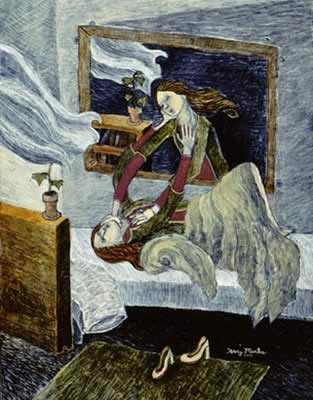
“Nightmare in a Mirror” by Terry Marks, Source http://www.stuckism.com/GFDL/Marks.html (CC BY-SA 3.0 Unported)

You have a recurring nightmare.  Perhaps you are being chased by something enormous and faceless, something terrifying.  Perhaps the sight of something innocuous in a dream causes you unexplained anguish or despair.

You wake in a cold sweat (or with tears on your pillow), sure there must be something wrong with you.

Symbolic Imagery and PTSD

The language of our dreams can be puzzling.  Images can be confusing, and are often symbolic.

For abuse survivors, nightmares are a frequent symptom of Post-Traumatic Stress Disorder (PTSD) [1].  An estimated 71% – 96% of those with PTSD have nightmares.

Short-Term v. Long-Term Memory

Scientists agree that dreams involve the mind’s transfer of short-term memories to long-term storage.

Continue reading

33 Comments

Filed under Child Abuse, Child Molestation, Christianity, Emotional Abuse, Neglect, Physical Abuse, Religion, Sexual Abuse