Punishing Ourselves, Part 2 – Emotional Hunger

File:Sarasota Mall at UTC corridor 6.jpg

Shopping mall, Sarasota, FL, Author PCHS-NJROTC (CC BY-SA 4.0 International)

 “But his brothers hated Joseph because their father loved him more than the rest” (Gen. 37: 4 NLT).

Human beings inherently crave connection.  When our basic need for relationship is denied, abuse victims can develop an intense emotional hunger.  Some of us attempt to satiate that hunger with food, others with possessions, still others with sex.

But these will not satisfy us.  So the emotional hunger returns, and the cycle begins all over again – each time destined to fail.

Punishment and Reward

“…the wandering of desire…is vanity and grasping for the wind” (Eccl. 6: 9)..

The reward – whether of food, material things, or sex – becomes punishment.  Each stop gap measure has negative consequences.  Each leaves us feeling empty [1].  Our sense of worthlessness resurfaces with renewed force.

Then the reward used to stem our emotional hunger becomes, itself, a source of shame.  It takes more and more food/things/sex to bring us even temporary relief.  Our desperation increases.

Punishment and Self-Forgiveness

These things I have spoken to you, that in Me you may have peace. In the world you will have tribulation; but be of good cheer, I have overcome the world” (John 16: 33).

Consciously or not, we ache for forgiveness, someone to take the guilt away.  And there is Someone who can do that.  In fact, He longs to do that.  He died on a cross to do that.

But we did nothing to “deserve” abuse.  We do not, therefore, need forgiveness for our abuse.  What Jesus Christ does to relieve us of the false guilt for which we have been punishing ourselves is reveal a truth it would have been too painful for us to accept as children, i.e. that our parents and caregivers were the ones at fault.

Where their love failed us, His will not.  And the life He offers us is everlasting.

[1]  Got Questions, “What does the Bible say about eating disorders?”, https://www.gotquestions.org/eating-disorders.html.

Originally posted 10/8/17

This series began last week with “Punishing Ourselves, Part 1 – Numbness and Deprivation”

FOR MORE OF MY ARTICLES ON POVERTY, POLITICS, AND MATTERS OF CONSCIENCE CHECK OUT MY BLOG A LAWYER’S PRAYERS AT: https://alawyersprayers.com

12 Comments

Filed under Child Abuse, Child Molestation, Christianity, Emotional Abuse, Neglect, Physical Abuse, Religion, Sexual Abuse

Punishing Ourselves, Part 1 – Numbness and Deprivation

File:Caïn venant de tuer son frère Abel by Henri Vidal, Tuileries Garden, 18 July 2017.jpg

“Cain After Killing His Brother Abel”, Tuilleries Garden, Paris, France, Author Joe deSousa (CC0 1.0 Universal Public Domain Dedication)

WARNING:  Graphic Images

And Cain said to the Lord, ‘My punishment is greater than I can bear!’ ” (Gen. 4: 13).

Though there are some hideous punishments inflicted on children, I will not be focusing on those here.  I want instead to talk about the punishment we inflict on ourselves.  The two are linked.

As abuse victims, we come to believe ourselves deficient, sinful, unworthy of love.

We may be told this directly by curses, blows, and cigarette burns, or indirectly by food, warmth, and shelter denied; by affection, comfort, and encouragement withheld; by the absence of laughter, except at our expense; by the absence of protection from sexual predation; and, above all, by the absence of hope.

Whatever the details in our case, we come to see ourselves as guilty.  We may not be able to name the sins we committed to “deserve” our abuse.  But we are certain of our guilt.

It is as if we bear the mark of Cain without ever having committed the crime.

Punishment and Deprivation

My soul has been deprived of peace; I have forgotten what happiness is” (Lam. 3: 17).

Those of us who were deprived of the basic necessities as children may deprive ourselves the same way as adults.

We cannot keep the refrigerator full or the pantry stocked.  We have difficulty using the new sheets, and may prefer sleeping on the couch or floor.  We resist purchasing a favorite food or appealing item of clothing for ourselves.  We take time off from work only reluctantly for a vacation.

Collateral to this, abuse victims who were physically and/or emotionally starved may hide food (or money and valuables) in secret spots around the house or yard.

While it may be painful to us, none of this behavior is a sign of “insanity” on our part.  It is simply a residual scar of the abuse inflicted on us, the rational response to irrational circumstances. Continue reading

7 Comments

Filed under Child Abuse, Child Molestation, Christianity, Emotional Abuse, Neglect, Physical Abuse, Religion, Sexual Abuse

International Child Abuse Network

File:Micrurus tener.jpg

Poisonous micrurus tener a/k/a Texas coral snake,
Photographer/Author LA Dawson
(CC BY-SA 2.5 Generic)

Ninety eight individuals connected with a child abuse network spanning the globe have been arrested, since FBI agents Daniel Alfin and Laura Schwartzenberger were murdered in 2021 [1].  The perpetrators range in age from 32 to 81.

Members of this network shared child abuse material on the dark web.  Perpetrators used encryption software to access websites within the network, share files anonymously, and chat on message boards.

Both Alfin and Schwarzenberger specialized in investigating crimes against children.  Their deaths prompted the probe (“Operation Bakis”) which resulted in these arrests.  Clearly, those deaths were not in vain.

Thirteen children were, also, rescued as a result of the probe.

Greater love has no one than this, than to lay down one’s life for his friends” (John 15: 13).

[1]  CBS News, “Nearly 100 arrested in global child sex abuse operation launched after murder of FBI agents” by Emily Czachor, 8/8/23, https://www.cbsnews.com/news/operation-bakis-98-arrests-global-child-sex-abuse-australia-us-murder-fbi-agents/.

FOR MORE OF MY ARTICLES ON POVERTY, POLITICS, AND MATTERS OF CONSCIENCE CHECK OUT MY BLOG A LAWYER’S PRAYERS AT: https://alawyersprayers.com

11 Comments

Filed under Child Abuse, Child Molestation, Christianity, Emotional Abuse, Justice, Law, Neglect, Physical Abuse, Religion, sex trafficking, Sexual Abuse

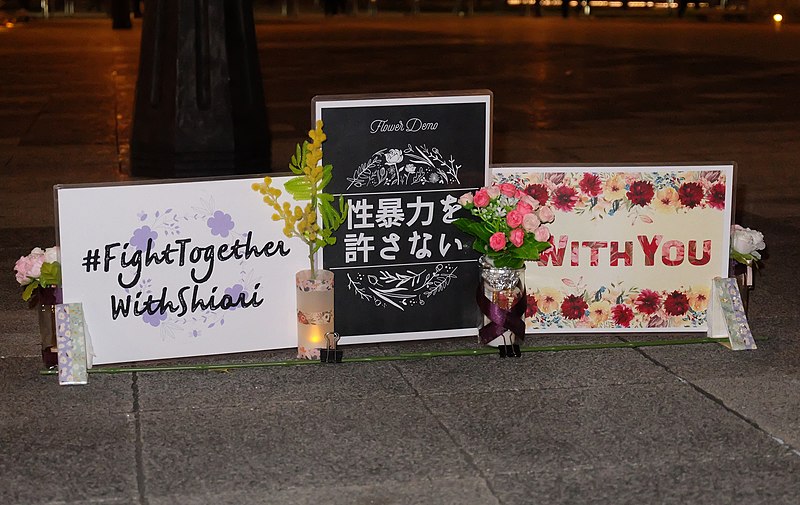
Japanese Reforms

File:Flower demo Tokyo 2020-11-11.jpg

Appeal board made by participants in Flower Demo, Tokyo, Japan (2020), Author Breaklily (CC BY-SA 4.0 International)

Sexual violence against women has historically been associated with shame and stigma in Japan.  The laws were drawn in such a way as to excuse the behavior of male defendants, while simultaneously disregarding women’s rights.

At last, however, the country has raised the age of consent from 13 to 16 years, and redefined rape to include non-consensual intercourse [1].  Proof of force is no longer a prerequisite to conviction.  Photo voyeurism (including upskirting) has, also, been criminalized.

These long overdue reforms were prompted by Flower Demo, a Japanese movement protesting sexual violence against women [2][3].  Those taking part carried flowers to reflect their empathy for victims.

Several scandalous rape cases brought attention to the issue, drawing public outrage.  One involved a highly intoxicated woman.  Another involved a 15 y.o. her assailant had held pinned to a wall.  Still another involved incest ongoing for a period of years.

Sin Nature

Violence against women is a byproduct of the sin nature of mankind.  It is perpetuated by an attitude that women are mere sex objects, by the use of disparaging sexist language, and by the glorification of sexual assault.

Rape, in this context, is not just a notch on the assailant’s belt.  It is an act of machismo, proof of masculinity (albeit toxic).

Any shame associated with the act is displaced to the victim.

This is not what God intended.  When He created men and women, He created them as equals.

[1]  BBC, “Japan redefines rape and raises age of consent in landmark move” by Kelly Ng, 6/16/23, https://www.bbc.com/news/world-asia-65887198.

[2]  Wikipedia, “Flower Demo”, https://en.wikipedia.org/wiki/Flower_Demo.

[3]  Zenbird, “Flower Demo, the protests battling Japan’s sexual violence against women” by Kirsty Kawano, 11/25/20, https://zenbird.media/flower-demo-the-protests-battling-japans-sexual-violence-against-women/.

FOR MORE OF MY ARTICLES ON POVERTY, POLITICS, AND MATTERS OF CONSCIENCE CHECK OUT MY BLOG A LAWYER’S PRAYERS AT: https://alawyersprayers.com

15 Comments

Filed under Child Abuse, Child Molestation, Christianity, domestic abuse, Emotional Abuse, Justice, Law, Rape, Religion, Sexual Abuse, Sexual Assault, Violence Against Women

Gilgo Beach

File:SCPD Gilgo Death Investigation.jpg

Map indicating location of bodies discovered at Gilgo Beach, Author Atiru
(CC BY-SA 4.0 International)

WARNING:  Graphic Images

Gilgo Beach is a quiet stretch of sandy coastline on Long Island, NY, made infamous by the serial killings which have been uncovered there [1].

Shockingly, the remains of up to 18 victims, murdered between 1996 and 2011, have been found in the general area.  For the most part, these victims — the majority of them women — are believed to have been sex workers.

Serial Predator

Rex Heuermann — a 59 y.o. married architect and father of two — has been charged in the murders of three such victims (Melissa Barthelemy, Amber Costello, and Megan Waterman) [2].  He is the prime suspect in the murder of a fourth (Maureen Brainard-Barnes).  There is speculation that he may be responsible for many more.

Investigative Delay

The identification of victims was necessarily a lengthy and complex process.

However, the FBI did not become officially involved in this investigation until 5 years after the first remains were located by Suffolk County Police [3].  For reasons of his own, former Police Chief James Burke is said actually to have blocked that involvement [4].

There is, also, widespread suspicion among family members of the victims that Suffolk Police did not prioritize the investigation because these women were prostitutes, rather than “upstanding” members of the community.

Child Abuse and Prostitution
A. Sexual Abuse

What is particularly tragic about this story is that there is every likelihood the women had already been the victims of childhood sexual abuse. Continue reading

11 Comments

Filed under Abuse of Power, Child Abuse, Child Molestation, Christianity, domestic abuse, domestic violence, Emotional Abuse, Justice, Law, Neglect, Physical Abuse, Prostitution, Rape, Religion, sex trafficking, Sexual Abuse, Sexual Assault, Violence Against Women

Family Annihilators

File:Ours.JPG

Author Pic-Puce at French Wikipedia (CC BY-SA 3.0 Unported)

WARNING:  Graphic Images

A young girl runs down the street screaming that her father is killing everyone [1].  In fact, the father is found to have murdered his sons — ages 3, 4, and 7 — as well as attempting to murder his wife.

The term “family annihilators” (those who kill their families) was first coined by psychiatrist Park Dietz in 1980 [2A].  Tragically, such individuals are becoming increasingly common [4A].

Family annihilators are primarily, though not exclusively, men [3A][4B].  They tend to fall into one of four categories [4C]:

  • Self-Righteous:  Those who are self-righteous, for instance, blaming their spouses for the break-up of a family and angry about diminished access to children.  Infidelity and the desire to punish can set off this type.  Alcohol can, also, play a role [2B].
  • Ashamed/Disappointed:  Those who are ashamed of themselves or disappointed with their families.  Cultural honor killings fall into this category.  Alex Murdaugh, convicted of murdering his wife and son after Murdaugh’s own corruption came to light, is an illustration [3B].
  • Paranoid:  Those who are paranoid and motivated by a desire to “protect” their families from a perceived threat, such as the removal of children by social services.  This type of family annihilator may believe family members are wholly dependent on him/her for their survival, and rationalize he/she is acting mercifully to “save” them from a cruel world.  Depression can, also, be a factor [2C].  Until the killing spree, such an individual may be perceived by outsiders as dedicated to the family.  Andrea Yates is an illustration [5].
  • Sociopathic:  Those who are socially alienated or outright sociopathic, killing their families for monetary gain or similar cold blooded motives.  Family members are viewed as objects, mere means to an end, by such individuals.  Greed and other narcissistic purposes can motivate this type.  Susan Smith, who drowned her two sons to further a romantic relationship, is an illustration [6].

Continue reading

8 Comments

Filed under Child Abuse, Christianity, domestic abuse, domestic violence, Emotional Abuse, Physical Abuse, Religion, Violence Against Women

Abuse and Defensiveness, Part 2

https://upload.wikimedia.org/wikipedia/commons/d/dd/Cath%C3%A9drale_d%27Amiens%2C_fa%C3%A7ade_-_d%C3%A9tail.JPG

Depiction of Final Judgment on the facade of Amiens Cathedral, France, Author Savant-fou (CC BY- SA 3.0 Unported)

We continue our discussion of defensiveness with an examination of the impact of this psychological defense mechanism on relationships, and the tactics abuse victims can use to stop relying on it.

Impact of Defensiveness

When defensiveness is frequently employed by partners (romantic and otherwise), it is likely to become a vicious cycle with both parties critical and entrenched in their positions before any real discussion of an issue can take place [1A][2A].

Situations easily become tense and hostile.  Everything seems to escalate into a fight [2B].  Issues are never resolved.

In a business context, this is likely to cause isolation from colleagues, and may put a job in jeopardy [2C][3A].  In a romantic context, it will interfere with empathy and intimacy, ultimately becoming destructive to the relationship [1B][3B].

Tactics to Overcome Defensiveness

Professional counseling is one technique for overcoming defensiveness (along with underlying mental health issues like anxiety, depression, and PTSD), particularly as such counseling will increase our awareness of the problem [1C][4A].  Journaling can, also, assist, in this regard [4B].

Acknowledging (rather than attempting to deflect) our feelings can help validate them, and defuse a situation before it gets out of hand [4C].  This allows us to remain calm, listen, express empathy, and focus on the issue at hand without rushing to judgment [2D][4D].

Taking responsibility for something we may truly have done wrong is an opportunity for growth, not a sign of weakness [4E].

Other tactics include building self-esteem, and learning more beneficial communication skills [1D].  Assertiveness training is, for instance, available [5].

Once we recognize the triggers for our defensiveness and understand what may be prompting it, we can more readily ask ourselves what behaviors might be more effective in achieving the specific outcomes we desire while preserving the relationships we value [1E].

Recognition and Eternal Rewards

And whatever you do, do it heartily, as to the Lord and not to men, knowing that from the Lord you will receive the reward of the inheritance; for you serve the Lord Christ” (Col.  3: 23-24).

This is a flawed and broken world.  We will not always receive from it the justice we believe we deserve or the recognition we desire.  As followers of Christ, we will, in fact, be rejected, reviled, and persecuted (1 Peter 4: 12).

God, however, knows our hearts, as well as our failings.  He knows the experiences, positive and negative, which have shaped our lives.  He knows our pain, and our good intentions, whether we can fully express them or not.

Since He sees and knows all things — but loves us immeasurably, despite that — excuses before God are worthless (Luke 8: 17).  Imperfect as we are, He purchased us at the price of His blood.  This makes defensiveness with Him unnecessary, reducing the pressure on us to employ it with others.

God alone is the final Judge, in any case, the only One whose opinion of us really matters in the end.

[1A through 1E]  Healthy Love & Money, “What Is Defensiveness and How It Becomes a Vicious Cycle” by ED Coambs MBA, MA, MS, LMFT, 10/20/22, https://www.healthyloveandmoney.com/blog/what-is-defensiveness-and-how-it-becomes-a-vicious-cycle.

[2A through 2E]  Verywell Mind, “How to Stop Being Defensive” by Sanjana Gupta, https://www.verywellmind.com/how-to-stop-being-defensive-7187366.

[3A and 3B]  Wikipedia, “Defensive communication”, https://en.wikipedia.org/wiki/Defensive_communication.

[4A through 4E]  Verywell Mind, “What Is Defensiveness?” by Arlin Cuncic MA, https://www.verywellmind.com/what-is-defensiveness-5115075.

[5]  Wikipedia, “Assertiveness”, https://en.wikipedia.org/wiki/Assertiveness.

Part 1 in this series was posted last week.

FOR MORE OF MY ARTICLES ON POVERTY, POLITICS, AND MATTERS OF CONSCIENCE CHECK OUT MY BLOG A LAWYER’S PRAYERS AT: https://alawyersprayers.com

6 Comments

Filed under Child Abuse, Child Molestation, Christianity, domestic abuse, domestic violence, Emotional Abuse, Neglect, Physical Abuse, Religion, Sexual Abuse

Abuse and Defensiveness, Part 1

File:Richard Humphreys, the Boxer MET DP167133.jpg

“Richard Humphreys:  The Boxer” by John Hoppner (1778-1788), Metropolitan Museum of Art (Accession No. 53.113), Source/Photographer https://www.metmuseum.org/art/collection/search/436691 (Creative Commons CC0 1.0 Universal Public Donation)

“Defensiveness is where you try to convince the other person not to think negatively of you, where you defend yourself, where you try to make sure you don’t get found guilty by the court.  Assertiveness is merely stating the truth.”

-Dan Munro [1]

Defensiveness is a psychological defense mechanism which involves justifying our actions when we experience shame, sadness, and/or anger as the result of perceived criticism [2A][3A].

Defensiveness is distinct from assertiveness in the defense of our rights.  One is emotion driven, an attempt (conscious or unconscious) to deflect blame to our opponent, and often related to anxiety or low self-esteem.  The other is simply a confident and reasoned communication style, which stops short of aggression [4].

Connection to Abuse

Abuse — whether emotional, physical, sexual, or arising from neglect — is a recognized cause of defensiveness [2B][3B][5].  Since we were unable to protect ourselves against abuse as children, it is entirely possible that we may become reflexively defensive as adults.

Domestic abuse can, also, result in defensiveness.

Continue reading

20 Comments

Filed under Child Abuse, Child Molestation, domestic abuse, domestic violence, Emotional Abuse, Neglect, Physical Abuse, Sexual Abuse

The Children of War

File:Infant victim of Dak Son massacre.jpg

3 y.o. Dieu Do, homeless and fatherless after a 1967 Viet Cong attack, Source http://www.dcvonline.net/php/modules.php?name=News&file=print&sid=3989, Author USIA (PD as work product of US Govt.)

WARNING: Graphic Images

“The only way to eliminate war is to love our children more than we hate our enemies.”

-Golda Meir

The United Nations International Children’s Emergency Fund (UNICEF) last year issued a milestone report titled “25 Years of Children and Armed Conflict:  Taking Action to Protect Children in War” [1].

That report documents the grave violations against children in situations of armed conflict, highlighting steps the international community can take to protect children.  But the ravages of war have long been recognized [2][3].

Conflict fundamentally impacts the world in which children live, along with impacting the adults around them.  Conflict destroys houses, businesses, roads, crops, and fields.  It pollutes groundwater and sanitation systems; wreaks havoc with electrical systems; disrupts food and medical supply chains, impairing access to essential services.

Both aerial bombardment and explosions from artillery can produce anxiety and Post Traumatic Stress Disorder among adults, adolescents, and children [4A][5A].  Mere vibrations from shelling can kill an unborn child in the womb [4B]. Continue reading

11 Comments

Filed under Child Abuse, Child Molestation, Emotional Abuse, Neglect, Physical Abuse, Sexual Abuse

The Sound of Freedom

An upcoming film The Sound of Freedom documents the efforts to free a young girl from human traffickers.  The film stars Jim Caviezel, best known for his work in The Passion of the Christ.

The Sound of Freedom is based on the real life efforts of Tim Ballard to combat the trafficking of children.  Ballard is a former Special Agent for the Department of Homeland Security (DHS) [1].  He spent a dozen years as an undercover operative with the US Child Sex Tourism Jump Team.

Ballard’s non-profit Operation Underground Railroad (OUR) https://ourrescue.org in conjunction with governments and law enforcement has successfully rescued over 6000 children trafficked for purposes of sexual exploitation, slave labor, and involuntary organ harvesting. Continue reading

25 Comments

Filed under Child Abuse, Child Molestation, Christianity, Emotional Abuse, human trafficking, Neglect, Physical Abuse, sex trafficking, Sexual Abuse, Slavery