Category Archives: human trafficking

Literacy, Rousseau, and Unschooling, Part 1

Little Red Schoolhouse, Talbot County, MD, Author Shopkins91, (CC BY-SA 3.0 Unported and GNU Free Documentation License)

Unschooling (to be distinguished from homeschooling) is a controversial educational philosophy which has gained rapid popularity online, and allows children to direct their own learning [1][2].  A rosy picture is painted of care-free learning, without pressure, stress, structure, or restrictions.

The assumption is that children pursuing only the subjects which interest them will learn more naturally and easily.  The corollary assumption seems to be that subjects of little immediate interest to them will be of no later use.

Some parents are not even teaching their children to read or write, and are actually proud of that fact.

The Rousseau Connection

Whether its proponents are aware or not, unschooling derives loosely from the writings of an 18th Century philosopher.   In his work Discourse on Inequality, Jean-Jacques Rousseau proposed that human beings in their “natural” state were inherently peaceful, egalitarian, and good.  They had simply been corrupted by civilization.

This idea has great appeal to those who believe wholeheartedly in Darwin’s theory of evolution.  It suggests that a return to Eden is possible, a return to innocence and union with nature.  All we need do is discard the trappings of civilization – trappings like law and formal education.

Unfortunately, this is nonsense, spiritually and otherwise.  Innocence and ignorance are not the same.

Literacy Highlights

Literacy has been prized by civilization for thousands of years [3].  We denote pre-history as such because literacy did not exist.  All knowledge had to be passed down orally. Continue reading

12 Comments

Filed under Child Abuse, Child Molestation, Christianity, human trafficking, Justice, Law, Neglect, racism, Religion, Sexual Abuse

Editing the Human Genome

Double helix of DNA biochemistry, Author brian0918&#153 (PD)

Editing the human genome is no longer beyond the realm of possibility.  To the contrary, it represents the frontier of medicine, promising a golden future without heritable disease or genetic defects.  The question is:  at what cost to human rights?

Human genome editing takes two forms:  somatic genome editing (which modifies non-reproductive cells) and germline genome editing (which modifies reproductive cells, including sperm and egg cells, and can be passed on to future generations) [1A].

Somatic Gene Editing

Somatic gene editing is viewed as less controversial, since it cannot be passed on.  The United States, the United Kingdom, and China have all permitted clinical trials involving somatic editing to treat cancer, sickle cell anemia, and other genetic diseases [1B].

Germline Gene Editing

No country has yet approved germline genetic editing, although twins whose germline had been modified using the genetic cut-copy-paste technology known by the acronym CRISPR (Clustered Regularly Interspaced Short Palindromic Repeats) were born in China in 2018 [1C][2A]. 

A majority of the European Union has ratified the Oviedo Convention which prohibits heritable gene editing in humans [1D].  Germany, Canada, and Australia have adopted similar prohibitions [1E].  

There is a strong possibility that these bans will eventually be lifted for therapeutic purposes, though there is no current agreement on what qualifies as “therapeutic”.  There is an equal chance that access to germline genetic editing will at some point be characterized as a legal “right” [6A].

In the United States, law currently prohibits the use of federal funds on human germline gene therapy [2B].  However, there are no protocols or restrictions for human genomic engineering [2C]. 

Recently, a startup named Preventive was identified as attempting to engineer the first genetically modified baby outside China [3].  This is not surprising, since Do-It-Yourself CRISPR kits are actually available online [6B]. Continue reading

25 Comments

Filed under Abuse of Power, Child Abuse, Christianity, human trafficking, Justice, Law, Religion

Where Are the Children?

“Two Children Abandoned in the Amazon”, Source/Author Raguilar1158, (CC BY-SA 4.0 International)

Though much vilified, US Immigration and Customs Enforcement (ICE) plans to open a dedicated Call Center to assist state and local law enforcement in locating hundreds of thousands of unaccompanied migrant children allowed illegally into the United States under the Biden Administration, children whose condition and whereabouts are now unknown [1]. 

More important than the immigration status of these children is their welfare which has not been adequately tracked, if at all.   Thousands upon thousands of children simply vanished.  

Whistleblowers have since exposed how the vicious scheme worked [2].  Under the auspices of trafficking cartels, children – some younger than 5 years of age, some sedated by melatonin laced gummies – arrived at the border with nothing but a phone number scribbled on their arms or clothing. Continue reading

15 Comments

Filed under Child Abuse, Child Molestation, Emotional Abuse, human trafficking, Justice, Law, Neglect, Physical Abuse, Politics, Rape, sex trafficking, Sexual Abuse, Slavery

Child Labor and Project 2025

A “doffer” boy at Globe Cotton Mills in Georgia (1909), Source Library of Congress, Author National Photo Company Collection (Digital ID npcc.19471), (PD)

UNICEF reports that some 138 million children worldwide were engaged in child labor in 2024, over a third of those in hazardous work [1A].

UNICEF defines work hazardous for children as “work that, by its nature or circumstances, is likely to harm children’s health, safety or moral development [1B].” 

  • Such work may take place under especially difficult conditions, involving long or overnight hours [1C][2A]. Often, it involves the use of or proximity to dangerous machinery, equipment, and tools. Agriculture and meat packing plants fall into this category.
  • Such work may take place in an unhealthy environment where children are exposed to dangerous substances or processes, or to extreme temperatures or noise levels [1D][2B]. Munitions plants fall into this category.
  • Such work may take place underground, underwater, at treacherous heights, or in confined spaces [1E][2C]. Mines fall into this category.

Usually, child labor interferes with a child’s right to play and to receive an education.  It may require strength beyond  a child’s capacity. 

Hazardous work is one of the worst forms of child labor, putting children at risk of permanent injury or death.  It includes, but is not limited to, anything that exposes children to emotional, physical, or sexual abuse [1F].

Federal vs. State Law

Federal laws to protect young workers were established by the Fair Labor Standards Act in 1938 [3A].  

Shockingly, over the past 5 years some 28 states have introduced legislation to reduce protections for young workers [4A].  Twelve states have gone on to enact them [4B].  Iowa, for example, passed a law permitting 14 year olds to work on assembly lines and in meat packing plants, in direct violation of federal child labor laws [3B]. Continue reading

14 Comments

Filed under Child Abuse, Child Molestation, Emotional Abuse, human trafficking, Justice, Law, Neglect, Physical Abuse, Politics, Poverty, Sexual Abuse

In the Company of the Elite

Jeffrey Epstein mugshot (2013), Source https://offender.fdle.state.fl.us/offender/CallImage?imgID=1665905 (PD as work product of the State of Florida)

The scandal involving Jeffrey Epstein, the disgraced former financier and convicted sex offender, has broadened to include a large number of powerful and well-known individuals [1].  Epstein (who trafficked young girls with the help of Ghislaine Maxwell) regularly kept company with politicians, filmmakers, journalists, scientists, comedians, intellectuals, and royalty.

We may be shocked to learn these names, and appalled at the behavior exhibited.  We should not be surprised that the so called “elite” suffer from the very same sin nature common to all mankind.  Wealth may disguise that fact; power may effectively keep secrets from the public.  But the stain remains.

Undoubtedly, there are varying degrees of guilt.  Some will claim they never knew what went on.  Others will claim they knew, but did not participate.  Still others will simply deny everything.

God knows the whole story, whether we ever will or not.

[1]  The Guardian, “Epstein scandal broadens as trove of letters from famous figures published” by Anna Betts, 8/5/25, https://www.theguardian.com/us-news/2025/aug/05/jeffrey-epstein-letters-photos.

FOR MORE OF MY ARTICLES ON POVERTY, POLITICS, AND MATTERS OF CONSCIENCE CHECK OUT MY BLOG A LAWYER’S PRAYERS AT: https://alawyersprayers.com

6 Comments

Filed under Abuse of Power, Child Abuse, Child Molestation, Christianity, Emotional Abuse, human trafficking, Justice, Law, Neglect, Physical Abuse, Politics, Religion, sex trafficking, Sexual Abuse

Light from Darkness, Part 2

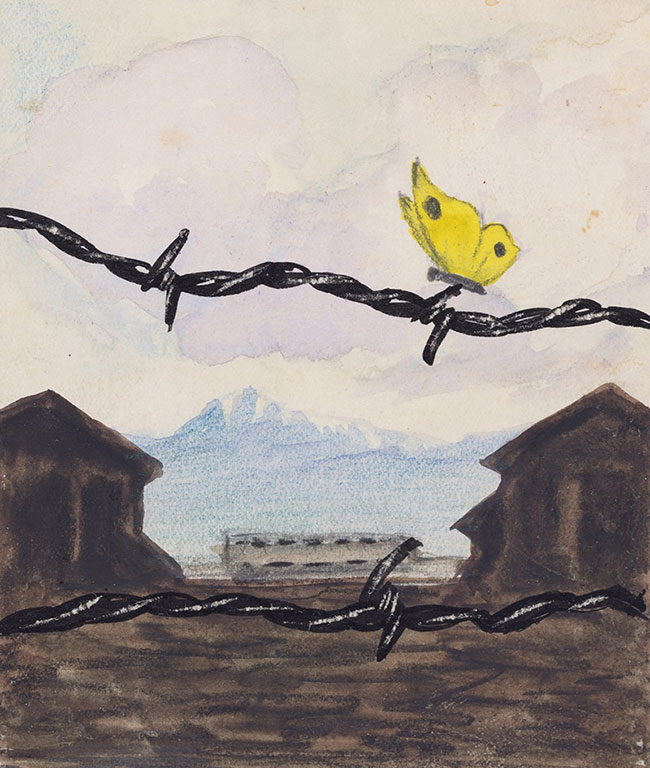
“One Spring, Gurs Camp” (1941) by Karl Robert Bodek and Kurt Low, Yad Vashem Museum, Israel, Image courtesy of Yad Vashem Collection

WARNING:  Graphic Images

Abuse comes in many forms.  From 1933 to 1945 in Nazi Germany it was governmental, with the goal being complete extermination of the Jews [1].

The artworks comprising the Yad Vashem Collection were created by artists (Jewish and non-Jewish) between 1939 and 1945 to provide a living testament of the Holocaust [2A].  A hundred works from the collection were exhibited in Germany in 2016, just three years after the Alternative for Germany (AfD) was founded – a far Right party whose leader, Björn Höcke denigrated the Memorial to Murdered Jews of Europe [3][4].

Art in the concentration camps served simultaneously as a witness, a means of self-assertion, and an expression of optimism [2B].

The works are both heart wrenching and awe inspiring.  In “One Spring, Gurs Camp” (above), the barbed wire depicts imprisonment and loneliness.  The butterfly and the mountains in the background, however, suggest hope. 

One of the two artists who collaborated on “One Spring”, 28 y.o. Kurt Low, was released and able to flee to Switzerland.  The other, 37 y.o. Karl Bodek, was ultimately murdered at Auschwitz. Continue reading

15 Comments

Filed under Abuse of Power, Child Abuse, Child Molestation, Christianity, domestic abuse, domestic violence, Emotional Abuse, human trafficking, Neglect, Physical Abuse, Rape, Religion, sex trafficking, Sexual Abuse, Sexual Assault, Slavery, Violence Against Women

Light from Darkness, Part 1

Margeaux Gray, Image courtesy of The Pixel Project

Margeaux Gray is a survivor of childhood sex trafficking, having been sold into slavery at the age of 5 [1][2][3].  She is, also, an artist who uses her talent both to convey the trauma of abuse and to honor the individual, no matter how broken. 

Ms. Gray advocates against all forms of abuse.  She mentors at-risk youth, speaks publicly about abuse, and confers with physicians and organizations about improving health care and social services for victims.   

Below are excerpts of an interview with Ms. Gray and images of her work:

“Human trafficking…thrives on the ignorance of family and the community.  I was sexually exploited and sold into sexual slavery by a man who had my trust and the trust of my family…I was not kidnapped or locked away in a basement.  My mom, sister, and aunt did not think twice about the two of us going out and doing things together.”

“Untitled” by Margeaux Gray at age 13, Image courtesy of AMA Journal of Ethics

“At around fourteen years old, I disclosed to a healthcare worker that I was being sexually abused.  This was before human trafficking was a definition.  It was reported to police.  After that the trafficking lessened, but continued.  I had an emotional attachment to the man who trafficked me. This is…referred to as traumatic bonding…It took four years for me to gain a greater understanding of the what had been and was continuing to be done to me.”

“A victim of slavery is a trauma victim and every survivor deals with trauma in different ways…Many victims…suffer with alcohol and drug addiction, Post Traumatic Stress Disorder (PTSD), depression, and sexually transmitted diseases to name a few.”

“Universal Light, Nurture and Nursing” by Margeaux Gray, Image courtesy of AMA Journal of Ethics

“Art…was a strategic way for me to cope and find some freedom when I had little. Through my healing it has allowed me a way to process my emotions resulting from being trafficked. Today I use it as an extension of my voice.  I have specifically used visual art to educate, inspire, and empower others.”

Not all abuse victims are talented artists.  But the arts — writing, drawing, painting, music, theater — are a way to reveal the pain we have endured while reaching toward something better, something more. 

We need not become professionals to do this.  We need not even share the results of our efforts with others, if that feels too intimidating.  We need only allow the soul to express itself.

Even concentration camp victims have done this [4].  Because light is stronger than darkness.  And love is stronger than hate.

[1]  The Pixel Project, “Inspirational Interview:  Margeaux Gray – Part I”, 10/26/14,  https://www.thepixelproject.net/2014/10/26/inspirational-interview-margeaux-gray-part-i/.

[2]  The Pixel Project, “Inspirational Interview:  Margeaux Gray – Part II”, 10/27/14, https://www.thepixelproject.net/2014/10/27/inspirational-interview-margeaux-gray-part-ii/.

[3]  AMA Journal of Ethics, “Out of Darkness, Light:  Drawing and Painting by Margeaux Gray” by Margeaux Gray and Mary Richards, 1/19/17, https://journalofethics.ama-assn.org/article/out-darkness-light-drawing-and-painting-margeaux-gray/2017-01.

[4]  Yad Vashem Collection, “Art from the Holocaust”, January 2016, https://www.yadvashem.org/yv/en/exhibitions/art/index.asp.

This series will conclude next week.

FOR MORE OF MY ARTICLES ON POVERTY, POLITICS, AND MATTERS OF CONSCIENCE CHECK OUT MY BLOG A LAWYER’S PRAYERS AT: https://alawyersprayers.com

12 Comments

Filed under Child Abuse, Child Molestation, domestic abuse, domestic violence, Emotional Abuse, human trafficking, Neglect, Physical Abuse, sex trafficking, Sexual Abuse, Slavery, Violence Against Women

Twitter and the Mainstreaming of Porn

https://upload.wikimedia.org/wikipedia/commons/0/0c/Bronze_Satyr_with_Phallus%2C_Naples_Archaeological_Museum.jpg
Satyr with phallus, Naples Archaeological Museum, Italy, Source https://www.flickr.com, Author Tyler Bell (Creative Commons Attribution 2.0 Generic)

Pornography – printed or visual material containing the explicit description or display of sexual organs or activity, intended to stimulate erotic rather than aesthetic or emotional feelings.

–Oxford Dictionary

X, the social media platform f/k/a Twitter, has formally changed its policy to allow so called “adult” content [1].

Actually, Twitter has long tolerated adult content, i.e. pornography and graphic violence.  Reuters reported two years ago that made up fully 13% of the platform’s content [2].

This change is purportedly meant to make the platform’s rules more transparent.  In reality, it is intended to attract more users by attracting more content “creators” (a term which now includes pornographers).

Porn as an Industry

Tragically, X is not alone in mainstreaming the sexual exploitation of women and children.  Once a relatively small niche market, pornography has in recent years become an established, technologically sophisticated, multi‐billion‐dollar industry [3].

The pornography industry is closely related to organized crime, since child pornography is illegal in many countries [4A].  The crimes associated with it can include kidnapping, sexual assault, and murder.

But home video equipment and computers have greatly assisted pedophiles in the production and distribution of child pornography.

A Shift in Values

The growth and acceptance of the pornography industry reflect a serious crisis of values [5].

It used to be that individuals purchasing obscene or salacious material were embarrassed at being seen with it.  No more.  Standards of decency have been radically revised.  Pornography has been normalized, and is discussed openly. Continue reading

10 Comments

Filed under Child Abuse, Child Molestation, domestic abuse, domestic violence, Emotional Abuse, human trafficking, Neglect, Physical Abuse, Rape, sex trafficking, Sexual Abuse, Sexual Assault, Violence Against Women

Enslaved 2024 – Part 3

File:Human Trafficking.jpg

Human Trafficking, concept image by Tapas Kumar Halder, Author Tapas Kumar Halder, (CC BY-SA 4.0 International)

We conclude our discussion of the blight of human trafficking with suggestions as to how the public can prevent and respond to this profound evil [1].

What You Can Do

Concerned as they may be, most people are overwhelmed by the magnitude of human trafficking — at a loss for how they can make a difference.  But there are things the average person can do [2]:

  • Become educated about human trafficking, and stay alert to the situations people may be experiencing.
  • Share information about human trafficking with family, friends, neighbors, business associates, and fellow bloggers.
  • Support local anti-trafficking organizations, either financially or by volunteering.  Pro bono attorneys are especially needed.  An online directory of community organizations is available here:  https://humantraffickinghotline.org/en/find-local-services.
  • Buy with care.  Consider where (and by whom) food, clothing, jewelry, electronics, and other items were produced.  An extensive list of items made by forced labor or child labor can be found here:  https://www.dol.gov/agencies/ilab/reports/child-labor/list-of-goods.
  • Get help for a family member, co-worker, student, tenant, patient, or someone else in need.  The National Human Trafficking Hotline https://humantraffickinghotline.org/en/contact provides free confidential support, 24/7.  Call 1-888-373-7888 or text HELP to 233733 (BEFREE).
  • Partner with the schools, healthcare providers, and other institutions and professionals serving those experiencing human trafficking.  Together with them, craft student safety programs for children at risk, fair workplace protocols, and ethical procurement practices at places of employment.  Work for safe and affordable housing, and accessible healthcare.
  • Speak out.  Inquire what elected representatives are doing about human trafficking.  Urge that trafficking be made a priority.

Continue reading

10 Comments

Filed under Child Abuse, Child Molestation, Christianity, Community, domestic abuse, domestic violence, Emotional Abuse, human trafficking, Neglect, Physical Abuse, Poverty, Prostitution, Rape, Religion, sex trafficking, Sexual Abuse, Slavery, Violence Against Women

Enslaved 2024 – Part 2

As discussed in Part 1 of this series, human trafficking is the form slavery takes today [1].

Red Flags

The red flags for trafficking include the following [2]:

A.  In the Workplace, Generally

  • A job offer that seems to be too good to be true.
  • A job offer that requires a move far from family and friends, where the recruiter or prospective employer declines to provide detailed information about the job.
  • A prospective employer who refuses to provide a signed contract, or asks employees to sign a contract in a language they cannot read.
  • A prospective employer who collects fees from a potential employee for the mere “opportunity” to work at a particular job.
  • Promised pay withheld by a recruiter or employer after work has been done.
  • Dangerous work conditions without training, adequate breaks, safety gear, or other protections.
  • Inhumane living conditions provided by an employer.
  • Monitoring by an employer of all interaction with others.
  • Isolation by an employer from support systems.
  • Pressure by an employer to stay on the job.
  • Control by an employer of a passport and identity documents.
  • Threats of deportation or other harm by an employer.

Continue reading

9 Comments

Filed under Child Abuse, Child Molestation, domestic abuse, domestic violence, Emotional Abuse, human trafficking, Neglect, Physical Abuse, Poverty, Prostitution, Rape, sex trafficking, Sexual Abuse, Slavery, Violence Against Women