
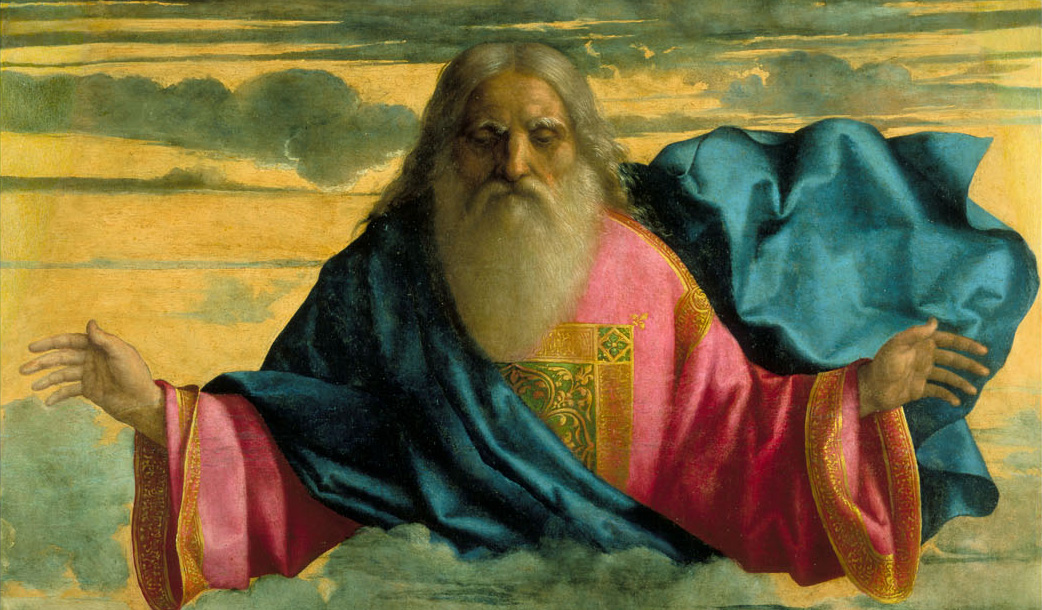
“Padre Eterno (The Eternal Father)” by Giovanni Bellini (1500-1505), Civic Museums of Pesaro, Italy, Source https://www.pesaromusei.it, (PD)
WARNING: Graphic Images
The relationship abuse victims have with God is, as they say, complicated. Since we see God through the filter of our own experience (a lens which can be distorted), victims both of childhood abuse and domestic violence tend to view Him as harsh and punitive [1].
Though God does not cause evil, we may well blame Him for our pain. There are those who have rejected Him because of that.
In considering the nature of God, however, we must not overlook the fact that He is forgiving. That idea may seem at odds with the picture of God presented in the Old Testament. But it is central to God’s character.
Forgiveness
Out of His great love, God created a world in which His children are given freedom to sin. They are not, in other words, required to love Him. The Old Testament tells the story of how Israel repeatedly abandoned God, repented, and was forgiven.
“But You are God, Ready to pardon, Gracious and merciful, Slow to anger, Abundant in kindness, And did not forsake them” (Neh. 9: 17).
The Book of Hosea brings this down to a personal level. The prophet is instructed by God to take a wife who is a harlot. She betrays him with other men. Yet he takes her back and treats her kindly.
Many, of course, point to the people God instructed the Israelites to kill. These critics conclude God must be an angry and heartless god. But God’s motives should be considered. This is where His justice comes in.
A. Egyptians
The ancient Egyptians worshiped a vast number of gods, i.e. demons (1 Cor. 10: 20), estimated to be over 2000 [8]. During the 400 years the Israelites were enslaved in Egypt, they served as witnesses to the Egyptians concerning the one true God. God then gave the Egyptians 10 more chances (the biblical plagues) to turn away from idols. They chose not to do that.
B. Canaanites
The Canaanites (among them the Perizzites, the Hivites, the Jebusites, and the people of Ai) were involved in practices abominable to God, including child sacrifice and sexual immorality.
- Children were burned alive to the Canaanite god (demon) Molech to ensure their parents’ prosperity [2A]. Music was used to drown out the pitiful screams.
- The Canaanite goddess (demon) Ashtoreth (known as Ishtar in Mesopotamia, and Astarte in Phoenicia) had male and female prostitutes who performed erotically, and engaged sexually with worshipers [2B].
- Gender-bending was one of Ashtoreth’s characteristics [2C][3]. So parades in honor of the goddess (demon) not only featured temple prostitutes, but lesbians, homosexuals, and transvestites (sexual orientations and gender identity not in accord with God’s intention for humanity) [2D][4].
- The goddess (demon) Ashtoreth was, also, deeply involved with magic, the occult, and the casting of spells (practices abhorrent to God) [2E][5].
- Mind altering substances like opium, cannabis, and the blue water lily are thought to have been used in worship [2F][6].
Idolatry is not harmless. It corrupts the heart [7].
Canaanite children who were not sacrificed themselves would have been brought up in this depraved culture, and have followed in their parents’ footsteps. Such indoctrination could, itself, be considered a form of child abuse.
The Canaanites were given ample time to repent, as an earlier Scriptural reference to the sin of the Amorites (another Canaanite group) not yet being “full” (Gen. 15: 16) implies. Like the Egyptians, they chose not to do that.
God wanted to prevent the Israelites from adopting similar idolatrous practices (Lev. 20: 1-8; Deut. 18: 9-11), and He wanted to protect their children (Lev. 18: 21).
C. Ninevites (Assyrians)
The Assyrians in Ninevah (notorious for violent and terroristic tactics like torture, dismemberment, and decapitation) repented after hearing the word of God from the prophet Jonah, and God stayed His hand of judgment [9]. God then explained to Jonah that His forgiveness was motivated by love even for these wicked people (Jonah 4: 10-11).
Love and Care
While the Old Testament does not contain the phrase “God is love” (1 John 4: 8), there are verses that strongly convey this. Here is a sample:
“Fear not, for I have redeemed you; I have called you by your name; You are Mine. When you pass through the waters, I will be with you; And through the rivers, they shall not overflow you. When you walk through the fire, you shall not be burned, Nor shall the flame scorch you” (Isa. 43: 1-2).
God’s love is, also, conveyed by His care for all creation – for the animals (Genesis 1; Psalm 104), and the land itself (Deut. 11: 12). It is reflected in His covenants with mankind, as well.
“‘For the mountains shall depart And the hills be removed, But My kindness shall not depart from you, Nor shall My covenant of peace be removed,’ Says the Lord, who has mercy on you” (Isa. 54: 10).
These are not empty promises. We will suffer in this broken world. That is a certainty. Yet, somehow God sustains us (Ps. 46: 1-3; Matt. 11: 28-30). And ultimately God will balance the scales (Ps. 9: 17; Prov. 11: 21; Rom. 2: 6).
Which brings us to God’s plan of Salvation, formulated before the world began (Rev. 13: 8). That plan – the ultimate expression of His love – involved the voluntary death, and Resurrection His Son, Jesus Christ for our sakes (Isaiah 53: 3-5). It restored the relationship with God which sin had destroyed, and offers those who believe in Him eternal life.
—
[1] There are undoubtedly exceptions. The author Joni Caggiano indicates that she knew God in childhood, and that He sustained her through abuse.
[2A through 2D] Jonathan Cahn, The Return of the Gods, published by FrontLine, an imprint of Charisma Media, copyright 2022.
[3] Andrea Mariana, “Ishtar: A Genderfluid Goddess” by Andrea Mariana, 8/4/23, https://andreamariana.com/?p=1082#:~:text=Ishtar%2C%20across%20both%20artistic%20and%20poetic%20representations%2C,seal%20presenting%20Ishtar%20as%20a%20warrior%20goddess.
[4] Redeemer, “The Bible and same sex relationships: A review article” by Tim Keller, 2015, https://www.redeemer.com/redeemer-report/article/the_bible_and_same_sex_relationships_a_review_article.
[5] Christian Answers, “The Occult – What Does the Bible Say About It?”, 2013, https://christiananswers.net/q-eden/edn-occult.html.
[6] Academia, “Psychedelics and the Ancient Near East” by Diana Stein, 2014, https://www.academia.edu/42890296/Psychedelics_and_the_Ancient_Near_East.
[7] The Fellowship, “Worshiping Molech: Child Sacrifice (Lev. 20: 1-9)”, 6/1/16, https://www.thefellowship.site/archives/leviticuspart3/childsacrifice.
[8] World History Encyclopedia, “Egyptian Gods – The Complete List” by Joshua Mark, 4/14/16, https://www.worldhistory.org/article/885/egyptian-gods—the-complete-list/.
[9] ListVerse, “10 Horrors of Being Invaded by the Assyrian Army” by Mark Oliver, 12/7/16, https://listverse.com/2016/12/07/10-horrors-of-being-invaded-by-the-assyrian-army/.
Part 1 in this series was posted last week
FOR MORE OF MY ARTICLES ON POVERTY, POLITICS, AND MATTERS OF CONSCIENCE CHECK OUT MY BLOG A LAWYER’S PRAYERS AT: https://alawyersprayers.com

 A Voice Reclaimed, Surviving Child Abuse and More
We will suffer in this broken world. That is a certainty. Yet, somehow God sustains us (Ps. 46: 1-3; Matt. 11: 28-30).
This is preached as an unquestionable truth by our Christian churches, denominations and taught by clergy. However, I think it may be a tenet not acceptable by many nor understandable. This idea causes many to leave the church and reduces the potency of faith. The ancient question remains: Why did God create a world in which we must suffer but yet He allegedly sustains us ? That seems a very unfair twist of fate for us. Why doesn’t He have enough power over His own Creation to prevent our suffering ? Yet we are to believe that Jesus already did the suffering. One answer offered is that God has included our suffering and our sin to give Him the His opportunity to express His comfort for us, His love for us thus establishing Him as the source of redemption and comfort. Our suffering moves many to leave the faith as the suffering must be included in our lives. This is God’s plan we are told but by my earthly father, my dad who died in 2021, never made me suffer and was always there for me to prevent any harm or suffering that was in his power to do so. The Job story is supposed to teach us that we don’t get to understand it nor may we protest and that opens another door that disturbs us and disappoints us. I don’t propose any answers nor torture myself with an endless search for explanations. That I attend my Presbyterian church every Sunday and the fellowship of the congregation and the singing as remembrance of the old, old hymns I appreciated in my childhood 70+ tears ago calls for my return every Sunday. .
Thank you, Carl.
Yesterday, 10/19 ,we sang one of my favs: “What a friend we have in Jesus”. Loved that one since early childhood. It’s one of those things that greatly reduce the need for subjects of academics and intellectualism. Filled with Holy Spirit vastly is a pillar of faith both in mind and spirit.
I loved your inclusion of Hosea. For so long I read it as an example of how we are to forgive–we have a tendency to put ourselves in the shoes of Hosea. When I finally saw that we, as humans, are the harlot, and God is in the role of Hosea, it was a lightbulb moment. He is good!
Thanks for this thoughtful topic. I hope you’re doing well, Anna!
–Scott
Thank you, Scott. Yes, I’m doing well. Hope you are the same.
Well done, Anna.
Thank you, Gabrielle. That is high praise coming from you.
In a lecture by Dr. Stanley Horton (named in Who’s Who in Hebrew Scholarship) he noted that God used Israel to judge the nations in the Land He had given them. Among some, only the men were to be killed by Israel, some included women and children and some included even animals!
He explained the differences in God’s love to protect the Hebrews, and not as a harshness against the natives of Canaan.
Rather, the immorality of the peoples was to be eliminated and Israel was to be kept pure. Thus, among some, the women, children and animals could be acceptable to be incorporated into Hebrew society, and as such they were to receive the same legal protections a Jew would have.
Among others, venereal diseases affected women, children, and tragically in some cases, EVEN ANIMALS!
So God is merciful to anyone who is willing to receive it, but sometimes the conditions of our sin call for judgment, especially for those who refuse His mercy.
This written as a brief in defense of a very loving, very patient God. Beautifully written! Wonderfully truthful.
I learnt so much, thank you for this. Best wishes, Linda
I’m so glad to hear that, Linda. Best wishes to you, too.
🥰
Wonderful, as always Anna. This post is a gentle reminder that true faith in God requires us to reach far beyond our own boundaries of understanding in order to accept that His ways and His thoughts are higher than ours. There is a great deal our minds cannot comprehend yet by faith we understand that God is just.
Enormously helpful, Anna, in delineating the mercy and justice of God in Scripture, and our response in faith to His promises from a position of suffering.
You are always very kind, Dora. ❤
Mercy and Justice in honor and love of God through Christ.
Anna, I was surprised to see your first footnote was about me. How kind of you and I talked about how I felt the presence of God as a young child especially, when I read the first part of this segment. I argued with God a lot to lift me up and take me to His Kingdom as I wanted nothing else to do with the “Monsters,” fear and abuse. When we read the Old Testament it is very difficult to read about the burning the children alive and other demonic practices that were done during those days. This is such a great verse to make a point about God’s mercy and great capacity for love:
““Fear not, for I have redeemed you; I have called you by your name; You are Mine. When you pass through the waters, I will be with you; And through the rivers, they shall not overflow you. When you walk through the fire, you shall not be burned, Nor shall the flame scorch you” (Isa. 43: 1-2).”
If I took a good look at my own life and my own sin I would in no way be allowed anywhere near heaven or Our Father, but through His Grace and Love we all have a chance to “pass through the waters,” I love this verse Anna.
I believe we are all so unworthy and yet I know that it is not for us to judge others either. All of these things are hard if we are completely honest with ourselves. That is why God gave His Only Son for us. It makes me think of how we have lived all of our life and our sins committed even after we called out for Our Father. For me, I like to read Job too, when I am feeling hopeless or helpless about anything (for now the situation our world is in) I read Job and I feel like we must hold on to faith.
Thank you for this comprehensive look at God’s capacity for Love, Mercy and Forgiveness. One thing I have always told myself is that the bible was written by men influenced by what was going on at that time in history – likely some of these verses were not written until decades after these events occurred.
This is one very thought-provoking piece, Anna. For me, I try to not place judgement on anyone else and I find keeping myself living a decent life in thought, word and deed, for me is a full-time job. God’s Grace will put me in His Holy Light when I die. Thank you again for sharing this with us. You always express yourself so well. Love, hugs and blessings my friend.
My dear friend, you give me far too much credit. May God shower you w/ blessings. Though we are all flawed, you so clearly reflect His love. ❤
Pingback: Mercy, Justice, and the God of the Old Testament, Part 2 – NarrowPathMinistries