
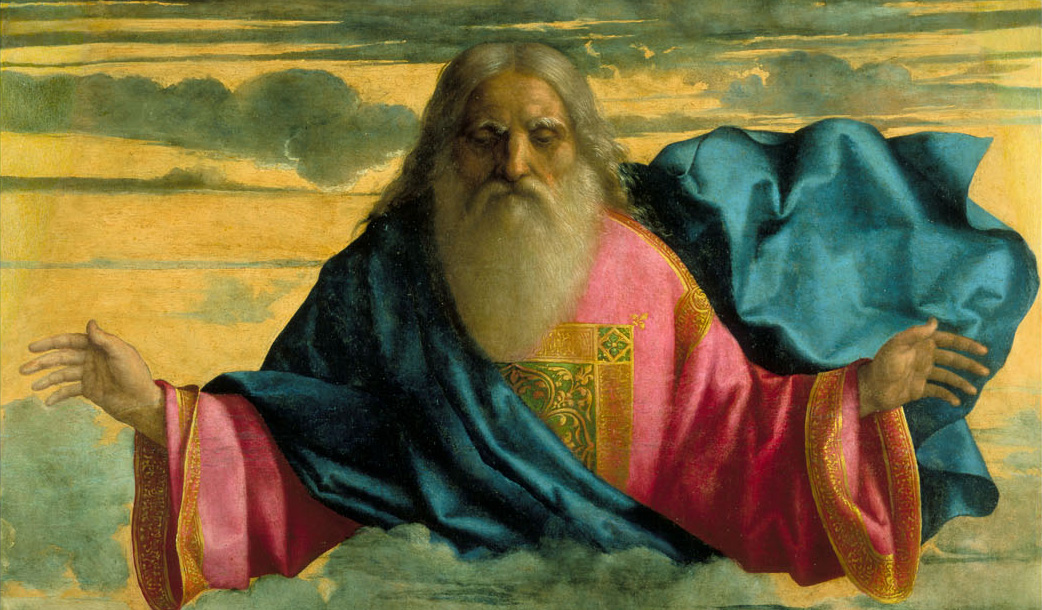
“Padre Eterno (The Eternal Father)” by Giovanni Bellini (1500-1505), Civic Museums of Pesaro, Italy, Source https://www.pesaromusei.it, (PD)
WARNING: Graphic Images
The relationship abuse victims have with God is, as they say, complicated. Since we see God through the filter of our own experience (a lens which can be distorted), victims both of childhood abuse and domestic violence tend to view Him as harsh and punitive [1].
Though God does not cause evil, we may well blame Him for our pain. There are those who have rejected Him because of that.
In considering the nature of God, however, we must not overlook the fact that He is forgiving. That idea may seem at odds with the picture of God presented in the Old Testament. But it is central to God’s character.
Forgiveness
Out of His great love, God created a world in which His children are given freedom to sin. They are not, in other words, required to love Him. The Old Testament tells the story of how Israel repeatedly abandoned God, repented, and was forgiven.
“But You are God, Ready to pardon, Gracious and merciful, Slow to anger, Abundant in kindness, And did not forsake them” (Neh. 9: 17).
The Book of Hosea brings this down to a personal level. The prophet is instructed by God to take a wife who is a harlot. She betrays him with other men. Yet he takes her back and treats her kindly.
Many, of course, point to the people God instructed the Israelites to kill. These critics conclude God must be an angry and heartless god. But God’s motives should be considered. This is where His justice comes in.
A. Egyptians
The ancient Egyptians worshiped a vast number of gods, i.e. demons (1 Cor. 10: 20), estimated to be over 2000 [8]. During the 400 years the Israelites were enslaved in Egypt, they served as witnesses to the Egyptians concerning the one true God. God then gave the Egyptians 10 more chances (the biblical plagues) to turn away from idols. They chose not to do that.
B. Canaanites
The Canaanites (among them the Perizzites, the Hivites, the Jebusites, and the people of Ai) were involved in practices abominable to God, including child sacrifice and sexual immorality.
- Children were burned alive to the Canaanite god (demon) Molech to ensure their parents’ prosperity [2A]. Music was used to drown out the pitiful screams.
- The Canaanite goddess (demon) Ashtoreth (known as Ishtar in Mesopotamia, and Astarte in Phoenicia) had male and female prostitutes who performed erotically, and engaged sexually with worshipers [2B].
- Gender-bending was one of Ashtoreth’s characteristics [2C][3]. So parades in honor of the goddess (demon) not only featured temple prostitutes, but lesbians, homosexuals, and transvestites (sexual orientations and gender identity not in accord with God’s intention for humanity) [2D][4].
- The goddess (demon) Ashtoreth was, also, deeply involved with magic, the occult, and the casting of spells (practices abhorrent to God) [2E][5].
- Mind altering substances like opium, cannabis, and the blue water lily are thought to have been used in worship [2F][6].
Idolatry is not harmless. It corrupts the heart [7].
Canaanite children who were not sacrificed themselves would have been brought up in this depraved culture, and have followed in their parents’ footsteps. Such indoctrination could, itself, be considered a form of child abuse.
The Canaanites were given ample time to repent, as an earlier Scriptural reference to the sin of the Amorites (another Canaanite group) not yet being “full” (Gen. 15: 16) implies. Like the Egyptians, they chose not to do that.
God wanted to prevent the Israelites from adopting similar idolatrous practices (Lev. 20: 1-8; Deut. 18: 9-11), and He wanted to protect their children (Lev. 18: 21).
C. Ninevites (Assyrians)
The Assyrians in Ninevah (notorious for violent and terroristic tactics like torture, dismemberment, and decapitation) repented after hearing the word of God from the prophet Jonah, and God stayed His hand of judgment [9]. God then explained to Jonah that His forgiveness was motivated by love even for these wicked people (Jonah 4: 10-11). Continue reading


 A Voice Reclaimed, Surviving Child Abuse and More