Tag Archives: Prophet Elijah

Mercy, Justice, and The God of the Old Testament, Part 1

“Moses Receiving the Tablets of the Ten Commandments” by Gebhard Fugel (c. 1900), Source https://freechristimages.com/bible-stories/ten-commandments.html, (PD)

While it may be surprising to find the Old Testament discussed on a blog about abuse, spirituality and abuse are closely entwined. 

Satan attempts to use the abuse we suffered as a weapon to destroy victims’ faith.  Many of us do lose our faith as a result, seeing God as harsh and cruel, if we continue to believe in Him at all.

Even those who were never victimized may have difficulty reconciling the God of the Old Testament with the God of the New Testament.  God, of course, has never changed.

Because of this confusion, it is worth examining God’s true nature.

Mercy and Justice

God described Himself to Moses in this way:

“And the Lord passed before him and proclaimed, ‘The Lord, the Lord God, merciful and gracious, longsuffering, and abounding in goodness and truth, keeping mercy for thousands, forgiving iniquity and transgression and sin, by no means clearing the guilty, visiting the iniquity of the fathers upon the children and the children’s children to the third and the fourth generation'” (Ex. 34: 6-7).

God is, therefore, both merciful and just.  These two qualities are in tension with one another in human beings.  Not so with God.

  • The Hebrew word translated as “mercy” or “merciful” is associated with the love of a mother, with compassion from the very womb [1A]. 
  • Graciousness refers to undeserved favor or grace [1B].
  • Longsuffering refers to patience with our mistakes and sins [1C]. Indeed, God is not only willing to forgive our sins, but desires to take them upon Himself [1D].

The phrase “visiting the iniquity of the fathers upon the children and the children’s children” will have special resonance for abuse victims, since it conveys the idea of generational sin or abuse.   Children are not punished by God for the sins of their parents [2].  Patterns of sin often, however, continue from one generation to the next. Continue reading
13 Comments

Filed under Child Abuse, Child Molestation, Christianity, domestic abuse, domestic violence, Emotional Abuse, Neglect, Physical Abuse, Religion, Sexual Abuse, Violence Against Women

Loneliness

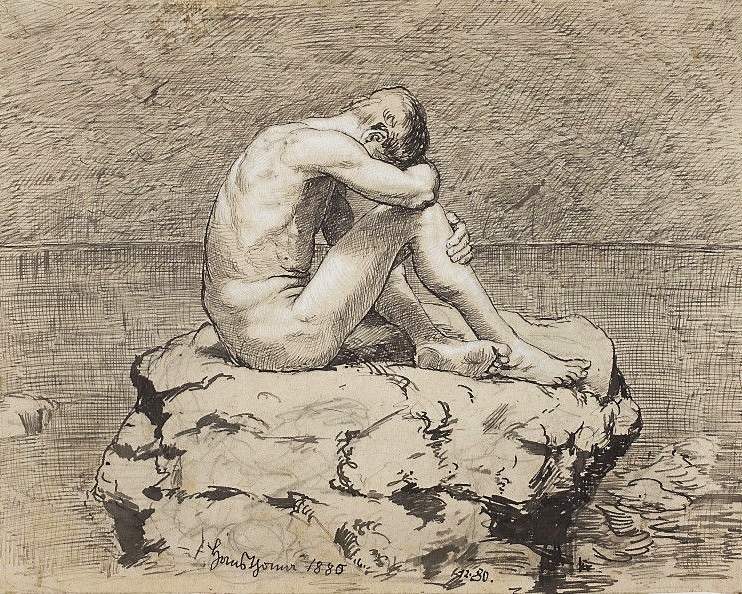
“Loneliness” (1880) by Hans Thoma, National Museum in Warsaw (Accession No. 192915/22), Source cyfrowe.mnw.art.pl (PD)

“Turn to me and be gracious to me for I am lonely and afflicted.  Relieve the troubles of my heart and free me from my anguish” (Ps. 25: 16-17).

Loneliness is a feeling of isolation, detachment, and lack of social connection – an emotional state now so common it has its own Wikipedia page [1].  An argument might easily be made that there is, in fact, a loneliness epidemic.  Across the globe, there are some 740,000 suicide deaths annually [2].

All human beings experience loneliness, at one time or another, particularly when we have lost someone or ended a relationship.  In some sense, loneliness characterizes our species.  But the feeling can be particularly intense for abuse victims.

Empty Goals

Part of this is due to the pursuit of empty goals by our culture. 

Ours is a materialistic society.  We are encouraged to be shallow, to seek fame and wealth above all things.  Yet these do not guarantee happiness.  In fact, avid pursuit of them may increase our loneliness.  

Fame for its own sake is meaningless.  And no number of McMansions (or villas on the Riviera, for that matter) can fill an empty heart.

Broken Families

Broken families are another cause for loneliness, and these are endemic in our society. 

At least 40% of American children are today born out of wedlock [3A].  The percentage among African Americans is much higher [3B].  This means children do not have the financial support – and regular presence – of both a mother and father.  As a consequence, 59% will live in poverty [4]. 

Half the remaining children will experience divorce, which means that fully 70% of American children will not live in a two parent household, for at least some part of their childhood [5]. Continue reading

20 Comments

Filed under Child Abuse, Child Molestation, Christianity, domestic abuse, domestic violence, Emotional Abuse, Neglect, Physical Abuse, Religion, Sexual Abuse, Violence Against Women