Tag Archives: Holocaust

Light from Darkness, Part 2

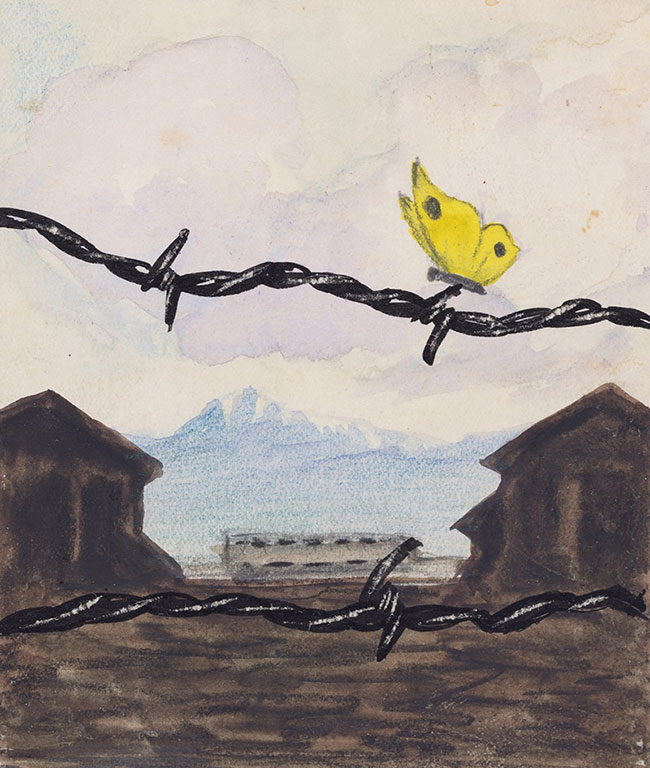
“One Spring, Gurs Camp” (1941) by Karl Robert Bodek and Kurt Low, Yad Vashem Museum, Israel, Image courtesy of Yad Vashem Collection

WARNING:  Graphic Images

Abuse comes in many forms.  From 1933 to 1945 in Nazi Germany it was governmental, with the goal being complete extermination of the Jews [1].

The artworks comprising the Yad Vashem Collection were created by artists (Jewish and non-Jewish) between 1939 and 1945 to provide a living testament of the Holocaust [2A].  A hundred works from the collection were exhibited in Germany in 2016, just three years after the Alternative for Germany (AfD) was founded – a far Right party whose leader, Björn Höcke denigrated the Memorial to Murdered Jews of Europe [3][4].

Art in the concentration camps served simultaneously as a witness, a means of self-assertion, and an expression of optimism [2B].

The works are both heart wrenching and awe inspiring.  In “One Spring, Gurs Camp” (above), the barbed wire depicts imprisonment and loneliness.  The butterfly and the mountains in the background, however, suggest hope. 

One of the two artists who collaborated on “One Spring”, 28 y.o. Kurt Low, was released and able to flee to Switzerland.  The other, 37 y.o. Karl Bodek, was ultimately murdered at Auschwitz. Continue reading

15 Comments

Filed under Abuse of Power, Child Abuse, Child Molestation, Christianity, domestic abuse, domestic violence, Emotional Abuse, human trafficking, Neglect, Physical Abuse, Rape, Religion, sex trafficking, Sexual Abuse, Sexual Assault, Slavery, Violence Against Women

The Rose Garden, Chapter 5 – World War II

https://upload.wikimedia.org/wikipedia/commons/6/62/Displaced_Persons_and_Refugees_in_Germany_BU6635.jpg

Displaced Persons Camp (1945), Hamburg, Germany, Source/Author Imperial War Museum for UK Govt., (PD)

WARNING:  Graphic Images

The earth also was corrupt before God, and the earth was filled with violence” (Gen. 6: 11).

It is difficult to reconstruct the chronology of World War II from my parents’ notebooks.  I can only cobble together bits and pieces.  The times were chaotic.  Territory repeatedly changed hands.  My mother’s narrative is particularly fragmented.

My father saw farms abandoned or destroyed by artillery.  Bridges that had stood for generations were demolished.

Food grew scarce.  Livestock were confiscated without pay by passing troops or slaughtered  outright.  My father took a beloved horse up into the hills, in the hope of finding him again someday.

Two of my father’s brothers and an uncle were forcibly conscripted.  A second uncle was arrested for transporting contraband.

One of the conscripted brothers was finally reunited with the rest of the family in Germany in 1949, having been captured on the Eastern Front and imprisoned by the Russians all that time.  He was a shadow of his former self.

My father, also, witnessed Jews being deported to concentration camps by the Nazis.  He wrote in his notebook:

“The curse was on.  We saw the Jews from Yugoslavia by the thousand[s] in barbed wire wagons, their tongues on the windows and yelling, ‘Water, water!  Please!’  They threw beautiful money, the Yugoslavian dinars, and we picked it up.  This is [the ugliness of] war.  We were children and did not know any better…

[There were] also, German army trains by the dozens going to Yugoslavia fighting partisans.  On their way, [the soldiers] were shining sitting on their tanks, autos, trucks, etc.  On their way home, [they were] filthy, ragged, and flea [bitten].”

My mother was eleven years old when in 1944 the Nazis occupied Hungary.  The war abruptly ended her schooling.

My mother had a personal connection to the Jewish deportation.  The kindhearted woman who ran the local grocery — a woman who had let my mother stand on the counter, when she was a toddler; the very woman who had inspired my mother to dream of working in a food store — was Jewish.

That woman came under cover of darkness to the house one night, and begged for help.  All my grandmother could do was give her some food, and a little money.  The woman was never heard from again.

My mother and her parents, themselves, had to flee to the nearby woods for safety as first Nazi forces, then Russian forces swept through their area.  For a brief time, they went into service in a neighboring village.  But they were never permitted to reclaim their property, so were left homeless.

Expulsion

When Russian forces came through, one of my grandfather’s sisters falsely accused my grandmother of collaborating with the Nazis.  This was the result of a long-simmering grudge related to my great-grandfather.  Promising the village a financial windfall, he had decades earlier left for America with the village’s funds and never made restitution.

It was in this connection, as I understand matters, that my grandmother’s retention of the family’s Hungarian passports saved them.

As Germany’s defeat neared, the USSR urged a plan to evacuate ethnic Germans from Eastern European countries, as an excuse for land redistribution [1A].   In Hungary, many refused to leave the only home they had ever known.

A series of expulsions began in 1946.  As a result, 170,000 German Hungarians were ultimately transported to the American Zone in West Germany; 50,000 to the Soviet Zone in East Germany; and 15,000 to Austria [1B].

Both my parents experienced being transported by cattle car.  The trauma affected my mother so deeply she was unable to speak for a full year afterwards. Continue reading

13 Comments

Filed under Child Abuse, Child Molestation, Christianity, Emotional Abuse, Neglect, Physical Abuse, Religion, Sexual Abuse