Tag Archives: God’s love for abuse victims

Climbing Gear

Open crevasse, Tangra Mountains, Antarctica, Author Apcbg, (CC BY-SA 4.0 International)

A chasm opens up again.  Depression yawns before us once more, sucking us in despite our best efforts.

It may be that something reminded us of our earlier trauma.  It may be that regret over an old loss or error in judgment morphed from sadness into despair.  Whatever the cause, as abuse victims we can suddenly find ourselves falling headlong into darkness. 

Consumed with self-loathing, we may feel achingly alone in a crowd, strangers in a strange land while at a local mall or familiar church service. 

The greetings, compliments, and good wishes of loved ones – however many, however sincere – are dismissed as undeserved.  Life loses its savor.  Even prayer seems stale.

Surprisingly, the skills and equipment necessary to alpine rescue have bearing on this.

Fatal Self-Isolation

Engulfed by depression, our instinct will likely be to self-isolate.  But this can be a fatal mistake, effectively putting us at risk of hypothermia from the cold of the mountain crevasse into which we have fallen. 

It can take a rescue team and specialized equipment to pull a climber who has fallen into such a crevasse back to safety.

Climbing Team

It is essential to remember that none of us really climbs the mountains of life alone.  We are all linked to others – to family, friends, roommates, neighbors, teachers, classmates, coaches, teammates, co-workers, health care providers, crisis hot lines, and God, Himself.  These are vital resources. Continue reading

8 Comments

Filed under Child Abuse, Child Molestation, Christianity, Emotional Abuse, Neglect, Physical Abuse, Religion, Sexual Abuse, Sports

Mercy, Justice, and the God of the Old Testament, Part 2

“Padre Eterno (The Eternal Father)” by Giovanni Bellini (1500-1505), Civic Museums of Pesaro, Italy, Source https://www.pesaromusei.it, (PD)

WARNING:  Graphic Images

The relationship abuse victims have with God is, as they say, complicated.  Since we see God through the filter of our own experience (a lens which can be distorted), victims both of childhood abuse and domestic violence tend to view Him as harsh and punitive [1]. 

Though God does not cause evil, we may well blame Him for our pain.  There are those who have rejected Him because of that. 

In considering the nature of God, however, we must not overlook the fact that He is forgiving.  That idea may seem at odds with the picture of God presented in the Old Testament.  But it is central to God’s character.

Forgiveness

Out of His great love, God created a world in which His children are given freedom to sin.  They are not, in other words, required to love Him.  The Old Testament tells the story of how Israel repeatedly abandoned God, repented, and was forgiven.  

But You are God, Ready to pardon, Gracious and merciful, Slow to anger, Abundant in kindness, And did not forsake them” (Neh. 9: 17).

The Book of Hosea brings this down to a personal level.  The prophet is instructed by God to take a wife who is a harlot.  She betrays him with other men.  Yet he takes her back and treats her kindly.

Many, of course, point to the people God instructed the Israelites to kill.  These critics conclude God must be an angry and heartless god.  But God’s motives should be considered.  This is where His justice comes in.

A.  Egyptians

The ancient Egyptians worshiped a vast number of gods, i.e. demons (1 Cor. 10: 20), estimated to be over 2000 [8].  During the 400 years the Israelites were enslaved in Egypt, they served as witnesses to the Egyptians concerning the one true God.  God then gave the Egyptians 10 more chances (the biblical plagues) to turn away from idols.  They chose not to do that.

B.  Canaanites

The Canaanites (among them the Perizzites, the Hivites, the Jebusites, and the people of Ai) were involved in practices abominable to God, including child sacrifice and sexual immorality. 

  • Children were burned alive to the Canaanite god (demon) Molech to ensure their parents’ prosperity [2A].  Music was used to drown out the pitiful screams.
  • The Canaanite goddess (demon) Ashtoreth (known as Ishtar in Mesopotamia, and Astarte in Phoenicia) had male and female prostitutes who performed erotically, and engaged sexually with worshipers [2B]. 
  • Gender-bending was one of Ashtoreth’s characteristics [2C][3].  So parades in honor of the goddess (demon) not only featured temple prostitutes, but lesbians, homosexuals, and transvestites (sexual orientations and gender identity not in accord with God’s intention for humanity) [2D][4].  
  • The goddess (demon) Ashtoreth was, also, deeply involved with magic, the occult, and the casting of spells (practices abhorrent to God) [2E][5]. 
  • Mind altering substances like opium, cannabis, and the blue water lily are thought to have been used in worship [2F][6].

Idolatry is not harmless.  It corrupts the heart [7].

Canaanite children who were not sacrificed themselves would have been brought up in this depraved culture, and have followed in their parents’ footsteps.  Such indoctrination could, itself, be considered a form of child abuse.

The Canaanites were given ample time to repent, as an earlier Scriptural reference to the sin of the Amorites (another Canaanite group) not yet being “full” (Gen. 15: 16) implies. Like the Egyptians, they chose not to do that.

God wanted to prevent the Israelites from adopting similar idolatrous practices (Lev. 20: 1-8; Deut. 18: 9-11), and He wanted to protect their children (Lev. 18: 21). 

C.  Ninevites (Assyrians)

The Assyrians in Ninevah (notorious for violent and terroristic tactics like torture, dismemberment, and decapitation) repented after hearing the word of God from the prophet Jonah, and God stayed His hand of judgment [9].  God then explained to Jonah that His forgiveness was motivated by love even for these wicked people (Jonah 4: 10-11). Continue reading

19 Comments

Filed under Child Abuse, Child Molestation, Christianity, domestic abuse, domestic violence, Emotional Abuse, Neglect, Physical Abuse, Religion, Sexual Abuse, Violence Against Women

Mercy, Justice, and The God of the Old Testament, Part 1

“Moses Receiving the Tablets of the Ten Commandments” by Gebhard Fugel (c. 1900), Source https://freechristimages.com/bible-stories/ten-commandments.html, (PD)

While it may be surprising to find the Old Testament discussed on a blog about abuse, spirituality and abuse are closely entwined. 

Satan attempts to use the abuse we suffered as a weapon to destroy victims’ faith.  Many of us do lose our faith as a result, seeing God as harsh and cruel, if we continue to believe in Him at all.

Even those who were never victimized may have difficulty reconciling the God of the Old Testament with the God of the New Testament.  God, of course, has never changed.

Because of this confusion, it is worth examining God’s true nature.

Mercy and Justice

God described Himself to Moses in this way:

“And the Lord passed before him and proclaimed, ‘The Lord, the Lord God, merciful and gracious, longsuffering, and abounding in goodness and truth, keeping mercy for thousands, forgiving iniquity and transgression and sin, by no means clearing the guilty, visiting the iniquity of the fathers upon the children and the children’s children to the third and the fourth generation'” (Ex. 34: 6-7).

God is, therefore, both merciful and just.  These two qualities are in tension with one another in human beings.  Not so with God.

  • The Hebrew word translated as “mercy” or “merciful” is associated with the love of a mother, with compassion from the very womb [1A]. 
  • Graciousness refers to undeserved favor or grace [1B].
  • Longsuffering refers to patience with our mistakes and sins [1C]. Indeed, God is not only willing to forgive our sins, but desires to take them upon Himself [1D].

The phrase “visiting the iniquity of the fathers upon the children and the children’s children” will have special resonance for abuse victims, since it conveys the idea of generational sin or abuse.   Children are not punished by God for the sins of their parents [2].  Patterns of sin often, however, continue from one generation to the next. Continue reading

13 Comments

Filed under Child Abuse, Child Molestation, Christianity, domestic abuse, domestic violence, Emotional Abuse, Neglect, Physical Abuse, Religion, Sexual Abuse, Violence Against Women

Rom-Coms

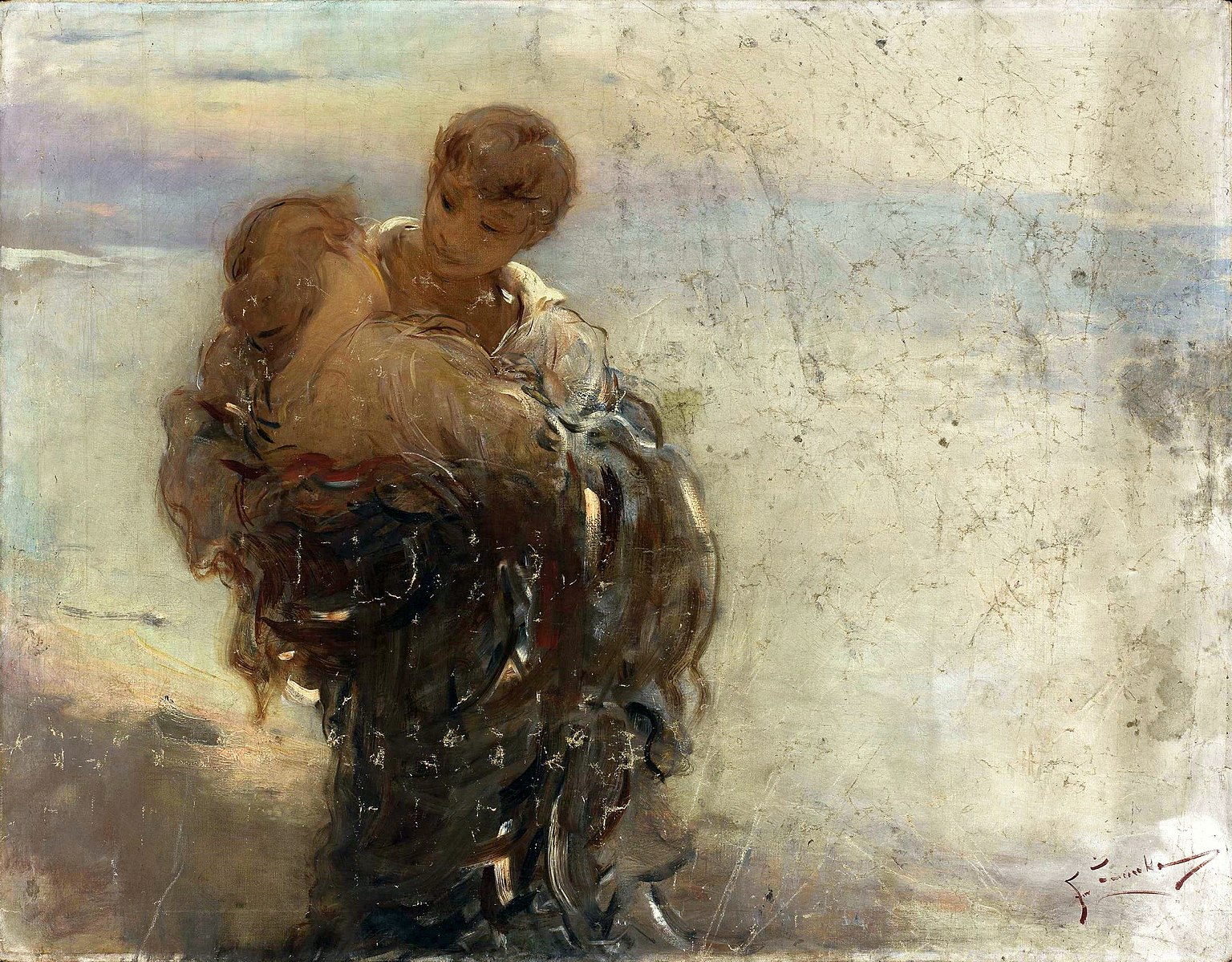
“In Rapture” by Franciszek Zmurko (c. 1900), National Museum in Warsaw (Accession No. MP 3946), Source/Author cyfrowe.mnw.art.pl/pl/zbiory/453259, (PD)

“Rose Castorini:  Listen, Johnny.  There’s a question I want to ask.  I want you to tell me the truth, if you can.  Why do men chase women?

Johnny Cammareri:  Well, there’s the Bible story.  God.  God took a rib from Adam and made Eve.  Now, maybe men chase women because they want the rib back.  When God took the rib, He left a big hole there, a place where there used to be something.  And the women have that.  Now maybe, just maybe, a man isn’t complete as a man without a woman.”

Moonstruck

Many of us enjoy romantic comedies or rom-coms as they are called.  Moonstruck happens to be a favorite of mine.  Boy meets girl.  Boy loses girl.  Boy gets girl.  And they both live happily ever after.

Trite as many rom-com plots are, they contain a kernel of truth about the importance and the power of love.  At some level we all recognize that.  It is the reason we find the boy’s pursuit of the girl engaging.

Sadly, as survivors of childhood abuse, we may settle for unresponsive partners or avoid relationships entirely.  We may not, therefore, have known the sweetness of courtship.  Or perhaps courtship was followed by the horrors of domestic violence. 

How much more meaningful then is God’s pursuit of us?  That pursuit began in the Garden, when sin first separated man from God.

Then the Lord God called to Adam and said to him, ‘Where are you?’” (Gen. 3: 9).

Continue reading

7 Comments

Filed under Child Abuse, Child Molestation, Christianity, domestic abuse, domestic violence, Emotional Abuse, Neglect, Physical Abuse, Religion, Sexual Abuse, Violence Against Women

Invisible Wounds – Emotional Abuse

Mimi & Eunice Cartoon:  “Posture”, Source https://mimiandeunice.com/2011/10/20/posture/, Author Nina Paley, (CC BY-SA 3.0 Unported)

“Ugh.  I hate the sight of your ugly face.”

“I wish I’d never had you.  I should have gotten an abortion.”

“You’re useless.  You’ll never amount to anything.”

“How can you be so stupid?  No wonder you have no friends.”

“Now, look what you made me do.  It’s all your fault.”

“No one could love you.  No one ever will.”

Emotional abuse leaves no visible scars.  But the wounds go deep.  We may as well have scalding water dumped over us.

Emotional abuse is often mischaracterized as a less damaging form of child abuse.  To the contrary, the American Academy of Pediatrics calls it, “the most challenging and prevalent form of child abuse and neglect” [1A]. 

Such abuse can carry over into adult relationships [2].  We settle for what we think we deserve.  There is, therefore, a clear link to domestic abuse [3].

Emotional abuse of children may be accompanied by physical neglect, physical abuse, or sexual abuse. 

However, there is credible evidence that the victims of emotional abuse and emotional neglect exhibit equal or worse immediate and long-term effects than the survivors of other forms of maltreatment and violence [1B].

Types of Emotional Abuse

A. Cruelty

Emotional abuse can involve name calling; constant criticism; negative remarks about a child’s (or later an adult partner’s) appearance, intellect, abilities, hopes, and dreams; cruel jokes at a child’s (or later an adult partner’s) expense; deliberate humiliation; and threats of violence or abandonment [4A]. 

A parent may permanently damage a child’s self-esteem simply by withholding all kind and encouraging remarks [4B].

B. Manipulation

There are other varieties of emotional abuse, no less harmful to a child.  These can range from manipulating or scapegoating a child; failing to promote a child’s social development by forbidding friends, and forcing isolation on a child; to making a child the parent’s emotional partner (covert incest); or exposing a child to traumatic events like domestic violence, drug and alcohol abuse [4C].

C. Excessive Control

Children can be damaged if they are pushed too hard, in order to fulfill a parent’s own ambitions, or controlled so closely that they have no lives of their own [4D].

D. Emotional Neglect

At the other extreme, children can be emotionally harmed, if they are regularly ignored [4E]. 

Failure by a parent to interact at all with a child is known as emotional neglect.  This can occur if, for instance, a parent suffers from serious mental illness.  It can be devastating for the child, even if he or she is otherwise fed and clothed.

E. Domestic Abuse

In the context of domestic violence, emotional abuse is often accompanied by extreme jealousy; isolation; enforced dependence; and coercive control by the abusive partner over money, travel, and communication with family and friends [5A]. Continue reading

23 Comments

Filed under Child Abuse, Child Molestation, domestic abuse, domestic violence, Emotional Abuse, Neglect, Physical Abuse, Sexual Abuse, Violence Against Women

False Guilt

Courtroom gavel, Author onaeg news agency, (CC BY-SA 4.0 International)

“There are two kinds of guilt.  One is true guilt, that is, it stems from sin against God; we are responsible for it and we have to deal with it.  The second is false guilt, which Satan places on us; this occurs when the devil accuses us of not living up to God’s standards.

Many people live countless years under such deceptive guilt.  They never feel as if they can quite get God’s acceptance; they think they never quite measure up and never quite please God; they believe they will never be all that God wants them to be.”

–Charles Stanley in How to Listen to God

Abuse victims are all too familiar with guilt. 

Told from childhood that we did not measure up, that everything wrong in the family was our fault, we grew up virtually enveloped in guilt.  This is compounded by the fact we are likely to believe we brought the abuse on ourselves (an outright lie, but one of which Satan is particularly fond).

All this is false guilt.

If confronted, we would have difficulty reciting our supposed “sins”.  This is because they do not exist.  Which is not to say that we do not commit real sins.  We are as fallible as the rest of mankind, in that regard.

But the guilt that is unrelenting – the guilt punishing, even crippling us – is false guilt.  We were not responsible for the abuse inflicted on us – whether it was emotional, physical, sexual or took the form of neglect.  We did not engender it.  We did not deserve it.

What we needed and deserved, but were deprived of, were love and care.

Unfortunately, what false guilt does is convince us we are still undeserving.  We labor under the weight of this lie, sometimes turning it into a self-fulfilling prophecy. Continue reading

9 Comments

Filed under Child Abuse, Child Molestation, Christianity, domestic abuse, domestic violence, Emotional Abuse, Neglect, Physical Abuse, Religion, Sexual Abuse

Healing from Abuse

Flowers growing from cement, Author Frederick Depuydt (CC BY-SA 4.0 International)

Healing from child abuse is possible.  But healing is a process [1].  In this regard, healing from domestic abuse is not very different. 

Necessary elements include recognizing the full impact of the trauma we experienced; processing the emotions the trauma generated; developing healthy coping mechanisms; and rebuilding a sense of safety and self-worth. 

Both healing from child abuse and healing from domestic abuse require courage and patience with ourselves.

The Impact of Trauma

The impact of childhood trauma is multi-faceted.  It can range from rage, self-hatred, anxiety, depression, and PTSD (nightmares, flashbacks, emotional detachment, etc.) to sexual addiction, sexual dysfunction, chronic physical ailments (migraines, backaches, etc.), drug or alcohol addiction, and eating disorders [2].  

Similarly, domestic violence can result in anxiety, depression, PTSD, and a host of physical ailments from gastrointestinal and cardiovascular issues to traumatic brain injury [3][4].

It bears mention that child abuse and domestic abuse can both result in death, either at the hand of the abuser or by way of suicide years later.

Professional counseling can be of great assistance to survivors in dealing with trauma, re-establishing necessary boundaries, and developing healthy coping skills [5].

Rebuilding Self-Worth

At the deepest level, victims must reclaim a sense of self-worth.  This is an enormous challenge.  Child victims of abuse are taught from the outset they are dung.  Adult victims (having survived turbulent childhoods) are gradually deprived of their power and self-respect by abusive partners. Continue reading

16 Comments

Filed under Child Abuse, Child Molestation, Christianity, domestic abuse, domestic violence, Emotional Abuse, Neglect, Physical Abuse, Religion, Sexual Abuse

Invalidation

Distressed woman, Source https://pixaby.com, Author pixaby user “Free-photos” (Creative Commons CC0 1.0 Universal Public Domain Dedication)

“You’re overreacting.”

“You’re being overly sensitive.”

“You shouldn’t take things so personally.”

“You make a big deal out of everything.”

“I’m sure it wasn’t that bad.”

“You probably misunderstood.”

“It never happened that way.  You’re making things up.”

“You shouldn’t be angry [or hurt or sad].”

Invalidation of our feelings, when it becomes a pattern of behavior, is a form of emotional abuse [1A].  Depending on our upbringing, it can begin in childhood, occur during an adult friendship or romantic relationship, or both.

Feelings As Valid

We are born with the capacity to feel in response to our environment and those in it.  Emotions are an important source of information for us [1B].  They help us identify danger, and protect ourselves against it.

Feelings, in themselves, are not right or wrong.  They are the result of thoughts, prior life events, and perceptions unique to ourselves [1C].  Two people can legitimately have different emotional responses to the same situation.

Emotional validation is a critical communication tool, particularly in families [2A].  It helps sustain emotional connection, making us feel safe and secure.  Its absence has the opposite effect.

Mechanism of Invalidation

At various times our feelings may be [1D]:

  • Minimized as excessive for a given situation;
  • Dismissed as inappropriate or groundless, because our assessment of the situation is supposedly inaccurate; or
  • Ignored entirely, as if we were invisible and not experiencing them (or our experience was irrelevant to the abuser which – sad to say – it frequently is).

This can cause enormous shame, over and above the emotion we are actually experiencing and attempting to convey.

Impact on Children

Children who regularly experience emotional invalidation may learn to ignore, hide, or distrust their own emotions, while striving ever harder to please others [2B].  This leaves them dependent on and vulnerable to external validation. 

Invalidation can lead to emotional detachment or, in extreme cases, borderline personality or narcissism.  It is, also, a tool used by narcissists on children and adults alike.

Adult “Gaslighting”

Among adults, invalidation is a powerful if subtle means of manipulation known as “gaslighting” which allows the abuser to alter the victim’s reality.  Abusers routinely use it to blame the victim, and diminish their responsibility for the harm they have done [1E]. Continue reading

24 Comments

Filed under Child Abuse, Child Molestation, Christianity, domestic abuse, domestic violence, Emotional Abuse, Neglect, Physical Abuse, Religion, Sexual Abuse

Loneliness

“Loneliness” (1880) by Hans Thoma, National Museum in Warsaw (Accession No. 192915/22), Source cyfrowe.mnw.art.pl (PD)

“Turn to me and be gracious to me for I am lonely and afflicted.  Relieve the troubles of my heart and free me from my anguish” (Ps. 25: 16-17).

Loneliness is a feeling of isolation, detachment, and lack of social connection – an emotional state now so common it has its own Wikipedia page [1].  An argument might easily be made that there is, in fact, a loneliness epidemic.  Across the globe, there are some 740,000 suicide deaths annually [2].

All human beings experience loneliness, at one time or another, particularly when we have lost someone or ended a relationship.  In some sense, loneliness characterizes our species.  But the feeling can be particularly intense for abuse victims.

Empty Goals

Part of this is due to the pursuit of empty goals by our culture. 

Ours is a materialistic society.  We are encouraged to be shallow, to seek fame and wealth above all things.  Yet these do not guarantee happiness.  In fact, avid pursuit of them may increase our loneliness.  

Fame for its own sake is meaningless.  And no number of McMansions (or villas on the Riviera, for that matter) can fill an empty heart.

Broken Families

Broken families are another cause for loneliness, and these are endemic in our society. 

At least 40% of American children are today born out of wedlock [3A].  The percentage among African Americans is much higher [3B].  This means children do not have the financial support – and regular presence – of both a mother and father.  As a consequence, 59% will live in poverty [4]. 

Half the remaining children will experience divorce, which means that fully 70% of American children will not live in a two parent household, for at least some part of their childhood [5]. Continue reading

20 Comments

Filed under Child Abuse, Child Molestation, Christianity, domestic abuse, domestic violence, Emotional Abuse, Neglect, Physical Abuse, Religion, Sexual Abuse, Violence Against Women

The Rose Garden – Afterword

https://upload.wikimedia.org/wikipedia/commons/7/72/Rosa_%27Charisma%27%2C_Bad_W%C3%B6rishofen%2C_Alemania%2C_2019-06-20%2C_DD_05.jpg

“Charisma” Rose, Author Diego Delso (CC BY-SA 4.0 International)

who comforts us in all our tribulation, that we may be able to comfort those who are in any trouble, with the comfort with which we ourselves are comforted by God” (2 Cor. 1: 4).

I have tried to paint an accurate and nuanced picture of people and events.  This is in no way intended to excuse abuse.  Whatever his or her personal history, the adult in a situation of child abuse remains the responsible party.

Ultimately, my story is not one of incest — or even loss — but love.  I was blessed with a loving sister, mother, grandmother and grandfather; and saved by Love Incarnate.

I had access to great books and great teachers.  I had the help of fine physicians and psychologists.  I had the opportunity to work in a field I loved passionately — in the process becoming the person I was intended to be.  I have always been surrounded by loving friends.

Not all children in the world are as fortunate.  Worldwide, millions each year are the victims of physical, emotional, and/or sexual abuse or neglect, with devastating consequences.  My case is just one among many.

The National Child Abuse and Neglect Data System (NCANDS) reports that there were 558,899 cases of documented abuse or neglect in 2022.  That equates to one in seven children in the United States abused or neglected each year [1][2].  Since abuse and neglect are underreported, experts believe the true number is far higher [3].

Thankfully, there is now a much greater awareness of the problem than when I was a child.

Each child’s life is precious, a banner waiting to unfurl.  But God values the worn and battle-scarred banner no less.

If there is a lesson to be drawn from my experience and family history, it is that — with God’s help — we endure.  Bitterness is not an answer to life.  We all bear scars.  Whatever our personal sorrows, we each of us have something inside only we can give.

And we have a choice.  To lift a finger, light a candle, lend a hand…or not.  Opportunities for good abound.

Defeat is a temporary condition.  It is a greater triumph to have struggled against failure and rejection, than never to have failed for fear of making the attempt.  Even in loss there is honor.

Take that chance.  The world is waiting.  The roses are in bloom.


[1]  Children’s Bureau, Administration for Children and Families, “Child Maltreatment 2022”, https://www.acf.hhs.gov/sites/default/files/documents/cb/cm2022.pdf.

[2]   McLean Hospital, “Understanding Child Abuse and Its Effects on Mental Health”, 8/18/23, https://www.mcleanhospital.org/essential/effects-child-abuse.

[3]  National Institutes of Health, National Library of Congress, National Biotechnology Information Center, “New Directions in Child Abuse and Neglect Research” by National Research Council, et al, 3/25/14, https://www.ncbi.nlm.nih.gov/books/NBK195982/ and https://nap.nationalacademies.org/catalog/18331/new-directions-in-child-abuse-and-neglect-research.

Copyright © 2008 – Present Anna Waldherr.  All rights reserved.
ISBN: 978-1-60247-890-9

FOR MORE OF MY ARTICLES ON POVERTY, POLITICS, AND MATTERS OF CONSCIENCE CHECK OUT MY BLOG A LAWYER’S PRAYERS AT: https://alawyersprayers.com

13 Comments

Filed under Child Abuse, Child Molestation, Christianity, Emotional Abuse, Neglect, Physical Abuse, Religion, Sexual Abuse