Tag Archives: abuse and the arts

Light from Darkness, Part 2

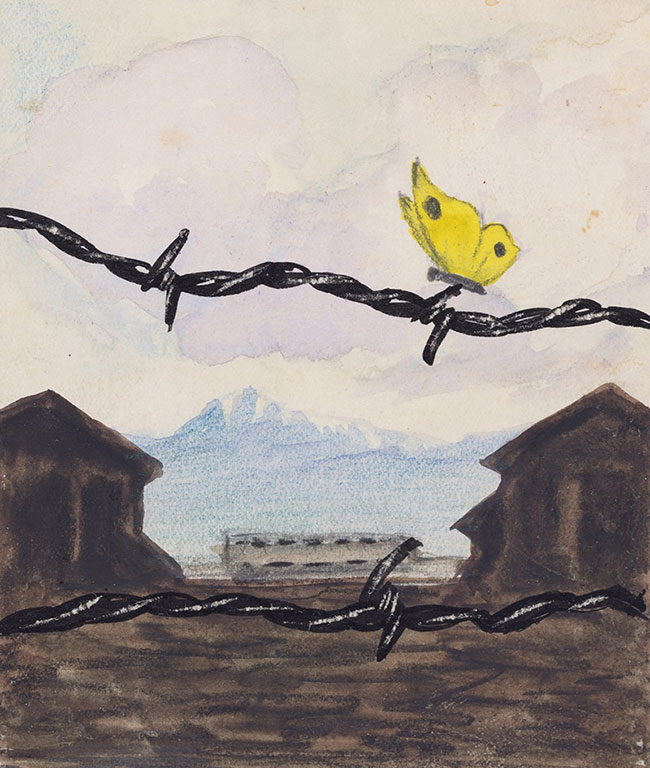
“One Spring, Gurs Camp” (1941) by Karl Robert Bodek and Kurt Low, Yad Vashem Museum, Israel, Image courtesy of Yad Vashem Collection

WARNING:  Graphic Images

Abuse comes in many forms.  From 1933 to 1945 in Nazi Germany it was governmental, with the goal being complete extermination of the Jews [1].

The artworks comprising the Yad Vashem Collection were created by artists (Jewish and non-Jewish) between 1939 and 1945 to provide a living testament of the Holocaust [2A].  A hundred works from the collection were exhibited in Germany in 2016, just three years after the Alternative for Germany (AfD) was founded – a far Right party whose leader, Björn Höcke denigrated the Memorial to Murdered Jews of Europe [3][4].

Art in the concentration camps served simultaneously as a witness, a means of self-assertion, and an expression of optimism [2B].

The works are both heart wrenching and awe inspiring.  In “One Spring, Gurs Camp” (above), the barbed wire depicts imprisonment and loneliness.  The butterfly and the mountains in the background, however, suggest hope. 

One of the two artists who collaborated on “One Spring”, 28 y.o. Kurt Low, was released and able to flee to Switzerland.  The other, 37 y.o. Karl Bodek, was ultimately murdered at Auschwitz. Continue reading

15 Comments

Filed under Abuse of Power, Child Abuse, Child Molestation, Christianity, domestic abuse, domestic violence, Emotional Abuse, human trafficking, Neglect, Physical Abuse, Rape, Religion, sex trafficking, Sexual Abuse, Sexual Assault, Slavery, Violence Against Women

Light from Darkness, Part 1

Margeaux Gray, Image courtesy of The Pixel Project

Margeaux Gray is a survivor of childhood sex trafficking, having been sold into slavery at the age of 5 [1][2][3].  She is, also, an artist who uses her talent both to convey the trauma of abuse and to honor the individual, no matter how broken. 

Ms. Gray advocates against all forms of abuse.  She mentors at-risk youth, speaks publicly about abuse, and confers with physicians and organizations about improving health care and social services for victims.   

Below are excerpts of an interview with Ms. Gray and images of her work:

“Human trafficking…thrives on the ignorance of family and the community.  I was sexually exploited and sold into sexual slavery by a man who had my trust and the trust of my family…I was not kidnapped or locked away in a basement.  My mom, sister, and aunt did not think twice about the two of us going out and doing things together.”

“Untitled” by Margeaux Gray at age 13, Image courtesy of AMA Journal of Ethics

“At around fourteen years old, I disclosed to a healthcare worker that I was being sexually abused.  This was before human trafficking was a definition.  It was reported to police.  After that the trafficking lessened, but continued.  I had an emotional attachment to the man who trafficked me. This is…referred to as traumatic bonding…It took four years for me to gain a greater understanding of the what had been and was continuing to be done to me.”

“A victim of slavery is a trauma victim and every survivor deals with trauma in different ways…Many victims…suffer with alcohol and drug addiction, Post Traumatic Stress Disorder (PTSD), depression, and sexually transmitted diseases to name a few.”

“Universal Light, Nurture and Nursing” by Margeaux Gray, Image courtesy of AMA Journal of Ethics

“Art…was a strategic way for me to cope and find some freedom when I had little. Through my healing it has allowed me a way to process my emotions resulting from being trafficked. Today I use it as an extension of my voice.  I have specifically used visual art to educate, inspire, and empower others.”

Not all abuse victims are talented artists.  But the arts — writing, drawing, painting, music, theater — are a way to reveal the pain we have endured while reaching toward something better, something more. 

We need not become professionals to do this.  We need not even share the results of our efforts with others, if that feels too intimidating.  We need only allow the soul to express itself.

Even concentration camp victims have done this [4].  Because light is stronger than darkness.  And love is stronger than hate.

[1]  The Pixel Project, “Inspirational Interview:  Margeaux Gray – Part I”, 10/26/14,  https://www.thepixelproject.net/2014/10/26/inspirational-interview-margeaux-gray-part-i/.

[2]  The Pixel Project, “Inspirational Interview:  Margeaux Gray – Part II”, 10/27/14, https://www.thepixelproject.net/2014/10/27/inspirational-interview-margeaux-gray-part-ii/.

[3]  AMA Journal of Ethics, “Out of Darkness, Light:  Drawing and Painting by Margeaux Gray” by Margeaux Gray and Mary Richards, 1/19/17, https://journalofethics.ama-assn.org/article/out-darkness-light-drawing-and-painting-margeaux-gray/2017-01.

[4]  Yad Vashem Collection, “Art from the Holocaust”, January 2016, https://www.yadvashem.org/yv/en/exhibitions/art/index.asp.

This series will conclude next week.

FOR MORE OF MY ARTICLES ON POVERTY, POLITICS, AND MATTERS OF CONSCIENCE CHECK OUT MY BLOG A LAWYER’S PRAYERS AT: https://alawyersprayers.com

12 Comments

Filed under Child Abuse, Child Molestation, domestic abuse, domestic violence, Emotional Abuse, human trafficking, Neglect, Physical Abuse, sex trafficking, Sexual Abuse, Slavery, Violence Against Women

Full and Satisfying

File:Harvest Still (126163195).jpeg

Harvest Still, Source https://500px.com, Photographer Nicu Buculei
(CC BY-SA 3.0 Unported)

Can the victims of abuse ever lead full and satisfying lives?  That depends, to a large extent, on how we define “full and satisfying”.

There is no question that abuse can kill.  Those of us who survive may be left with lifelong physical and emotional scars.  Abuse can leave victims struggling with depression, anxiety, and PTSD.  Abuse can turn sex into a weapon, in the desperate search for love.  Abuse can lead to self-medication, with drugs or alcohol.

But that is not the whole story.  Not by a long shot.

“…even the helpless victim of a hopeless situation facing a fate he cannot change, may rise above himself, may grow beyond himself, and by so doing change himself. He may turn a personal tragedy into a triumph.”

– Viktor Frankl, Man’s Search for Meaning

The psychiatrist and Holocaust survivor, Viktor Frankl, in Man’s Search for Meaning described his experiences as a prisoner at Auschwitz concentration camp.  He concluded that human beings strive for purpose, and that – whatever our circumstances – we have the ability to give life meaning through love, work, and suffering.

At first glance, that may not make sense.  Oh, most of us would agree that life can be given meaning by romantic love, perhaps brotherly love.  After some thought, we might be persuaded that life can be given meaning by work – even tedious or menial work, if done to support the ones we love.

Yet suffering?  Not such a stretch as it might seem.  We recognize the concept of sacrifice in a noble cause (love of God, love of country, etc.), and sacrifice for the sake of a beloved.  Mothers who have lost a child will understand that their grief is, in part, a testament to that child.

How does this relate to abuse victims?  Well, we have certainly suffered.  That our suffering was not to any purpose makes it all the more cruel.  We were innocent victims.  Blameless.

And that is the place to start… Continue reading

13 Comments

Filed under Child Abuse, Christianity, Emotional Abuse, Neglect, Physical Abuse, Religion, Sexual Abuse

Full and Satisfying

Nativity scene at St. Viktor Church, Dulmen, Germany, Author/Source Dietmar Rabich (CC BY-SA 4.0 International)

Can the victims of abuse ever lead full and satisfying lives?  That depends, to a large extent, on how we define “full and satisfying”.

There is no question that abuse can kill.  Those of us who survive may be left with lifelong physical and emotional scars.  Abuse can leave victims struggling with depression, anxiety, and PTSD.  Abuse can turn sex into a weapon, in the desperate search for love.  Abuse can lead to self-medication, with drugs or alcohol.

But that is not the whole story.  Not by a long shot.

“…even the helpless victim of a hopeless situation facing a fate he cannot change, may rise above himself, may grow beyond himself, and by so doing change himself.  He may turn a personal tragedy into a triumph.”

– Viktor Frankl, Man’s Search for Meaning

The psychiatrist and Holocaust survivor, Viktor Frankl, in Man’s Search for Meaning described his experiences as a prisoner at Auschwitz concentration camp.  He concluded that human beings strive for purpose, and that – whatever our circumstances – we have the ability to give life meaning through love, work, and suffering.

At first glance, that may not make sense.  Oh, most of us would agree that life can be given meaning by romantic love, perhaps brotherly love.  After some thought, we might be persuaded that life can be given meaning by work – even tedious or menial work, if done to support the ones we love.

Yet suffering? Not such a stretch as it might seem.  We recognize the concept of sacrifice in a noble cause (love of God, love of country, etc.), and sacrifice for the sake of a beloved.  Mothers who have lost a child will understand that their grief is, in part, a testament to that child.

How does this relate to abuse victims?  Well, we have certainly suffered.  That our suffering was not to any purpose makes it all the more cruel.  We were innocent victims.  Blameless.

And that is the place to start… Continue reading

19 Comments

Filed under Child Abuse, Christianity, Emotional Abuse, Neglect, Physical Abuse, Religion, Sexual Abuse

Full and Satisfying

Tree decorated for Valentine’s Day, San Diego, CA, Source/Author Johntex (GNU Free Documentation License/CC BY-SA 3.0 Unported, CC BY 2.5 Generic)

Can the victims of abuse ever lead full and satisfying lives?  That depends, to a large extent, on how we define “full and satisfying”.

There is no question that abuse can kill.  Those of us who survive may be left with lifelong physical and emotional scars.  Abuse can leave victims struggling with depression, anxiety, and PTSD.  Abuse can turn sex into a weapon, in the desperate search for love.  Abuse can lead to self-medication, with drugs or alcohol.

But that is not the whole story.  Not by a long shot.

“…even the helpless victim of a hopeless situation facing a fate he cannot change, may rise above himself, may grow beyond himself, and by so doing change himself. He may turn a personal tragedy into a triumph.”

– Viktor Frankl, Man’s Search for Meaning

The psychiatrist and Holocaust survivor, Viktor Frankl, in Man’s Search for Meaning described his experiences as a prisoner at Auschwitz concentration camp.  He concluded that human beings strive for purpose, and that – whatever our circumstances – we have the ability to give life meaning through love, work, and suffering.

At first glance, that may not make sense.  Oh, most of us would agree that life can be given meaning by romantic love, perhaps brotherly love.  After some thought, we might be persuaded that life can be given meaning by work – even tedious or menial work, if done to support the ones we love.

Yet suffering?  Not such a stretch as it might seem.  We recognize the concept of sacrifice in a noble cause (love of God, love of country, etc.), and sacrifice for the sake of a beloved.  Mothers who have lost a child will understand that their grief is, in part, a testament to that child.

How does this relate to abuse victims?  Well, we have certainly suffered.  That our suffering was not to any purpose makes it all the more cruel.  We were innocent victims.  Blameless.

And that is the place to start… Continue reading

20 Comments

Filed under Child Abuse, Christianity, Emotional Abuse, Neglect, Physical Abuse, Religion, Sexual Abuse