Category Archives: Religion

The Rose Garden, Chapter 8 – Sisters

https://upload.wikimedia.org/wikipedia/commons/e/e7/Two-finnish-refugee-sisters-arrive-in-Stockholm-142449184762.jpg

Sisters (PD)

Two are better than one, Because they have a good reward for their labor.  For if they fall, one will lift up his companion” (Eccl. 4: 9-10).

I have kept for nearly five decades now the letters my sister wrote me from France the summer she studied abroad.  Like her, they are interesting, funny, warm, forceful, and full of life.

My stereo and the cabinet on which it sits, my DVD player and television stand, my best china, the sculpture in my living room, the chef’s knives and appliances in my kitchen (microwave, coffee maker, tea maker, cappuccino machine, grill), the barbecue on my porch, in fact, the majority of jewelry in my jewelry box, were all gifts from my sister.

She is the real gift in my life.  Had she given me none of these things, I would feel the same.

My sister and I laughed together, played together, fought with one another, and clung to one another on the frequent occasions our father’s anger erupted.  My sister, in those days, was more reticent than I.  Quiet and shy, she kept her feelings to herself, where mine were always on the surface.

In the early years we slept together in a trundle bed.  This allowed us to share secrets and small jokes with each other, even after the lights were turned off.  I would lie awake making up stories after my younger sister had fallen asleep.

Sometimes we would be allowed to jump on our grandparents’ bed.  This was a great treat, since they had an old fashioned feather bed.  The feather bed enfolded us, the same way I imagined a fluffy cloud would.

My sister favored dolls.  Prominent among these was a talented doll which could talk when a string at the base of her neck was pulled.  Even more mysterious, the doll would drink from a bottle that appeared to refill with milk.

Envy prompted me one afternoon to throw the doll’s bottle across the room.  My sister was heartbroken that the bottle would no longer refill, as a result.

My sister lost another doll entirely to me.  This one, a fashion doll, was co-opted for a school project of mine.  My class had been studying the Middle Ages.  Against the doll’s wishes (or my sister’s, at any rate), this petite model was outfitted in a blue velvet gown and tiny headdress by our grandmother.

More often than not, my sister and I got along.  Grandma would not tolerate bad behavior.  Her demeanor toward my sister was, however, less rigid than towards me.

My sister loved to sit with Grandma while she ironed.  The two would sing together, as the aroma of fresh starch filled the garage where Grandma did the family laundry. Continue reading

8 Comments

Filed under Child Abuse, Child Molestation, Christianity, Emotional Abuse, Neglect, Physical Abuse, Religion, Sexual Abuse

The Rose Garden, Chapter 7 – The Snow Fort

File:Snow Fort 2009.jpg

Snow fort, Author Andrew Wiseman (CC BY-SA 3.0 Unported)

For He says to the snow, ‘Fall on the earth’; Likewise to the gentle rain and the heavy rain of His strength” (Job 37: 6).

Winter followed summer, and one year another.  With time I acquired logic and organizational skills from my grandmother.  From my grandfather, I learned to dance.

My grandfather reveled in music.  Where my grandmother’s taste ran to hymns, he enjoyed livelier music — polkas, waltzes, mazurkas, csárdáses.  I first learned to dance to these standing on the sofa, supported in Grandpa’s arms.

As I grew older, he chided me sternly to dance in a ladylike manner — “Small steps, small steps!” — something I never quite mastered.  Absorbing my grandfather’s passion for life more readily than his instructions on decorum, I was routinely swept away by the music.

Grandpa taught me the difference between pints and quarts, patiently pouring paint from one can to another for me.

Grandpa was, also, the one to part my hair on the left.  I would stand between his knees, as he carefully plied the comb.  “No, not on the right, Annalein.  Never on the right.  Hitler parted his hair on the right.”

It was my father who cut my hair.  Since it was usually kept short, I worried that strangers might mistake me for a boy.

Evenings the family would sit contentedly listening to my grandfather’s large collection of records or watching televised wrestling with him.

Sunday afternoons, we would all listen to Strauss on the radio with its rotating display of vinyl fish.  My sister and I would lie on the living room rug on these afternoons, drawing or coloring as the sun spilled through the windows.

My recollection of Grandpa is of a smiling, mustachioed man in a white cotton undershirt — a glass of beer and a box of crackers at his side. Continue reading

15 Comments

Filed under Child Abuse, Child Molestation, Christianity, Emotional Abuse, Neglect, Physical Abuse, Religion, Sexual Abuse

The Rose Garden, Chapter 6 – Two Women

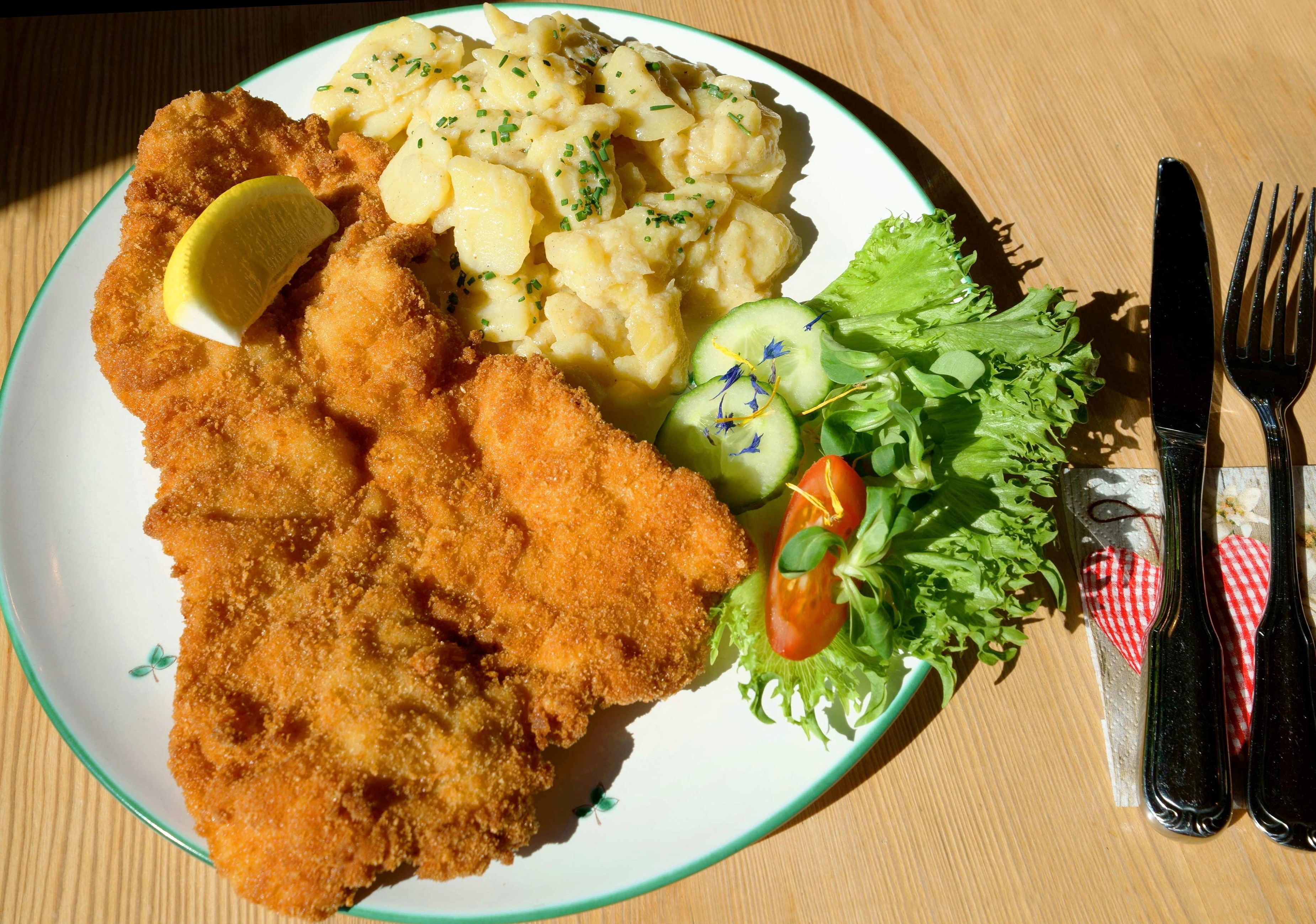
https://upload.wikimedia.org/wikipedia/commons/b/bc/Wiener_Schnitzel_2012.jpg

Wiener Schnitzel, Author Holger.Ellgaard (CC BY-SA 3.0 Unported)

Her children rise up and call her blessed…” (Prov. 31: 28).

My mother worked in the delicatessen she and my father owned.  Her  mother, my grandmother worked — less frequently than my mother — cleaning houses, downtown.

It was my mother who had convinced my father to purchase their small delicatessen in Harlem.  She thrived in the store, making countless friends over the years, despite her shyness and difficulties with language.  At the holidays, Ma lovingly placed hundreds of greeting cards into customer packages.

Grandma would tell us about her day and the swank Manhattan apartments she saw.  Mrs. Garland often said, “No one irons like you.”

Sometimes Grandma would share her concerns for her employers with us.  “Mrs. Garland has a girl older than you.  That one spends too much time alone.  I am going to ask if she can come and play with you.”  Little did we children realize who the famous Judy Garland was or her daughter, Liza.

The Kahls, another couple for whom Grandma cleaned, painted as a hobby.  A painting by the Kahls of the village where my mother spent her early life hung in a place of honor in our dining room, throughout my childhood.

Unlike Ma — always sweet, but ephemeral as smoke — Grandma was pragmatic and down to earth.  Where my mother was emotional, my grandmother was stoic.  Where Ma was silk, Grandma was steel.  Where my mother was yielding, my grandmother was highly organizational.

Lip Balm and Barrettes

Though Grandma was the more practical, Ma made sure to stock every variety of household item for us.

These were kept on hand in the garage:  lip balm, barrettes, contact paper, cold cream, glue, batteries, first aid ointment, hairspray, soap, scissors, cellophane tape, toothbrushes, hair brushes, baby powder, adhesive bandages, rubber bands, oak tag, markers, combs, headbands, suntan lotion, construction paper, crayons, stencils, sparkles, paper clips.  Like a genie, Ma would produce the necessary item at the critical moment.

Stationery, pens, and pencils were kept (along with socks) in a small cherry wood desk, in the living room. Continue reading

20 Comments

Filed under Child Abuse, Child Molestation, Christianity, Emotional Abuse, Neglect, Physical Abuse, Religion, Sexual Abuse

The Rose Garden, Chapter 5 – World War II

https://upload.wikimedia.org/wikipedia/commons/6/62/Displaced_Persons_and_Refugees_in_Germany_BU6635.jpg

Displaced Persons Camp (1945), Hamburg, Germany, Source/Author Imperial War Museum for UK Govt., (PD)

WARNING:  Graphic Images

The earth also was corrupt before God, and the earth was filled with violence” (Gen. 6: 11).

It is difficult to reconstruct the chronology of World War II from my parents’ notebooks.  I can only cobble together bits and pieces.  The times were chaotic.  Territory repeatedly changed hands.  My mother’s narrative is particularly fragmented.

My father saw farms abandoned or destroyed by artillery.  Bridges that had stood for generations were demolished.

Food grew scarce.  Livestock were confiscated without pay by passing troops or slaughtered  outright.  My father took a beloved horse up into the hills, in the hope of finding him again someday.

Two of my father’s brothers and an uncle were forcibly conscripted.  A second uncle was arrested for transporting contraband.

One of the conscripted brothers was finally reunited with the rest of the family in Germany in 1949, having been captured on the Eastern Front and imprisoned by the Russians all that time.  He was a shadow of his former self.

My father, also, witnessed Jews being deported to concentration camps by the Nazis.  He wrote in his notebook:

“The curse was on.  We saw the Jews from Yugoslavia by the thousand[s] in barbed wire wagons, their tongues on the windows and yelling, ‘Water, water!  Please!’  They threw beautiful money, the Yugoslavian dinars, and we picked it up.  This is [the ugliness of] war.  We were children and did not know any better…

[There were] also, German army trains by the dozens going to Yugoslavia fighting partisans.  On their way, [the soldiers] were shining sitting on their tanks, autos, trucks, etc.  On their way home, [they were] filthy, ragged, and flea [bitten].”

My mother was eleven years old when in 1944 the Nazis occupied Hungary.  The war abruptly ended her schooling.

My mother had a personal connection to the Jewish deportation.  The kindhearted woman who ran the local grocery — a woman who had let my mother stand on the counter, when she was a toddler; the very woman who had inspired my mother to dream of working in a food store — was Jewish.

That woman came under cover of darkness to the house one night, and begged for help.  All my grandmother could do was give her some food, and a little money.  The woman was never heard from again.

My mother and her parents, themselves, had to flee to the nearby woods for safety as first Nazi forces, then Russian forces swept through their area.  For a brief time, they went into service in a neighboring village.  But they were never permitted to reclaim their property, so were left homeless.

Expulsion

When Russian forces came through, one of my grandfather’s sisters falsely accused my grandmother of collaborating with the Nazis.  This was the result of a long-simmering grudge related to my great-grandfather.  Promising the village a financial windfall, he had decades earlier left for America with the village’s funds and never made restitution.

It was in this connection, as I understand matters, that my grandmother’s retention of the family’s Hungarian passports saved them.

As Germany’s defeat neared, the USSR urged a plan to evacuate ethnic Germans from Eastern European countries, as an excuse for land redistribution [1A].   In Hungary, many refused to leave the only home they had ever known.

A series of expulsions began in 1946.  As a result, 170,000 German Hungarians were ultimately transported to the American Zone in West Germany; 50,000 to the Soviet Zone in East Germany; and 15,000 to Austria [1B].

Both my parents experienced being transported by cattle car.  The trauma affected my mother so deeply she was unable to speak for a full year afterwards. Continue reading

13 Comments

Filed under Child Abuse, Child Molestation, Christianity, Emotional Abuse, Neglect, Physical Abuse, Religion, Sexual Abuse

The Rose Garden, Chapter 4 – Eden

https://upload.wikimedia.org/wikipedia/commons/3/3e/Yellow_Chrysanthemums.jpg

Yellow Chrysanthemums, Source https://flickr, Author Joe Lewis,
(CC BY-SA 2.0 Generic)

The Lord God planted a garden eastward in Eden, and there He put the man whom He had formed” (Gen. 2: 8).

I am told that at age three I was fearless — routinely toddling along in determined search of adventure, several steps ahead of my grandmother.

Roses

One particular day our path took us past a neighbor’s rose garden.  Evidently drawn to the blossoms, I entered the garden before my grandmother could stop me.

Entranced by the glorious shapes towering above me, I was only vaguely conscious of the heated discussion which ensued when the agitated neighbor rushed anxiously into her yard in defense of the roses.

At that moment, roses — in all shades from ivory to crimson — served to form one of my earliest recollections.

The Bronx

The Bronx is not widely known as a bucolic setting.  A borough of New York City originally named for Dutch settler Jonas Bronck, the Bronx by the 1970s had become a nationally recognized symbol of crime, urban poverty and decay, renowned for burned out buildings.

I was unaware of this growing up.  For me, the Bronx was host to a series of botanical marvels as cherished and familiar as family members.

A Peach Tree, An Apple Tree, and A Pear Tree

To begin with, there was the peach tree in the backyard, valiantly brandishing its fragile petals each spring.

Near that were the brilliant azalea bushes, and the apple tree whose graceful branches stretched past my second floor bedroom window.  Many a daydream was lazily conceived in view of those branches.  A stunted pear tree completed the picture.

Little did I realize that the peach, apple, and pear trees were mere shadows of the lush orchards my grandfather had to leave behind in Hungary.

The Neighbors’ Yards

In the next yard over to the right behind the house reigned a majestic oak, which in the summer months provided both shade and support for a hammock.  I was permitted to use this hammock when on speaking terms with the boy next door — the hammock, a definite incentive to peaceful coexistence or, at any rate, the temporary cessation of hostilities.

The oak truly came into its own in the fall at which point it dropped bushels of acorns before entirely losing its leaves.  The boy and I fought jealously over ownership of the fallen acorns while our fathers — from a rather different perspective — fought over the leaves

The yard to the rear and left of the house was occupied by our Italian neighbors’ carefully cultivated pepper, zucchini, and tomato plants.  Though looked upon with disdain by my Hungarian grandmother, these always grew with abandon.

Adjacent to them, in the yard belonging to my great aunt, grew hydrangea bushes with the mysterious ability to change from pink to blue depending on whether pennies or nickels were buried at their base by attentive children.

Two stately fir trees and a holly bush marked the boundaries of our small front yard.

An Extraordinary Woman

My Spartan grandmother’s garden, however, dominated the yard.  Her garden was one of the few indulgences Grandma allowed herself.  That she could allow herself anything approaching indulgence — given the many hardships she had known — was a testament to her strength.

My grandmother was an extraordinary woman.  In Hungary during World War II, Grandma had survived invasion first by German then Russian armies.  At risk of her life, she disobeyed a Nazi directive and avoided shipment to Siberia.

Though aware that the possession of Hungarian documents was cause for execution under the Nazi regime, my grandmother retained the family’s Hungarian passports throughout the Nazi occupation.

When Russian invaders supplanted Nazi, she was able to produce these passports.  From among some seventy-five persons, only my grandmother, my mother (then still a girl), and two or three others successfully avoided deportation to Siberia. Continue reading

18 Comments

Filed under Child Abuse, Child Molestation, Christianity, Emotional Abuse, Neglect, Physical Abuse, Religion, Sexual Abuse

The Rose Garden, Chapter 3 – History Lessons

File:Ethnic Map of Hungary 1910 with Counties.png

1910 Map of Hungary (ethnicities indicated), Author Ascended Dreamer,
(CC BY-SA 4.0 International)

Then the children of Israel journeyed from Rameses to Succoth, about six hundred thousand men on foot, besides children.  A mixed multitude went up with them also, and flocks and herds — a great deal of livestock” (Ex. 12: 37-38).

The year before my father died, my sister decided he should write down his life story.  She was adamant that both our parents do this, in fact.

So, in two lined, spiral notebooks, Ma and Pop wrote out the family history in longhand.  This was especially difficult for my mother who had earlier suffered a stroke and was nearly illiterate, in any case.

I have the notebooks.  It took me four years to read through them.  Not because of their length, but because of the emotion their contents evoked in me.

Hungary

My parents’ story begins in Hungary.  Then as now, Hungary (Magyarország) was a small, landlocked country in Central Europe.

Since earliest times, Hungary has been a crossroads with a mix of peoples.   Celts, Romans, and Huns; Slavs, Franks, and Bulgars; Magyars and Mongols; Ottomans and Austrians; Serbs, Croatians, Romanians and Czechs; finally Germans and Russians were among those who occupied the territory —  all, in their turn, migrating, invading, vying for power, uniting, dividing, and intermingling.

As I search the narratives for clues to my father’s character and his choices, I find the related history — family and national — immensely moving.

Not only is this my heritage, I see my life mirrored in these events.  Like Hungary, itself, I have been enriched by many sources.  Like Hungary, the territory that is my life has been embattled.

The Great Swabian Trek

Some 150,000 Germans were relocated to Hungary by the Austrian Hapsburgs during the 18th Century.  Their migration came to be known as the “Great Swabian Trek.”

Although from a variety of regions (with many dialects), German settlers were disparagingly called “Swabians” by the Hungarians.  The name came to mean all Germans who settled the Danube valley, an unwanted ethnic group.

Despite hardship, German immigrants to Hungary greatly increased the economic prosperity of that country.  The Banat region where they settled later became known as the “breadbasket of Europe.”

My parents’, grandparents’, and great-grandparents’ lives played out against this background.  This work ethic shaped my life. Continue reading

13 Comments

Filed under Child Abuse, Child Molestation, Christianity, Emotional Abuse, Neglect, Physical Abuse, Poverty, Religion, Sexual Abuse

The Rose Garden, Chapter 2 – Flypaper

https://upload.wikimedia.org/wikipedia/commons/b/bb/School_girl_2008_%282633987169%29.jpg

School girl, Source https://www.flickr.com, Author elmimmo, (CC Attribution 2.0 Generic)

WARNING:  Graphic Images

Fathers, do not provoke your children, lest they become discouraged” (Col. 3: 21).

My father helped uncounted strangers.  He gave directions, fixed tires, delivered groceries, shared tools, shoveled driveways.  He lent money that went unreturned.  He cleared debris, cut down unwanted tree limbs, and cleaned the home of one elderly man for years.

My father, also, molested me [1].  I have struggled with the scars of the incest my entire life.  My mother never knew about the molestation.  At least, I never told her.  Of course, we were trained early on to protect her.

Why stir things up now?  I am after all a grown woman.  My father has been dead for many years.  I have — I think — come to terms with my past and my pain, perhaps even forgiven him.

Compartmentalization

Yet certain questions haunt me.  Why did this happen?  Did narcissism perhaps play a role [2]?  How can the disparate aspects of my father’s personality be reconciled?  Admittedly, child molesters are expert at compartmentalization [3][4].  Why then can I not break free?

Onset

People who have just learned of the incest will — after a distressed pause — often ask how it first began.  That is not a question I can answer definitively.  I cannot recall the first time.  I simply do not remember a period when the incest was not a part of my reality.

They say children begin to form coherent memories around the age of two.  As abhorrent as the thought may be to anyone concerned for the welfare of children, infants can be molested.  But if the incest had been happening as early as that to me, the subsequent rage would have been so monumental as to destroy me.

My best guess is that the molestation started the summer I was four.  That was the summer my younger sister was born.

Our mother had a difficult pregnancy.  The house was in turmoil because my father and grandfather had decided to install a bathtub.  I remember the smell of plaster and the vacant feel of the house while my mother was hospitalized for the delivery.

Did her absence create opportunity for my father?  Did it generate some unnamed anxiety he chose this way to ease?

Acting Out

Certainly I was acting out sexually by the second grade, a sure sign I was being molested.

Since I attended a parochial grammar school, we wore uniforms, the skirts a sturdy navy serge.  Generally a model student, I invented a game which involved the girls pulling up one another’s skirts.  This caused a great deal of uproar and embarrassment.

The girls in my class learned to sit rigidly on alert, their skirts tucked tightly beneath their thighs to guard against surprise attacks.  Unfortunately, I was at a loss how to prevent the more sinister attacks taking place at home.

Though I could not say why I found the skirt activity compelling, I did not need to engage in the behavior to satisfy any sense of curiosity on my part.  I had by the second grade long known where babies come from, and seen my father naked at close quarters.

He emphasized that this was for my own good; was to compensate for the fact that he had been deprived of anatomic knowledge as a boy.  His sexual instruction was for my benefit.  So he maintained very nearly until his death.

Not that my teachers took notice back then.  Reporting by educators of abuse suspicions did not become mandatory until 1974.

I was ordinarily, in fact, teacher’s pet.  I enjoyed school, therefore, did well.  The fact that — despite this — I was being treated by my father as very nearly mentally impaired set up an internal dichotomy it took decades to resolve. Continue reading

16 Comments

Filed under Child Abuse, Child Molestation, Christianity, Emotional Abuse, Neglect, Physical Abuse, Religion, Sexual Abuse

The Rose Garden, Chapter 1 – The Giant

File:Statue of an athlete, from Hadrian's Villa, from AD 160, British Museum (16113067990).jpg

Statue of an Athlete from Hadrian’s Villa (160 AD), Source British Museum, Author Carole Raddato of Frankfurt, Germany (CC BY-SA 2.0 Generic)

I might with the words of angels be able to reconstruct the landscape of my childhood; portray in all their complexity the most important people in my life, laying bare their hidden motives.  Instead, I am left to grasp at straws, and wonder how the paths we take are determined [1].

In the end, we walk by faith, trusting that Providence has a purpose for our lives.

There were giants on the earth in those days, and also afterward, when the sons of God came in to the daughters of men and they bore children to them” (Gen. 6: 4).

There is a public space in the northeast corner of the Bronx known as Pelham Bay Park.  Irregular in shape, the park nestles against the less affluent (some would say forgotten) end of Long Island Sound, covering more than 2700 acres.

Unlike most urban parks, Pelham Bay does not consist largely of pavement.  The park offers locals both grassy vistas and wooded areas.  As the result of recent civic improvements, Pelham Bay is today reasonably well groomed.  Due to budgetary constraints, however, the park was for many years left by the City of New York to fend for itself.

Pelham Bay represented wilderness to me as a girl.  In my young mind, the park was vast and uncharted, holding an irresistible appeal. My father and I would drive to the park, and walk in the woods there.  Once I learned to bike without supervision, Pelham Bay Park — some five or six miles from our home — was within my own range.

It was, in fact, at Pelham Bay that my father taught me how to ride a bike.  As with most children, that moment is etched indelibly in my mind.  The event took place in the paved lot behind what my father called “The Giant.”

The Giant was just that, the stone figure of an athlete approximately eighteen feet tall, farther elevated above the nearby park grounds by a small concrete stadium.  This vantage afforded the Giant and those moved to climb the full height of the stadium a bird’s-eye-view of the surrounding countryside and a feeling of great, if temporary, self-satisfaction.

Though fond of the view, I rarely experienced that feeling since my father was always insistent on climbing to the Giant not by way of the steps provided, but by the concrete risers comprising the stadium seats.

“Keep up, Annie,” he would call.  But this route posed a formidable challenge to my much shorter legs, requiring complete concentration and leaving me breathless by the time I finally reached the top.

My father seemed a giant to me as a child.  He would dominate dinner conversation; his personality, fill a room.  He could do no wrong.  Anxious to please him, I routinely made the ascent at Pelham Bay, but regularly experienced the effort as a failure on my part. Continue reading

23 Comments

Filed under Child Abuse, Child Molestation, Christianity, Emotional Abuse, Neglect, Physical Abuse, Religion, Sexual Abuse

Children of the Damned

File:Views around the old city of Mosul in 2019 during the summer, following war with the Islamic State 29.jpg

View of Mosul in 2019, following war with ISIS, Author Levi Clancy (CC0 1.0 Universal Public Domain Dedication)

In 27 prison camps and detention centers across Syria, some 50,000 of the most dangerous ISIS members and their families are being held indefinitely.  CNN was recently accorded rare access, and found these locations a spawning ground for ISIS [1].

Five years after the caliphate was defeated, the ISIS ideology lives on here.

Though ISIS is known for rape and brutality toward women, the women who defected to ISIS came from over 60 countries.  They complain of the conditions in these camps, but radiate hostility toward the outside world and continue to profess loyalty to ISIS.

Unauthorized training sessions are conducted to prepare child soldiers for conflict.  Young boys are married off to produce the next generation of ISIS fighters.  Some 60 births occur each month.

In an effort to counter this, the Syrian Democratic Forces (SDF) remove adolescent boys from their families, so that they are not further radicalized by their mothers.

Conditions in the SDF rehabilitation centers are somewhat better.  But the number of beds there is limited.

Condemned from Birth

These are children of the damned — condemned from birth to lives constrained by their parents’ choices.

Unlike the children in a 60’s science fiction film by the same name, they are not harbingers of peace [2].  Not only are they confined to detention camps by no fault of their own.  They are fed hate with their mother’s milk, and raised on a diet of lies.

Statements of moral superiority and contempt for others form the basis of the ISIS ideology [3].  Religious reasoning is used to justify criminal actions.  Violent behavior is normalized.  Personal grievances are blamed on others.

And so blood begets blood (Ezek.35: 6; Matt. 26: 52).

Continue reading

7 Comments

Filed under Child Abuse, Child Molestation, Christianity, domestic abuse, domestic violence, Emotional Abuse, Justice, Law, Neglect, Physical Abuse, Rape, Religion, Sexual Abuse, Sexual Assault, Terrorism, Violence Against Women

Surviving Child Abuse, Part 2 – Coping Strategies

File:Arizona Wildflowers (47287023152).jpg

Wildflowers, Peridot Mesa, AZ, Source Arizona Wildflowers, Author Alan Stark of Goodyear, AZ (CC BY-SA 2.0 Generic)

Denying or shutting down feelings — emotions, pains, etc. — usually blocks people’s energy or blinds them to important warnings [1].”

The instinctive coping mechanisms for child abuse are repression, denial, and dissociation [2].  These survival mechanisms protect us against the painful truth of the abuse, but tend to maintain the abuse secret.   They are, in the long run, maladaptive.

Therapy, Loving Friends, Self-Care, and Stress Reduction

While there is no single approach proven to be universally successful, there are helpful coping strategies for dealing with the long-term effects of childhood abuse [3A][4A].

These include cognitive behavioral therapy; the support of loving friends and family members; a healthy daily routine of self-care; and stress reduction activities like mindfulness, exercise, and prayer [3B][4B][5][6A].

Supportive and trusting relationships allow us to explore and express our feelings in a safe setting.

Medication can, at times, be useful, as well.

Creativity (Self-Expression)

Creativity is another outlet for expressing our feelings .  We may blog or keep a journal, snap photos, take up amateur dramatics, draw, paint, sculpt, learn to throw pottery or arrange flowers [7][8].  It makes no difference.

Nor does it make a difference whether our efforts meet some ideal standard or not.  The act of self-expression can help us expel the poison and reclaim our joy.

Music

Music touches the soul in ways that words alone cannot [9].  We can experience the positive effect music has whether we compose, play an instrument, dance, sing, or simply listen to music.

Continue reading

12 Comments

Filed under Child Abuse, Child Molestation, Christianity, domestic abuse, domestic violence, Emotional Abuse, Neglect, Physical Abuse, Religion, Sexual Abuse, Violence Against Women