Category Archives: Child Abuse

Full and Satisfying

File:Harvest Still (126163195).jpeg

Harvest Still, Source https://500px.com, Photographer Nicu Buculei
(CC BY-SA 3.0 Unported)

Can the victims of abuse ever lead full and satisfying lives?  That depends, to a large extent, on how we define “full and satisfying”.

There is no question that abuse can kill.  Those of us who survive may be left with lifelong physical and emotional scars.  Abuse can leave victims struggling with depression, anxiety, and PTSD.  Abuse can turn sex into a weapon, in the desperate search for love.  Abuse can lead to self-medication, with drugs or alcohol.

But that is not the whole story.  Not by a long shot.

“…even the helpless victim of a hopeless situation facing a fate he cannot change, may rise above himself, may grow beyond himself, and by so doing change himself. He may turn a personal tragedy into a triumph.”

– Viktor Frankl, Man’s Search for Meaning

The psychiatrist and Holocaust survivor, Viktor Frankl, in Man’s Search for Meaning described his experiences as a prisoner at Auschwitz concentration camp.  He concluded that human beings strive for purpose, and that – whatever our circumstances – we have the ability to give life meaning through love, work, and suffering.

At first glance, that may not make sense.  Oh, most of us would agree that life can be given meaning by romantic love, perhaps brotherly love.  After some thought, we might be persuaded that life can be given meaning by work – even tedious or menial work, if done to support the ones we love.

Yet suffering?  Not such a stretch as it might seem.  We recognize the concept of sacrifice in a noble cause (love of God, love of country, etc.), and sacrifice for the sake of a beloved.  Mothers who have lost a child will understand that their grief is, in part, a testament to that child.

How does this relate to abuse victims?  Well, we have certainly suffered.  That our suffering was not to any purpose makes it all the more cruel.  We were innocent victims.  Blameless.

And that is the place to start… Continue reading

13 Comments

Filed under Child Abuse, Christianity, Emotional Abuse, Neglect, Physical Abuse, Religion, Sexual Abuse

Passed Over at the Dance – Love and Failure

File:Rose by manuel gegenhuber.jpgImage by Manuel Gugenhuber (CC BY-SA 3.0 Unported)
Many of us feel that we failed at love.  We were passed over at the dance.  We picked the wrong partners — those who did not or could not love us, those who loved us once but no longer care.  Those who raised our hopes, then shattered our dreams.  Those who simply walked away.

There are countless reasons for this.  It may be that childhood abuse colored our choices.  It may be that those choices were limited by our circumstances.  It may be that a partner changed over the years…or that we changed.  It may be that a partner was equally wounded from the start.

Rejection is heartbreaking.  The end of love is heartbreaking.  We think the years we invested were wasted, that our lives were wasted.  That our love was poured out on sand.

But heartbreak and failure are not one and the same.  Nearly everyone alive has experienced heartbreak, at one time or another.  Sad love songs are more popular than upbeat ones.

God, Himself, is love (1 John 4: 16).  He created us to know, love, and serve Him.  We do that by obeying His laws (1 John 5: 2), and serving others (Eph. 2: 10).

None of us live up to God’s standards — not as we should, not on a constant basis.  We stray.  We make mistakes, despite our good intentions.  But if we pour out our love, as best we can — whether on spouses, lovers, siblings, friends, children, or strangers — we have fulfilled the central purpose for which we were created (Luke 7: 47).

That is not failure.  Whatever the outcome, that is not failure.

FOR MORE OF MY ARTICLES ON POVERTY, POLITICS, AND MATTERS OF CONSCIENCE CHECK OUT MY BLOG A LAWYER’S PRAYERS AT: https://alawyersprayers.com


11 Comments

Filed under Child Abuse, Child Molestation, Christianity, domestic abuse, domestic violence, Emotional Abuse, Neglect, Physical Abuse, Religion, Sexual Abuse, Violence Against Women

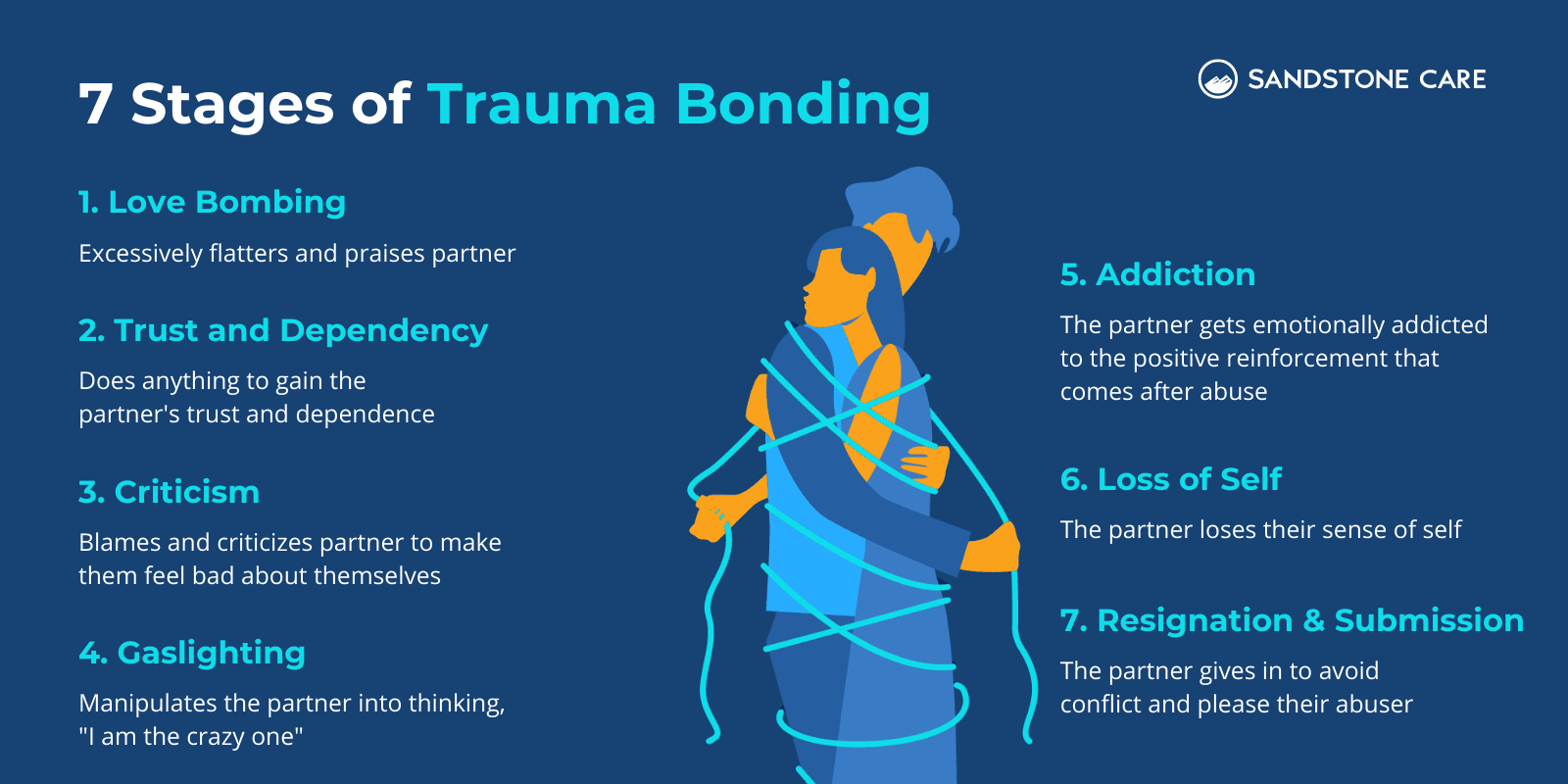
“Stages of Trauma Bonding” by Cynthia Bailey Rug

7 Stages Of Trauma Bonding explained on a dark navy background

Image courtesy of Sandstone Care

Below is a post by the Christian author, Cynthia Bailey Rug.  While this post is specifically directed toward the victims of narcissism, it is highly relevant to the victims of childhood abuse and/or domestic violence who are particularly vulnerable to trauma bonding.

Cynthia Bailey Rug blogs at https://cynthiabaileyrug.wordpress.com  .  The full text of this post dated 10/14/23 can be found there.

“Trauma bonding, also known as Stockholm Syndrome, is a common & strange phenomenon among victims of ongoing abuse [1][2].  It happens when abusers aren’t abusive all of the time, & show their victims random kindnesses.  Those kindnesses seem to prove to victims that their abuser isn’t all bad, & they really do care for their victim.  That thinking bonds the victim to their abuser & makes them more willing to tolerate abuse.

Narcissists are exceptionally good at trauma bonding their victims to them.  It happens very subtly & in gradually increasing stages of toxicity.  Trauma bonding is much like the story of putting a frog in a pot of water.  If the water is boiling when he goes in, he recognizes the danger & hops out immediately.  But, if it’s warm & gradually the temperature increases to boiling, he won’t notice he’s in danger until it’s too late…

The first stage of trauma is love bombing.  This is when the narcissist [or other abuser] showers you with love, praise & adoration.  You can do no wrong.  You are absolutely perfect!…Gifts can be a part of love bombing too…” Continue reading

20 Comments

Filed under Child Abuse, Child Molestation, domestic abuse, domestic violence, Emotional Abuse, Neglect, Physical Abuse, Sexual Abuse, Violence Against Women

Kinsey, de Beauvoir, Sartre, and Pedophilia

File:Alfred Kinsey 1955.jpg
Alfred Kinsey, Author Mondadori Publishers (specific photographer unknown) (PD in Italy)

WARNING: Graphic Images

“More than half a century after the publication of his landmark study, Sexual Behavior in the Human Male, Alfred C. Kinsey remains [controversial]…Though some hail him for liberating the nation from sexual puritanism, others revile him as a fraud whose ‘junk science’ legitimized degeneracy…One independent scholar has even accused him of sexual crimes… [1A]”

The Kinsey Institute for Research in Sex, Gender and Reproduction at Indiana University has encoded the 7,985 sex histories Alfred Kinsey collected, along with another 10,000 his team collected [1B][2].

This source material and Kinsey’s methodology have never been made public [1C][3A].  Consequently, they have not been subject to critical peer review.  That has not diminished their influence.

Kinsey is infamous for having met in June 1944 with Rex King — a deviant whose sexual encounters with men, women, boys, girls, animals and family members took 17 hours to record [1D].

Both before and after meeting with King, Kinsey encouraged him to share the details of his perversion.  Kinsey wrote, “I rejoice at everything you send, for I am then assured that that much more of your material is saved for scientific publication [1E].” Continue reading

15 Comments

Filed under Child Abuse, Child Molestation, Emotional Abuse, Justice, Law, Neglect, Physical Abuse, Sexual Abuse

Relapse

File:EB1911 Greek Art - Foot-race - Panathenaic Vase.jpg

Foot-race at the Panathenaea (c. 800 BC – 480 BC), reverse of an ancient Greek vase, Source Encyclopædia Britannica (11th ed.), (PD)

Despite decades of counseling, abuse victims may struggle with the scars of their trauma for a lifetime.  This is a discouraging truth whether applicable to alcohol or drug abuse, eating disorders, cutting, or other self-destructive behaviors stemming from the abuse.

When we do relapse the shame returns full force.  But the conclusions we draw from our relapse are important.

Not Worthless or Hopeless

That we have relapsed does not mean that we are worthless and our situation hopeless.  It simply means that we are human beings who have been deeply wounded.

Survival Skills

Nor does relapse mean that the survival skills we struggled to acquire have been proven useless.  We have simply set them aside, in favor of more familiar and more damaging behaviors [1]. Continue reading

6 Comments

Filed under Child Abuse, Child Molestation, Christianity, domestic abuse, domestic violence, Emotional Abuse, Neglect, Physical Abuse, Religion, Sexual Abuse

Murdered Children and the Indian Child Welfare Act

File:Carlisle pupils.jpg

Pupils at Carlisle Native Industrial School, Pennsylvania (PD)

WARNING:  Graphic Images

From 1869 to the 1960s, hundreds of thousands of Native American children were removed from their parents and placed at boarding schools operated by the Bureau of Indian Affairs [1][2].

There the children were forbidden to use their tribal names, speak their tribal languages, wear their tribal clothing, or practice their tribal religions.  Discipline was generally harsh.  Emotional, physical, and sexual abuse were not unknown.

Though perhaps well intentioned, this cultural genocide (now termed ethnocide) was inexcusable [3][4A].  The trauma to these children was incalculable [4B].

Indian Child Welfare Act (ICWA)

The Indian Child Welfare Act (ICWA) was created as a reaction to such forced assimilation [5][6A][9A].  The purpose of the ICWA was to protect the cultural identity and heritage of Indian tribes [9B].

The ICWA mandates that the state pursue the best interests of the tribe, rather than that of the individual child, in cases of abuse.  Officials must place an abused or neglected child with race-matched foster and adoptive families [6B].

Published guidelines by the Bureau of Indian Affairs, in fact, indicate that child welfare officials should not consider the best interests of the child in placement – irrespective of poverty, substance abuse, or other “non-conforming social behavior” such as crime in the home [9C].

For any child living on a reservation, the tribe has exclusive jurisdiction of child welfare cases [9D]. Continue reading

17 Comments

Filed under Child Abuse, Child Molestation, Community, Emotional Abuse, Justice, Law, Neglect, Physical Abuse, Poverty, Sexual Abuse

Greatness

Dorothy Height (2008), Author Adrian Hood (CC BY-SA 4.0 International)

Greatness is not measured by what a man or woman accomplishes, but by the opposition he or she has overcome to reach his goals.

-Dorothy Height

Dorothy Height was an African American social worker, journalist, politician, and civil rights advocate [1].  She served as Chairperson of the Leadership Conference on Civil and Human Rights, and was a founding member of the National Women’s Political Caucus.

At the National Council of Negro Women, Ms. Height worked to end lynching in the South, restructure the criminal justice system, and increase voter registration.  Presidents Dwight Eisenhower and Lyndon Johnson frequently sought her advice. Continue reading

4 Comments

Filed under Child Abuse, Child Molestation, Christianity, domestic abuse, domestic violence, Emotional Abuse, Justice, Neglect, Physical Abuse, Religion, Sexual Abuse, Violence Against Women

Not Love

File:Andrew Tate - James Tamim Upload (Cropped Wide Portrait).png

Andrew Tate on “Anything Goes with James English” podcast (2023).  Source https://www.youtube.com/watch?v=LjYjLJpzeas, Author Anything Goes with James English (CC Attribution 3.0 Unported)

The social media “influencer” Andrew Tate who once contended that the victims of rape should bear responsibility for their violation has, himself, been charged in Romania with rape, human trafficking, and the formation of a crime syndicate to sexually exploit women [1][2].

Evidence exists of Tate and his cohorts coercing women into sexual acts [3][4].  Tate contends that he is innocent.  Hopefully, the courts will sort this out, and the appropriate consequences will follow.

Another misogynist, even another rapist, is not news.

The larger question is why an egotist like Tate would have gained such popularity (particularly among young men), and why women so often fall prey to men like this.

Hypermasculinity

“Hypermasculinity” is the sociological term for a toxic form of masculinity characterized by the view that violence is virile; that danger is exciting; and that women should be treated with less regard than one would have for an animal [4].

To be a man, by this definition, is to be merciless and wholly self-centered. Continue reading

13 Comments

Filed under Child Abuse, Child Molestation, Christianity, domestic abuse, domestic violence, Emotional Abuse, human trafficking, Neglect, Physical Abuse, Prostitution, Rape, Religion, sex trafficking, Sexual Abuse, Violence Against Women

Communism, Homosexuality, and the Catholic Church Sex Scandal

File:John-jay1.jpg

John Jay College (CUNY), Author Roger Rowlett (CC BY-SA 2.5 Generic)

In 2011, a landmark study by the John Jay College of Criminal Justice at the City University of New York identified no single cause or predictor for the sexual abuse of minors by Catholic priests between 1950 and 2010 [1A][2A].

Celibacy, Homosexuality, and Predation

Principal investigator on the study, Karen Terry PhD, stated that neither celibacy nor homosexuality were causes of the abuse.  Terry concluded that “The increased frequency of abuse in the 1960s and 1970s was consistent with the patterns of increased deviance of society during that time [2B].”

It is not politically correct to criticize homosexual behavior today.  However, more than 80% of victims in this study were pre-teen and teenage boys [1B].  In other words, the problem was primarily one of male-on-male predation by Catholic priests on underage boys.

The Sexual Revolution

Alfred Kinsey — the bisexual author of the Sexual Revolution — is known to have had great animosity toward the Catholic Church [3A][4].  It is now believed that he discarded research data which did not support his intended goal of normalizing homosexuality [3B]. Continue reading

24 Comments

Filed under Abuse of Power, Child Abuse, Child Molestation, Christianity, Emotional Abuse, Neglect, Physical Abuse, Religion, Sexual Abuse

The Twins, Part 2 – Perfectionism

File:Twins (Qajar art, Art Museum of Georgia).jpg

“Twins” (Late 18th – Early 19th Century) by unknown Iranian artist, Art Museum of Georgia (PD)

This post was written in collaboration with Marie Williams whose remarks are highlighted.  Marie, a dear friend, has since gone home to be with the Lord.

We return to the topic of procrastination and perfectionism, related patterns of behavior in which many abuse victims find themselves trapped.

The part we play in creating our own dilemmas – the large and small crises in our lives stemming from procrastination – was discussed in Part 1 of this series.

Chance for Failure (Imperfection)

“…for God gave us a spirit not of fear but of power and love and self-control” (2 Tim. 1: 7).

Apart from the problems it would generate for anyone, failure – defined by many abuse victims as imperfection, to any small degree – results in shame and self-revilement for us.  Since creating these dilemmas greatly increases our chance for failure, the question arises why we persist in creating them.

“The whole time I was procrastinating, I thought myself foolish, an idiot, a dunce, a failure, because who in their right mind, sees a fire starting or about to start, purposely hides the fire extinguisher, forgets where she has put it and then goes and reads a book, deciding to deal with the fire when it becomes bigger and more unmanageable?  Because that is what procrastination amounts to when you come to think of it in rational terms.  Yet I could not help myself.”

-Marie Williams

The obvious answer is that we do not believe ourselves capable of accomplishing the task at hand.  Putting it off defers the painful acknowledgment of our own inadequacy.  And it provides us an excuse for failure.  Had conditions been right, had we started on the task sooner, perhaps we might have succeeded after all.

Again, the question is why.  Why are we so certain of failure?  This goes directly to our childhood abuse. On an unconscious level, we create these dilemmas to replicate the abuse which is what gives them such power over us. 

We were told repeatedly how inadequate we were.  Told how ugly, stupid, skinny, fat, or retarded we were.  Told that we would never amount to anything.  Or we were ignored entirely, starved for food and affection both.

No shock that we doubt and second guess ourselves, wrestling over decisions.

“I floundered when faced with choices.  Wanting to please and be approved of ALL THE TIME, I became lost in my own lack of confidence.  This, I think, was due to the fact that I couldn’t manage the abuse.  I adopted the same response to situations which generated that same confusion in me.”

-Marie Williams

Failure becomes a self-fulfilling prophecy.  Our abusers are “proven” right.  So it seems to us.  Our failure couldn’t possibly have anything to do with the damage they inflicted on us.  Nooo. Continue reading

4 Comments

Filed under Child Abuse, Child Molestation, Christianity, Emotional Abuse, Neglect, Physical Abuse, Rape, Religion, Sexual Abuse, Sexual Assault, Violence Against Women