Tag Archives: binge eating

Vigilance, Part 1 – Neglect

“Color Coded” (2022) by Tania Love Abramson, a survivor of chronic sexual abuse, Image courtesy of AMA Journal of Ethics https://journalofethics.ama-assn.org

There are a thousand ways to harm a child.  The evidence of child abuse may be subtle or more obvious.  To remain vigilant against such abuse, those of us concerned for the welfare of children must learn to recognize the warning signs.

This series of posts will address such warning signs.  The signs here are derived from lists compiled by Prevent Child Abuse America [1A].  They fall into 4 categories:  neglect, emotional abuse, physical abuse, and sexual abuse.  More often than not, these categories will overlap in the experience of a child.

No single warning sign, by itself, is considered definitive.  Occurring repeatedly or in combination, however, these signs warrant further investigation.

General

The general signs that child abuse may be present in a family include unusual wariness on the part of a child; sudden changes in a child’s behavior; deterioration in a child’s school performance; and learning disabilities on a child’s part unrelated to an identifiable medical or psychological condition.

But the children of abuse may, also, be overachievers, anxious to please.

That said, we will begin with neglect.

Neglect

Child neglect involves the failure to provide for a child’s basic needs for nurture, nutrition, shelter, education, healthcare, and safety.

Neglect can be difficult to distinguish from poverty.  Sadly, there are children in this country who still do not get enough to eat, even in an otherwise loving home. Continue reading

22 Comments

Filed under Child Abuse, Child Molestation, Emotional Abuse, Neglect, Physical Abuse, Poverty, Sexual Abuse

The Rose Garden, Chapter 16 – The Weight of Sorrow

File:Clothing Rack of Jeans.jpg

Clothing rack of women’s jeans, Source https://www.publicdomainpictures.net, Author Peter Griffin, (CC0 1.0 Universal Public Domain Dedication)

Man shall not live by bread alone, but by every word that proceeds from the mouth of God” (Matt. 4: 4).

It is late in the season.  I wander from one clothing rack to another, searching for my size.  The coats have been picked through.  There are few remaining.  It is unlikely I will be able to find a coat that fits, let alone flatters, me.

Please, God, I pray.  Please, let me find something.  I promise to lose weight.  I promise to try harder.

One scar of the incest has been of such magnitude in my life that it warrants separate discussion.  This is weight control.  I have prayed as fervently in the Women’s Department as in any cathedral.

For an abuse victim, the difference between size 8 and size 18 is no mere matter of discipline.  A child who is molested feels like offal.  Whatever impulses drive her abuser, she is less than nothing in his eyes, and — despite his soothing words to the contrary — she knows it.

Against this backdrop, weight often becomes a problem.  Eating disorders are common — anorexia, bulimia, binge eating, etc. [1][2][3][4].  In this, I am typical.

Distress, Defense, Punishment, and Shame

Food is a natural source of comfort for the sexually abused child, maladaptive when weight becomes an issue.

Weight serves many purposes.  It is a distress signal:  silent evidence of the molestation, the secret exposed.  It is a defense, the child’s feeble attempt to create a physical barrier against the predator; later, an emotional barrier to adult relationships.

Increased weight is a psychological way of hiding from rejection.  Failed relationships can be blamed on weight.  However painful this approach may be, it is less painful than rejection of the “true self.”

Weight is punishment for misplaced guilt.  The little girl cannot be forgiven for having engendered the violation (as if she did), and cannot forgive herself for being “unlovable.”  So her anger turns inward, with depression the result.

The cycle repeats itself — over and over — as weight is gained, lost, and regained.   In the process, weight becomes an alternate focus for the shame of the abuse.

All this is unconscious.

A Symbol of Rage and A Test

As the child grows into a woman, weight takes on even more shades of meaning.  It embodies rage at men; shouts, in effect, “Damn them all!  They’re vapid and shallow, anyway — unable to recognize real worth.”

It serves as a test for the woman.  It serves as a test for the man she hopes will love her.  It serves as punishment for the woman’s failure to be lovable, yet again.

Food as Love – An Analgesic and An Anesthetic

Food offers instant gratification while love, in her experience, does not.

Food is, of course, nourishment.  As the body requires food, so the soul requires love.  Love is vital.  The soul craves it.  Deprived of love, the soul starves.  Food becomes the unsatisfactory substitute for love denied, an analgesic against the pain.

In terms of our anger at having been abused, food is more like an anesthetic.  Unable to express that anger appropriately at the time, we forced it down with food, then “forgot” why we were eating (or denying ourselves food) so compulsively.  Attempts to diet are futile because they do not address the underlying rage.

Distrust of God

While we may not think in such terms, at a deeper level, a disordered relationship with food by abuse victims reflects a distrust of God.

Since our needs were not met as children by those who stood in God’s shoes, we have little reason to believe that God will meet them now.  So we try to meet them ourselves, try to assure that we will at least have as much (or little) food as we want.

But we cannot satisfy our hunger — our desire not only for love and justice, but for control over our own lives — since that hunger is emotional rather than physical.

God is capable of filling our needs.  However, we must first put our trust in Him.  For abuse victims, that can be a lifelong challenge.

All this applied to me; took me decades to decipher.  Continue reading

16 Comments

Filed under Child Abuse, Child Molestation, Christianity, Emotional Abuse, Neglect, Physical Abuse, Religion, Sexual Abuse

Punishing Ourselves, Part 2 – Emotional Hunger

File:Sarasota Mall at UTC corridor 6.jpg

Shopping mall, Sarasota, FL, Author PCHS-NJROTC (CC BY-SA 4.0 International)

 “But his brothers hated Joseph because their father loved him more than the rest” (Gen. 37: 4 NLT).

Human beings inherently crave connection.  When our basic need for relationship is denied, abuse victims can develop an intense emotional hunger.  Some of us attempt to satiate that hunger with food, others with possessions, still others with sex.

But these will not satisfy us.  So the emotional hunger returns, and the cycle begins all over again – each time destined to fail.

Punishment and Reward

“…the wandering of desire…is vanity and grasping for the wind” (Eccl. 6: 9)..

The reward – whether of food, material things, or sex – becomes punishment.  Each stop gap measure has negative consequences.  Each leaves us feeling empty [1].  Our sense of worthlessness resurfaces with renewed force.

Then the reward used to stem our emotional hunger becomes, itself, a source of shame.  It takes more and more food/things/sex to bring us even temporary relief.  Our desperation increases.

Punishment and Self-Forgiveness

These things I have spoken to you, that in Me you may have peace. In the world you will have tribulation; but be of good cheer, I have overcome the world” (John 16: 33).

Consciously or not, we ache for forgiveness, someone to take the guilt away.  And there is Someone who can do that.  In fact, He longs to do that.  He died on a cross to do that.

But we did nothing to “deserve” abuse.  We do not, therefore, need forgiveness for our abuse.  What Jesus Christ does to relieve us of the false guilt for which we have been punishing ourselves is reveal a truth it would have been too painful for us to accept as children, i.e. that our parents and caregivers were the ones at fault.

Where their love failed us, His will not.  And the life He offers us is everlasting.

[1]  Got Questions, “What does the Bible say about eating disorders?”, https://www.gotquestions.org/eating-disorders.html.

Originally posted 10/8/17

This series began last week with “Punishing Ourselves, Part 1 – Numbness and Deprivation”

FOR MORE OF MY ARTICLES ON POVERTY, POLITICS, AND MATTERS OF CONSCIENCE CHECK OUT MY BLOG A LAWYER’S PRAYERS AT: https://alawyersprayers.com

12 Comments

Filed under Child Abuse, Child Molestation, Christianity, Emotional Abuse, Neglect, Physical Abuse, Religion, Sexual Abuse

Vigilance, Part 1 – Neglect

File:Child depressed alone poverty.jpg

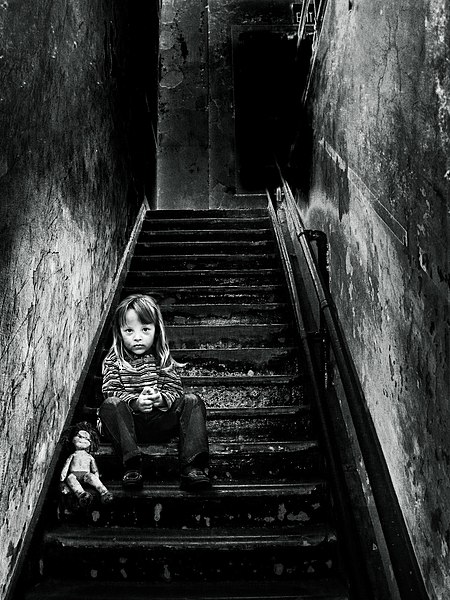
Sad girl with doll, Source https://pixabay.com/illustrations/image-manipulation-girl-doll-stairs-3349068/, Author DarkWorkX
(CC0 1.0 Universal Public Domain Dedication)

There are a thousand ways to harm a child.  The evidence of child abuse may be subtle or more obvious.  To remain vigilant against such abuse, those of us concerned for the welfare of children must learn to recognize the warning signs.

This series of posts will address such warning signs.  The signs here are derived from lists compiled by Prevent Child Abuse America [1A].  They fall into 4 categories:  neglect, emotional abuse, physical abuse, and sexual abuse.  More often than not, these categories will overlap in the experience of a child.

No single warning sign, by itself, is considered definitive.  Occurring repeatedly or in combination, however, these signs warrant further investigation.

General

The general signs that child abuse may be present in a family include unusual wariness on the part of a child; sudden changes in a child’s behavior; deterioration in a child’s school performance; and learning disabilities on a child’s part unrelated to an identifiable medical or psychological condition.

But the children of abuse may, also, be overachievers, anxious to please.

That said, we will begin with neglect. Continue reading

19 Comments

Filed under Child Abuse, Child Molestation, Emotional Abuse, Neglect, Physical Abuse, Poverty, Sexual Abuse

Punishing Ourselves, Part 2 – Emotional Hunger

“Joseph’s Coat of Many Colors Brought to Jacob after Joseph Is Sold into Slavery” by Diego Velazquez (1630), El Escorial (PD-Art l Old-100)

But his brothers hated Joseph because their father loved him more than the rest” (Gen. 37: 4 NLT).

Human beings inherently crave connection.  When our basic need for relationship is denied, abuse victims can develop an intense emotional hunger.  Some of us attempt to satiate that hunger with food, others with possessions, still others with sex.

But these will not satisfy us.  So the emotional hunger returns, and the cycle begins all over again – each time destined to fail.

Punishment and Reward

“…the wandering of desire…is vanity and grasping for the wind” (Eccl. 6: 9).

The reward – whether of food, material things, or sex – becomes punishment.  Each stop gap measure has negative consequences.  Each leaves us feeling empty [1].  Our sense of worthlessness resurfaces with renewed force.

Then the reward used to stem our emotional hunger becomes, itself, a source of shame.  It takes more and more food/things/sex to bring us even temporary relief.  Our desperation increases.

Punishment and Self-Forgiveness

These things I have spoken to you, that in Me you may have peace.  In the world you will have tribulation; but be of good cheer, I have overcome the world” (John 16: 33).

Consciously or not, we ache for forgiveness, someone to take the guilt away.  And there is Someone who can do that.  In fact, He longs to do that.  He died on a cross to do that.

But we did nothing to “deserve” abuse.  We do not, therefore, need forgiveness for our abuse.  What Jesus Christ does to relieve us of the false guilt for which we have been punishing ourselves is reveal a truth it would have been too painful for us to accept as children, i.e. that our parents and caregivers were the ones at fault.

Where their love failed us, His will not.  And the life He offers us is everlasting.

[1]  Got Questions, “What does the Bible say about eating disorders?”, https://www.gotquestions.org/eating-disorders.html.

This series began last week with “Punishing Ourselves, Part 1 – Numbness and Deprivation”

FOR MORE OF MY ARTICLES ON POVERTY, POLITICS, AND MATTERS OF CONSCIENCE CHECK OUT MY BLOG A LAWYER’S PRAYERS AT: https://alawyersprayers.com

5 Comments

Filed under Child Abuse, Child Molestation, Christianity, Emotional Abuse, Neglect, Physical Abuse, Religion, Sexual Abuse