
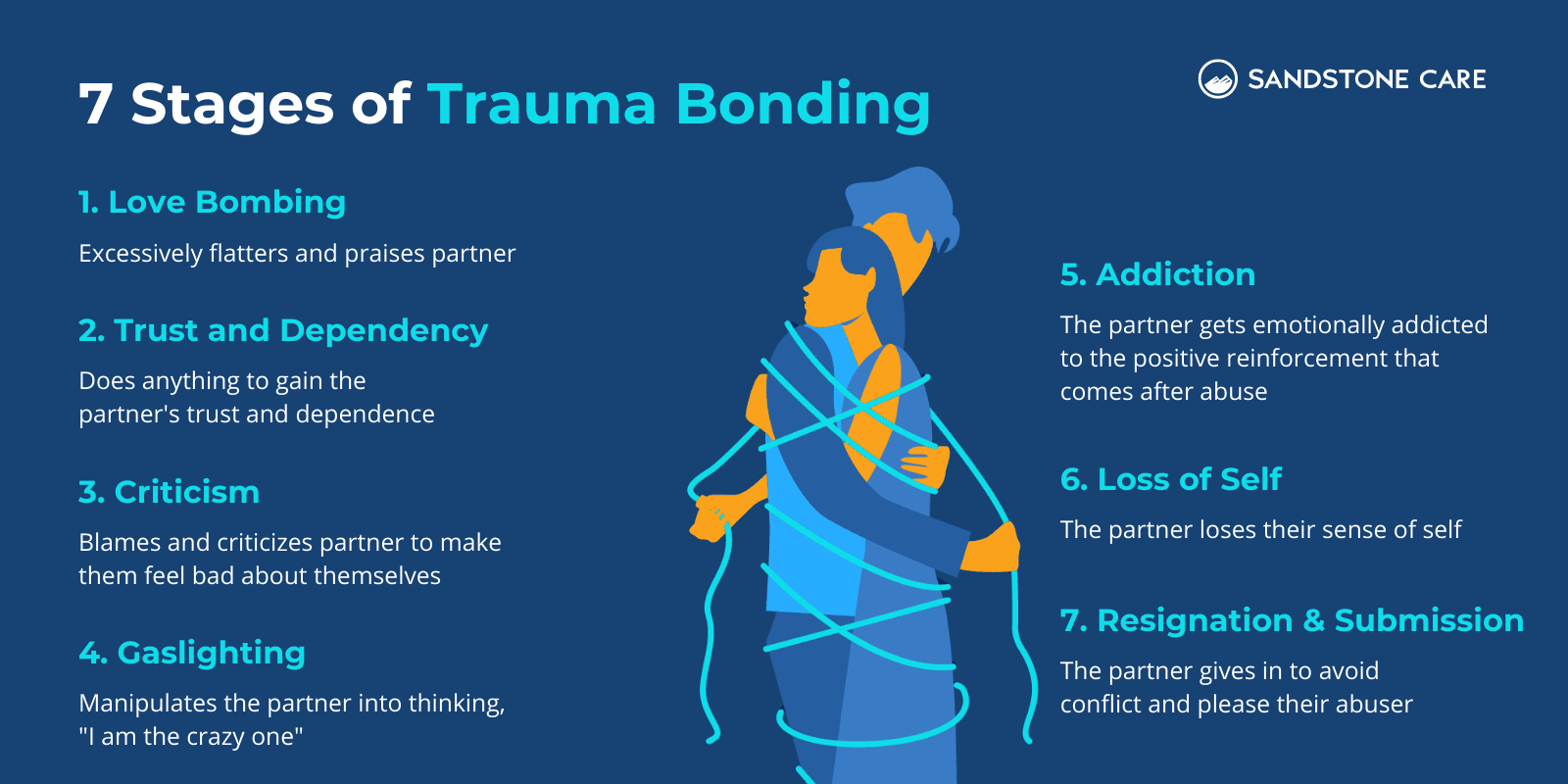
Image courtesy of Sandstone Care
Below is a post by the Christian author, Cynthia Bailey Rug. While this post is specifically directed toward the victims of narcissism, it is highly relevant to the victims of childhood abuse and/or domestic violence who are particularly vulnerable to trauma bonding.
Cynthia Bailey Rug blogs at https://cynthiabaileyrug.wordpress.com . The full text of this post dated 10/14/23 can be found there.
“Trauma bonding, also known as Stockholm Syndrome, is a common & strange phenomenon among victims of ongoing abuse [1][2]. It happens when abusers aren’t abusive all of the time, & show their victims random kindnesses. Those kindnesses seem to prove to victims that their abuser isn’t all bad, & they really do care for their victim. That thinking bonds the victim to their abuser & makes them more willing to tolerate abuse.
Narcissists are exceptionally good at trauma bonding their victims to them. It happens very subtly & in gradually increasing stages of toxicity. Trauma bonding is much like the story of putting a frog in a pot of water. If the water is boiling when he goes in, he recognizes the danger & hops out immediately. But, if it’s warm & gradually the temperature increases to boiling, he won’t notice he’s in danger until it’s too late…
The first stage of trauma is love bombing. This is when the narcissist [or other abuser] showers you with love, praise & adoration. You can do no wrong. You are absolutely perfect!…Gifts can be a part of love bombing too…”“Concurrently with love bombing, they earn your trust. They validate & support you in every imaginable way…They won’t hesitate to defend you to anyone. They also hang on your every word & want to know all about your dreams…& goals.
After some time, you naturally feel as if you met the person you can’t imagine living without. Once you’re secure in this relationship, things begin to change…
The more time passes, the more that romantic partner vanishes. You no longer are the perfect, love of their life. Instead, you are to blame for everything…They also gaslight you into making you believe that they know best about everything, including what is best for you. Over time, you believe their narrative, not reality & truth.
When this first happens, you fight back, but quickly learn that the only way to experience that loving person at the beginning of the relationship is to give in & stop asking for things like respect & love. This trains you to settle for…breadcrumbs…
This also results in you losing yourself. You give up those things you once loved to keep this person happy. Changing your likes, beliefs, & looks seem a small price to pay to be loved like this person once loved you. You also think if you become what they want you to, they’ll love you…
If this describes your relationship, make no mistake, this is an extremely dangerous relationship! You deserve better than this, & you can survive without this person…”
“Although the victim may disclose the abuse, the trauma bond means that the victim may wish to receive comfort from the very person who abused them.”
-Parents Against Childhood Exploitation (PACE UK) [3]
—
[1] Wikipedia, “Traumatic bonding”, https://en.wikipedia.org/wiki/Traumatic_bonding.
[2] Sandstone Care, “Trauma Bonding” by Deborah Quinn, article clinically reviewed by Sarah Fletcher LPC, 5/3/23, https://www.sandstonecare.com/blog/trauma-bonding/.
[3] Parents Against Child Sexual Exploitation (PACE), “Why does my child keep returning to the abusers?” by “Nancy”, 10/15/13, https://web.archive.org/web/20150924063046/http://paceuk.info/trauma-bonding-child-sexual-exploitation/.
FOR MORE OF MY ARTICLES ON POVERTY, POLITICS, AND MATTERS OF CONSCIENCE CHECK OUT MY BLOG A LAWYER’S PRAYERS AT: https://alawyersprayers.com

 A Voice Reclaimed, Surviving Child Abuse and More
Insightful post. When I have been asked by someone who does not understand abuse, why an abuse victim stays with the abuser, this article pretty much is the answer I have given. I would say if you went out on your first date and the person hit you or hurt you in any way, you would not go on a second date. The abuser is always charming in the beginning. Then the roller coaster ride of praise then ridicule, slowly tearing the victim down mentally and emotionally comes. Then the physical abuse begins, once the person is in their own mental prison.
Thank you for this post I believe it will help many.
Thank you for confirming the content, Julie.
You are welcome. It is good that you posted this.
Very interesting.
I am sure you encountered this many times in your work, Dolly.
Quite so, dear Anna.
Es ist unendlich traurig, dass es so viele Opfer von “Trauma Bonding” gibt, die dringend fachliche Hilfe brauchen, aber sie nicht finden. LG M.
Sehr richtig, Marie. LG, A. ❤
Thank you for sharing this. It has given me much to think about.
Those unfamiliar w/ abuse in its many forms often look down on victims as weak. The complexities of trauma bonding provide new insight. Of course, victims may, also, stay with their abuser out of fear for their lives or the lives of their children.
It is a vicious cycle.
The link to the original post gives a 403 error
Thank you for drawing this problem to my attention. I believe I have now resolved it. However, if your browser continues to bring up the original image, delete the final forward dash and period from the web address. If that still doesn’t work, copy and paste the web address into your search bar.
When laid out like this, it is easier to see the subtlety.
Yes, Cynthia Bailey Rug explains it very well.
So informative, Anna, thank you.
Thank you, Dora. The credit, of course, goes to Cynthia Bailey Rug.
Pingback: “Stages of Trauma Bonding” – NarrowPathMinistries
I have seen all of this and more in the ministry. Even now I am counseling with someone who has been married for 60 years and deals with most of what was written in this post. That someone could survive with their heart and mind intact after so long a time, settling for the occasional crumb tossed their way is a miracle in itself.
I agree, Ron. Abuse is all too common. It takes great courage to endure that.