Tag Archives: danger signals of domestic abuse

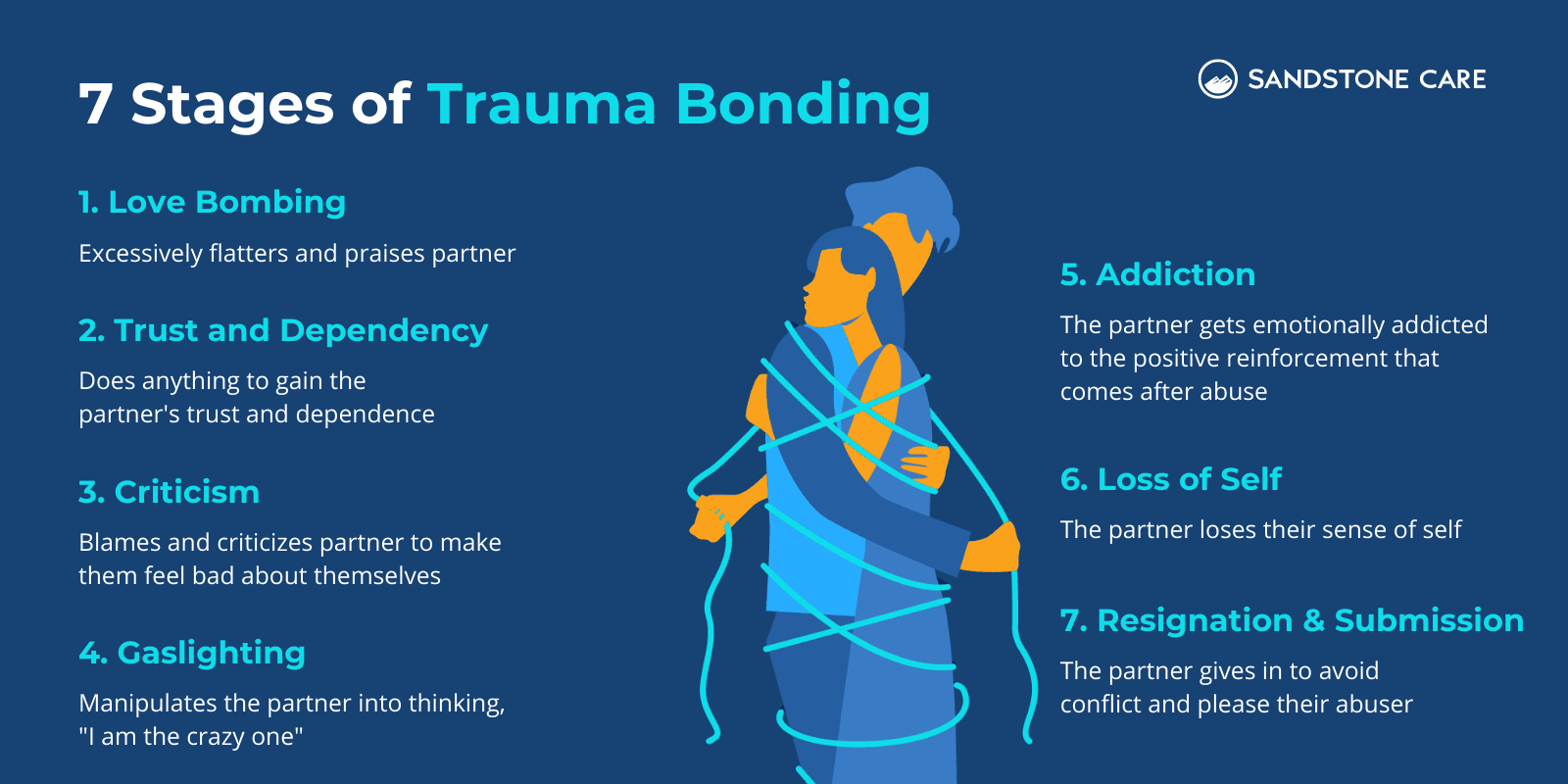
“Stages of Trauma Bonding” by Cynthia Bailey Rug

7 Stages Of Trauma Bonding explained on a dark navy background

Image courtesy of Sandstone Care

Below is a post by the Christian author, Cynthia Bailey Rug.  While this post is specifically directed toward the victims of narcissism, it is highly relevant to the victims of childhood abuse and/or domestic violence who are particularly vulnerable to trauma bonding.

Cynthia Bailey Rug blogs at https://cynthiabaileyrug.wordpress.com  .  The full text of this post dated 10/14/23 can be found there.

“Trauma bonding, also known as Stockholm Syndrome, is a common & strange phenomenon among victims of ongoing abuse [1][2].  It happens when abusers aren’t abusive all of the time, & show their victims random kindnesses.  Those kindnesses seem to prove to victims that their abuser isn’t all bad, & they really do care for their victim.  That thinking bonds the victim to their abuser & makes them more willing to tolerate abuse.

Narcissists are exceptionally good at trauma bonding their victims to them.  It happens very subtly & in gradually increasing stages of toxicity.  Trauma bonding is much like the story of putting a frog in a pot of water.  If the water is boiling when he goes in, he recognizes the danger & hops out immediately.  But, if it’s warm & gradually the temperature increases to boiling, he won’t notice he’s in danger until it’s too late…

The first stage of trauma is love bombing.  This is when the narcissist [or other abuser] showers you with love, praise & adoration.  You can do no wrong.  You are absolutely perfect!…Gifts can be a part of love bombing too…” Continue reading

20 Comments

Filed under Child Abuse, Child Molestation, domestic abuse, domestic violence, Emotional Abuse, Neglect, Physical Abuse, Sexual Abuse, Violence Against Women

Red Flags

It can be difficult, at the outset of a relationship, to predict whether a prospective partner will become abusive.  However, there are certain danger signals which, in combination, should not be ignored.  These involve embarrassment/criticism, control/manipulation, isolation, blame, threats, and violence.

Here is a list of “red flags” [1][2]:

Embarrassment/Criticism

  • A partner who regularly disparages your friends, family, ideas, and goals.
  • A partner who deliberately embarrasses and insults you.  Such a partner may humiliate you in public, or criticize you viciously in private.  He or she may attack your looks or your parenting skills, as a means of undermining your confidence.

Control/Manipulation

  • A partner who prevents you from making decisions. This interference may, at first, be as simple as telling you what you can and cannot wear to work.
  • A partner who is extremely jealous and possessive.  Such a partner continually tracks where you go, whom you meet, and what you do.  He or she may expect to you check in, throughout the day, and spend every moment of your free time with him/her.
  • A partner with a hair-trigger temper. You walk on eggshells to keep the peace.
  • A partner who takes your money or refuses to provide you necessary income for expenses.
  • A partner who plays “mind games” to make you feel guilty.  Such a partner may, for instance, threaten to commit suicide if you leave him or her.
  • A partner who pressures you to have sex, or to engage in a type of sexual activity with which you are not comfortable.
  • A partner who prevents you from using birth control.
  • A partner who pressures you to use drugs or alcohol.

Continue reading

27 Comments

Filed under domestic abuse, domestic violence, Violence Against Women